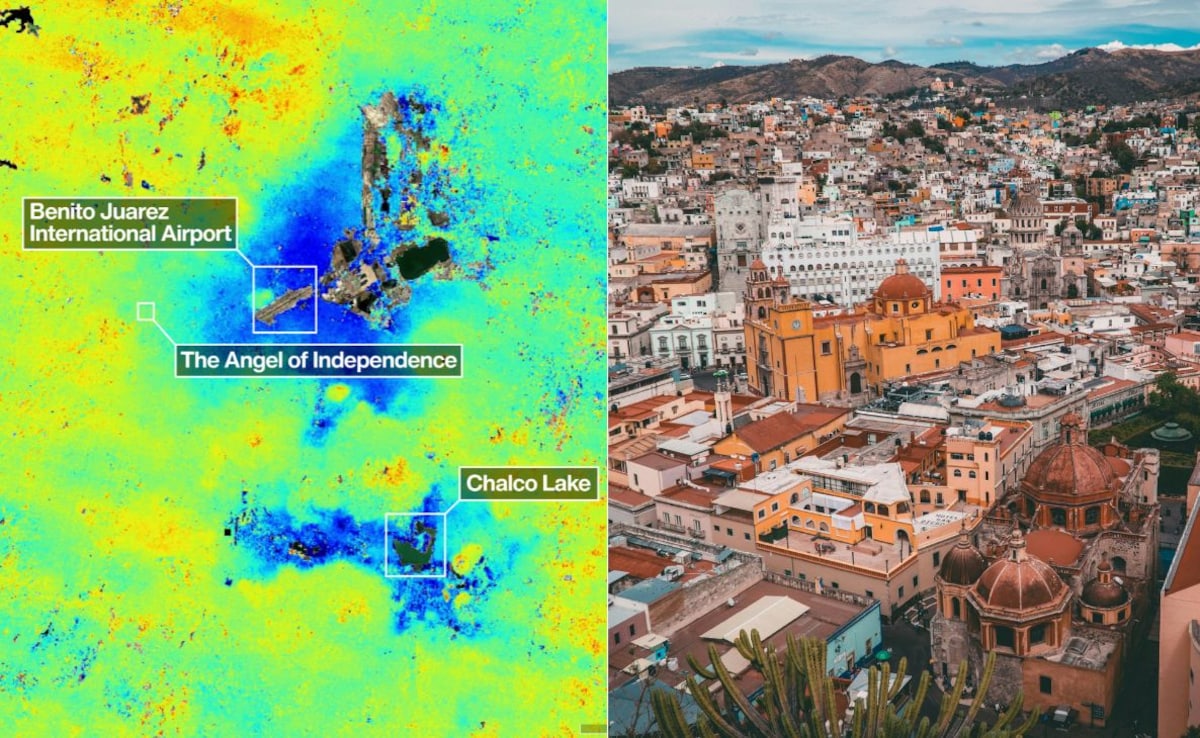
The headlines are addicted to the apocalypse. They want you to stare at satellite imagery from NASA and tremble at the sight of a city "vanishing" into the earth. The narrative is always the same: Mexico City is sinking at 20 inches a year in some areas, the infrastructure is crumbling, and the end is nigh.
It is lazy journalism fueled by a fundamental misunderstanding of geology and urban planning.
Mexico City is not "sinking" in the way a ship sinks in the ocean. It is consolidating. The city is reclaiming its original identity as a lacustrine basin. The "crisis" isn't the movement of the earth; the crisis is our arrogant, five-century-long obsession with trying to turn a lake into a dry parking lot. We are fighting a war against gravity and hydrology that we lost the moment the Spanish started draining Lake Texcoco in the 1500s.
Stop treating this like a sudden technical glitch caught by a satellite. It is a predictable, mechanical consequence of building a megalopolis on 2,000 meters of water-saturated clay.
The Physics Of The Inevitable
The mainstream media loves to blame "thirst" and groundwater extraction. While pumping from the aquifers accelerates the process, it is not the sole culprit. We are dealing with aquitard consolidation.
When you remove water from the pore spaces of volcanic clay, the weight of the city—millions of tons of concrete, steel, and humanity—compresses that soil. This is not elastic. It is permanent. You cannot "refill" the aquifer and expect the city to pop back up like a sponge. The clay flakes undergo a structural realignment.
NASA’s Interferometric Synthetic Aperture Radar (InSAR) data isn't showing us a tragedy; it’s showing us a math equation. The clay beneath the city is roughly 90% water. When you build a skyscraper on a sponge, the sponge flattens.
The "sinking" isn't the problem. The "leveling" is. The city is subsiding at different rates—differential subsidence. This is what snaps metro lines and cracks the foundations of colonial cathedrals. If the entire valley floor dropped at a uniform rate, we wouldn't even notice. We’d just be 30 feet closer to the mantle, and the tacos would taste exactly the same.
The Infrastructure Fallacy
I have watched engineers burn through billions of pesos trying to "stabilize" historical monuments with deep-seated piles and hydraulic jacks. It is a vanity project.
We are told that the solution is better water management. The "experts" say we need to stop the leaks in the pipe network, which lose about 40% of the city's water. They claim that if we fix the pipes, we save the city.
This is a lie.
Even if we stopped every leak tomorrow, the weight of the city would continue to drive consolidation. The sheer mass of the urban sprawl has already triggered a geochemical shift in the upper soil layers. We are past the point of "fixing" the subsidence. We need to start discussing managed retreat and amphibious architecture, but those terms don't poll well.
Why The "Water Crisis" Is A Policy Choice
People ask: "How can a city that is flooding also be running out of water?"
It sounds like a paradox. It isn’t. It’s a design failure.
Mexico City sits in a high-altitude bowl. During the rainy season, it is deluged. But because we have paved over every square inch of the valley, that water cannot reach the aquifer. Instead, we treat rainwater like sewage. We pump it out of the valley through the Túnel Emisor Oriente—a massive, expensive concrete throat designed to vomit our water into the next state over.
We are paying billions to get rid of the one thing that could slow the sinking, only to pay billions more to pump water back up from the ground or from distant basins like Cutzamala. It is a circular economy of stupidity.
The "contrarian" truth? The city needs to get wet again.
The Myth of The Sustainable Megacity
There is no such thing as a sustainable city of 22 million people built on a swamp.
We see the same patterns in Jakarta, Venice, and New Orleans. We use "technology" to fight nature until nature decides it’s tired of the game. In Mexico City, the earth is reclaiming the space. The cracks in the pavement are the earth's way of breathing.
The industry insiders won't tell you this because there is no money in surrender. There is, however, a lot of money in "remediation" contracts, "smart city" sensors, and "resilience" consultants. They want to sell you a 50-year plan to save a city that is fundamentally incompatible with its geography.
The Cost of Staying Dry
If you want to live in Mexico City, you have to accept the tax of the tilt.
- Energy Death Spirals: As the city sinks, the sewage pumps have to work harder to move waste "uphill" against the new gradient. We are burning massive amounts of electricity just to keep our own waste from flowing back into our kitchens.
- The Wealth Gap of Gravity: The wealthy areas built on the volcanic rock of the south (like the Pedregal) stay high and dry. The working class in the east (Iztapalapa, Chalco) are built on the deepest, softest clays. They sink faster. They flood more. They lose water first. Subsidence is a class struggle.
- The Heritage Trap: We spend millions preserving the Metropolitan Cathedral while the neighborhoods around it crumble. We are prioritizing 18th-century stone over 21st-century lives.
Stop Fixing, Start Adapting
The obsession with "stopping" the sinking is a waste of human capital. We should be leaning into the descent.
Imagine a scenario where we stop trying to keep the water out. We replace the rigid, brittle concrete infrastructure that snaps every time the earth shifts with flexible, modular systems. We stop building massive, heavy skyscrapers in the central lakebed and move high-density development to the rocky peripheries.
We need to stop seeing the "sinking" as a geological disaster and start seeing it as a hard limit on growth. The earth is telling us that the valley has reached its carrying capacity. Every new floor added to an apartment building in Roma or Condesa is a downward pressure on the entire neighborhood.
The Brutal Reality
The NASA photos aren't a call to action. They are a post-mortem.
The basin of Mexico wants to be a lake. It has been trying to be a lake for 500 years. We can keep building taller dikes and deeper tunnels, but gravity doesn't negotiate. We aren't "saving" Mexico City; we are just delaying the inevitable return of the water.
The smart money isn't on the engineers who promise to stop the sink. The smart money is on the architects who know how to build a city that can float.
Don't look up at the satellites. Look down at your feet. The ground is moving because it was never meant to hold you.
Accept the descent.