The asphalt does not melt all at once. It softens gradually, turning from solid rock into a sticky, tar-scented paste that clings to the soles of leather shoes.
In Madrid, a mail carrier named Mateo—a hypothetical but entirely accurate composite of the workers currently navigating the Spanish capital—adjusts his cap. It is barely eleven in the morning, but the air already feels thick, heavy, and metallic. It is the texture of an oven door swung wide open. His throat burns. Every breath feels like swallowing wool.
When we read about European heatwaves in standard news tickers, the language is invariably sterile. We see terms like "high-pressure ridge," "Saharan plume," and "unprecedented thermal anomalies." But meteorology is a poor translator for physical suffering. A high-pressure system is not just a line on a satellite map. It is an invisible weight that presses down on a continent, trapping stagnant air, choking ancient cities built for a completely different climate, and quietly stopping human hearts.
The heatwave that paralyzed southwestern Europe last week is no longer stationary. It is moving. It is crawling north and east, pushing its invisible wall of thermal pressure into France, Germany, and the western Balkans.
We are watching a disaster in slow motion.
The Concrete Trap
European cities are beautiful precisely because they are old. They are masterpieces of stone, brick, and narrow, winding alleys designed centuries ago to shield inhabitants from the wind and create communal density. But stone has a memory.
During a prolonged heatwave, a phenomenon known as the Urban Heat Island effect transforms these architectural wonders into thermal batteries. Concrete and dark rooftops absorb the sun's radiation all day long. When darkness falls, a natural cooling cycle should begin. Instead, the trapped heat radiates backward into the night air.
Imagine living in a room where the walls are permanently set to ninety-five degrees Fahrenheit, radiating heat directly toward your bed while you try to sleep. That is Paris in mid-summer under a Saharan plume. It is London when the thermosphere goes quiet.
The human body is an exquisitely tuned cooling machine, relying on a simple mechanism: sweat. When sweat evaporates from our skin, it pulls heat away from the body, keeping our internal core stable at around ninety-eight point six degrees. But this system requires an exit strategy. When the surrounding air matches or exceeds our body temperature, and when the humidity spikes, evaporation slows to a crawl. The body begins to store heat.
The heart beats faster, pumping blood desperately toward the skin to dump the thermal load. If the air around you will not accept that heat, your internal temperature rises. Organs begin to swell. The brain grows foggy.
For the young and wealthy, this is an inconvenience mitigated by air conditioning and cold drinks. For the elderly living on the top floors of Parisian apartment buildings—structures built with zinc roofs that act like frying pans—it is a lethal trap.
The Geography of Vulnerability
As the heatwave marches toward central Europe, it encounters a population entirely unprepared for its arrival.
In northern and western Europe, air conditioning is not a standard household utility; it is a luxury or an afterthought. Less than five percent of European homes are air-conditioned, compared to nearly ninety percent in the United States. The architecture of Germany or Belgium is designed to capture heat, keeping residents warm through long, gray winters. Triple-glazed windows and heavy insulation work spectacularly well in December. In July, they convert a home into an insulated kiln.
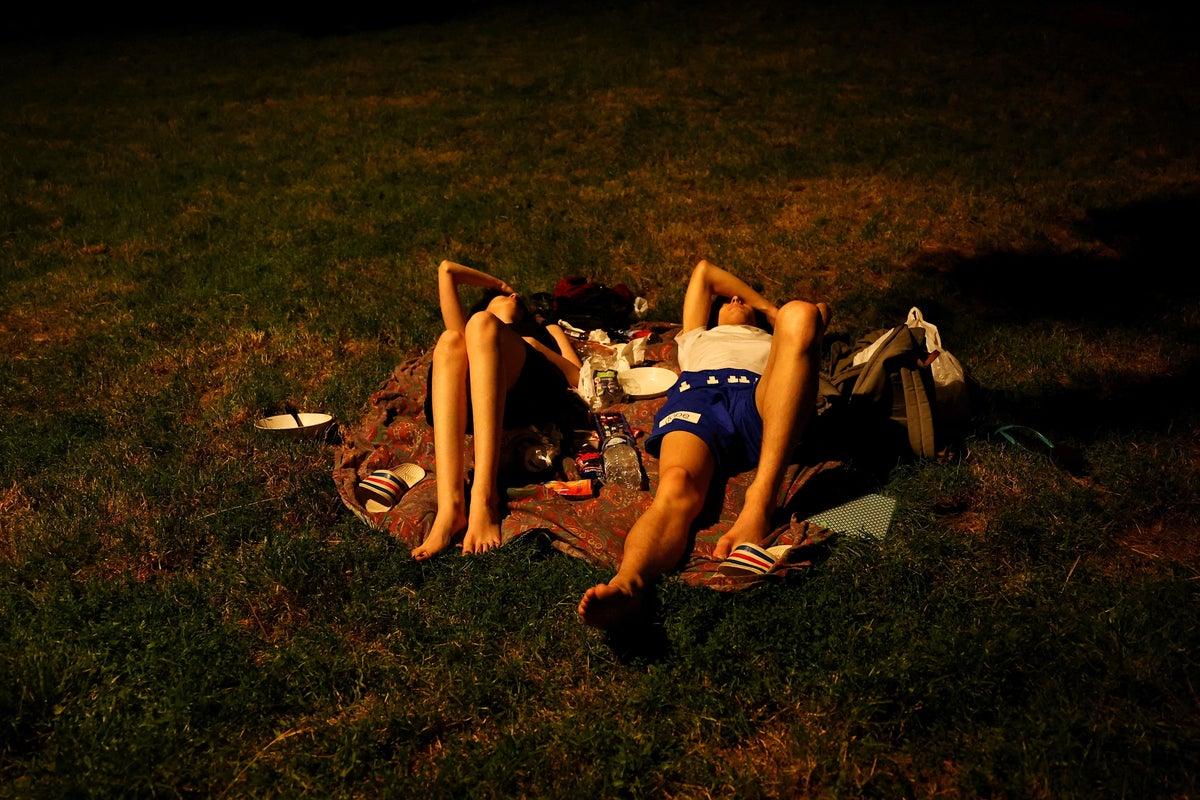
Consider the psychological shift required to survive this reality. For generations, summer in Europe has been a season of liberation. It meant outdoor cafes, sprawling picnics in the park, and long walks through sunlit plazas. To tell a culture deeply rooted in public, outdoor life that the sun has become an adversary requires a complete rewrite of social norms.
But the real danger lies in the infrastructure we take for granted.
Railroad tracks are made of steel. When steel gets hot, it expands. If it expands beyond the tolerance of its fasteners, the rails kink and buckle, turning a high-speed commuter line into a twisted hazard. Power grids, strained by the sudden, frantic deployment of portable cooling units, begin to groan under the load. Transformers overheat.
Worse still, the rivers that power the continent—the Rhine, the Danube, the Rhône—are suffering. When river temperatures rise too high, nuclear power plants can no longer use the water for cooling without threatening aquatic ecosystems. Power production drops precisely when demand peaks.
The invisible wall moves forward, revealing the fragility of our modern comfort.
The Mirage of the New Normal
There is a dangerous phrase creeping into the public vocabulary: "the new normal." It implies a stable plateau, a shift from one predictable climate regime to another. It suggests that if we can just adapt to this current level of heat, we will find our footing.
It is a comforting illusion.
What we are experiencing is not a new plateau; it is a staircase descending into the unknown. Every year, the baseline shifts. The anomalies become the averages, and the extremes push into territory that human biology was never designed to endure.
When you stand in the middle of a European city during a severe heatwave, the silence is what strikes you first. The birds stop singing. The bustling outdoor terraces stand empty, their chairs stacked against the walls. The vibrant tapestry of urban life is replaced by a heavy, breathless stillness. People retreat indoors, behind shuttered blinds, hiding from the sky.
We must stop treating these events as freak weather anomalies to be endured before returning to business as usual. They are structural crises. They demand a fundamental reimagining of how we build our cities, how we protect our workforce, and how we care for the vulnerable who cannot afford to escape the concrete trap.
Mateo finishes his route in Madrid, his uniform soaked, his head throbbing with the early signs of heat exhaustion. He looks north, toward the horizon, where the sky is a pale, washed-out blue. The heat is moving on, leaving behind a parched landscape and a warning that we continue to ignore at our own peril.
The sun is no longer just a source of light. It has become a clock, ticking down the time we have left to change.