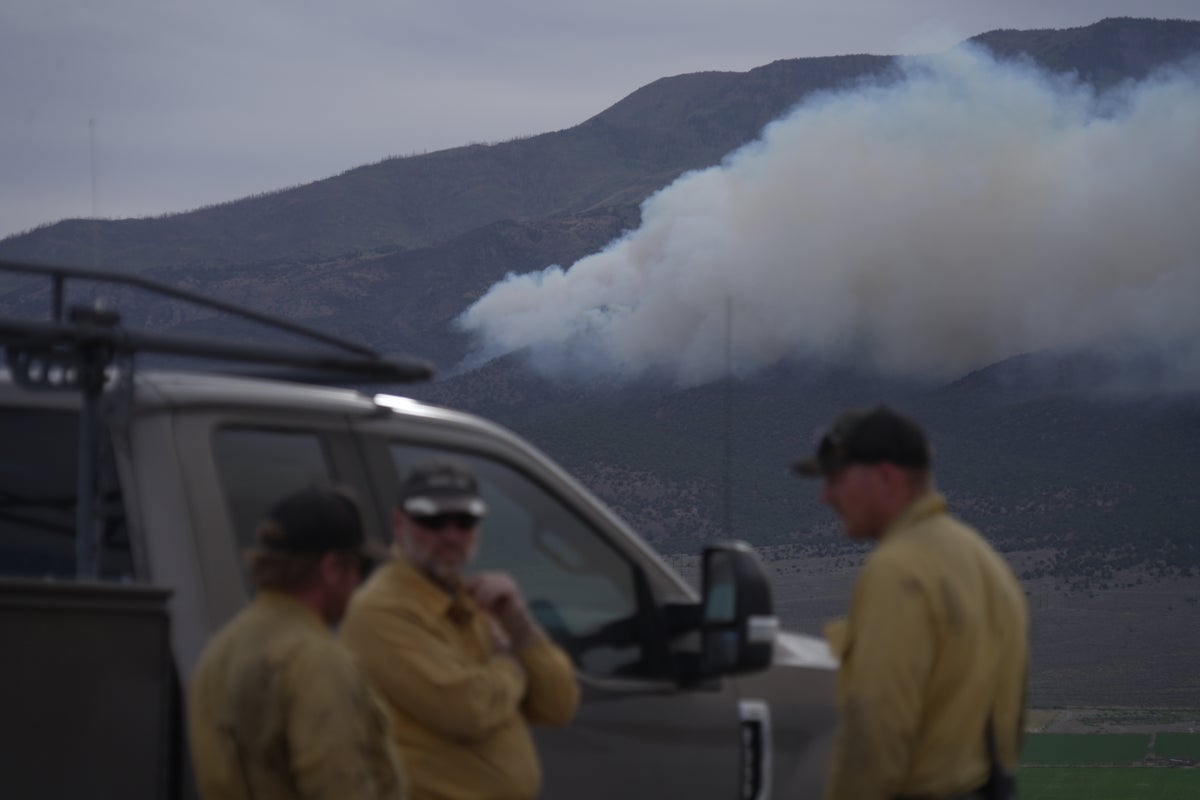
The rapid escalation of wildfire activity across the Western United States is not a random localized crisis but the predictable output of a multi-variable environmental and systemic equation. When a fast-moving wildfire breaches containment lines and forces regional land management agencies to institute strict public usage restrictions, it signals a compounding failure state where environmental fuel loads, microclimate dynamics, and human vectors intersect. To understand how these fires spread and why administrative restrictions are deployed, one must look past the sensationalism of breaking news and analyze the precise structural mechanisms driving both the destruction and the policy response.
The Tri-Linear Velocity Model of Wildfire Spread
The rate of spread (ROS) of a wildfire is governed by three primary vectors: fuel topography, atmospheric conditions, and ignition mechanics. Wildfires in the Western United States do not expand symmetrically; they follow paths of least thermodynamic resistance.
Fuel Stratification and Moisture Deficits
The combustible material in western ecosystems exists in three distinct layers, each contributing differently to the velocity of a fire:
- Fine Fuels (1-Hour Fuels): Grasses, pine needles, and small twigs less than one-quarter inch in diameter. These materials gain or lose moisture within a single hour to match the surrounding relative humidity. When relative humidity drops below 15%, these fuels become highly volatile, acting as the primary accelerant for horizontal fire propagation.
- Medium/Heavy Fuels (10-Hour to 100-Hour Fuels): Dead branches and down logs between one and three inches in diameter. These fuels dictate the intensity and duration of the fire bed, requiring sustained heat to ignite but producing the thermal output necessary to transition a surface fire into a crown fire.
- Live Canopy Fuels: The upper foliage of living trees. When drought conditions persist, tree sap moisture drops below critical thresholds, allowing fires to climb from the forest floor into the canopy, resulting in high-intensity crown fires that are largely immune to ground-based suppression tactics.
Orographic and Microclimate Acceleration
Topography acts as a natural force multiplier for wildfire velocity. Slope steepness alters the geometry of heat transfer. On a flat surface, radiant heat rises vertically into the air, largely bypassing unburned fuel. On a slope, the flame angle brings the thermal column closer to the uphill fuels, preheating and drying them out before the physical flame front arrives. A fire burning upslope can double its velocity for every 15-degree increase in incline.
Furthermore, daytime heating creates upslope thermal winds, pulling oxygen into the fire base and pushing the flame front upward. At night, this trend reverses into downslope drainage winds, which can catch suppression crews off guard by shifting the fire direction without a change in regional weather patterns.
Atmospheric Coupling and Ember Spotting
As a wildfire grows in intensity, it begins to generate its own localized weather systems. The immense convective heat creates a powerful updraft, forming pyrocumulus clouds. This updraft acts as a giant vacuum, sucking in surrounding air at high velocities, which introduces massive amounts of oxygen to the fire core.
This convective column lifts burning embers—often bark fragments or pinecones—thousands of feet into the air. Upper-level winds transport these embers miles ahead of the main fire front. When these embers land in dry fine fuels, they ignite "spot fires," effectively bypassing natural or man-made containment barriers like rivers, highways, or cleared firelines. This mechanism renders traditional direct attack strategies obsolete and accelerates the overall rate of geographical spread exponentially.
The Cost Function of Jurisdictional Restrictions
When land management agencies like the Bureau of Land Management (BLM) or the US Forest Service implement fire restrictions, it represents a calculated intervention designed to alter the risk equation. These restrictions are not arbitrary; they are triggered by quantitative thresholds within the National Fire Danger Rating System (NFDRS), specifically tracking the Energy Release Component (ERC) and fuel moisture percentages.
The Tiered Restriction Framework
Administrative fire bans operate on a progressive scale designed to systematically eliminate human ignition vectors as environmental volatility rises:
- Stage 1 Restrictions: Open campfires and charcoal broilers are prohibited except within designated, developed recreation sites. Smoking is restricted to enclosed vehicles or cleared areas. The goal is to isolate open flames from unmanaged, high-risk fuel beds.
- Stage 2 Restrictions: All campfires are banned across public lands, including within developed campsites. Operating internal combustion engines (like chainsaws or off-road vehicles) without spark arrestors is prohibited, and blasting or welding is restricted to specific low-risk hours. This stage target mechanical friction and electrical failure vectors.
- Stage 3 Restrictions (Full Closure): Complete denial of public access to specific geographical areas. The structural risk of human presence outweighs the economic or recreational value of keeping the land open.
[ERC Threshold Breach] -> [Stage 1: Flame Isolation] -> [Stage 2: Mechanical Restriction] -> [Stage 3: Full Closure]
The Friction of Enforcement and Compliance
The primary limitation of administrative restrictions lies in the vast, unpoliceable geography of the Western United States. A tiny contingent of law enforcement officers and park rangers cannot monitor millions of acres of public land. Therefore, the efficacy of fire restrictions relies heavily on public compliance and clear communication.
When restrictions are implemented too late, human ignitions continue to spark fires during peak volatility windows. Conversely, if restrictions are applied prematurely or maintained too long without clear data justification, public compliance degrades due to "restriction fatigue," leading to unauthorized use and increased risk.
Resource Allocation Bottlenecks in Multi-Agency Responses
Managing a fast-moving wildfire requires a massive mobilization of localized, state, and federal assets coordinated through the Incident Command System (ICS). However, the scalability of this system faces severe resource bottlenecks when multiple fires ignite simultaneously across a region.
The Interagency Resource Hierarchy
Wildfire suppression assets are finite and categorized by availability and specialized capability:
- Type 1 Incident Management Teams: National-level assets deployed to the most complex, high-consequence fires threatening life and critical infrastructure.
- Hotshot Crews and Smokejumpers: Elite ground forces trained for direct attack in rugged terrain and remote wilderness areas where heavy machinery cannot operate.
- Air Tankers and Scoopers: Fixed-wing aircraft used to drop retardant or water to cool the fire edge, giving ground crews time to establish containment lines.
The Allocation Dilemma
When a region experiences a simultaneous breakout of multiple fast-moving fires, the National Interagency Coordination Center (NICC) must prioritize resource distribution based on a strict matrix of values at risk. Life safety is always the primary driver, followed by the protection of inhabited communities, critical infrastructure (such as power grids and municipal watersheds), and high-value natural resources.
This creates a severe operational bottleneck. A fire burning in a remote timber area may receive zero air support or hotshot crews because those assets have been diverted to a fire threatening a suburban interface. The unstaffed remote fire then grows unchecked, eventually scaling into a megafire that requires orders of magnitude more resources to contain later in the season.
Operational Limitations of Modern Suppression Containment
The metric of "percent containment" is frequently misunderstood. It does not measure how much of the fire is extinguished; it measures the percentage of the fire's perimeter that is bounded by a barrier highly unlikely to let the fire pass. Creating these barriers involves significant logistical friction and physical limitations.
Fireline Construction Dynamics
Ground crews establish containment by removing all combustible material down to mineral soil. This is done manually with hand tools (pulaskis, McLeod tools) or mechanically via bulldozers.
The limitation of mechanical fireline construction is terrain-dependent; bulldozers cannot operate on slopes exceeding a 45-degree angle without risking rollovers, forcing reliance on slower manual labor. Furthermore, a fireline must be wide enough to withstand the radiant heat of the approaching fire. If a fireline is ten feet wide but the adjacent brush is twenty feet tall, the radiant heat can easily ignite fuels across the line without a single ember crossing the gap.
Retardant Efficacy and Environmental Trade-offs
Aerial firefighting assets do not extinguish wildfires. Aerial retardant—a slurry of water, ammonium phosphate, and red dye—is a chemical inhibitor dropped ahead of the fire front. It coats the fuel, slowing down combustion and reducing flame lengths so ground crews can move in to construct physical firelines.
Retardant drops face structural limitations. High winds can drift the slurry off-target, rendering the drop useless. Heavy smoke can drop visibility below safe operating minimums, grounding aircraft entirely during the periods of most intense fire growth. Additionally, retardant application is strictly restricted near waterways due to its high toxicity to aquatic life, creating structural gaps in containment lines where fires cross rivers and streams.
Strategic Forecast for Western Land Management
The traditional model of reactive wildfire suppression is reaching its operational ceiling. As fuel loads continue to accumulate from a century of aggressive fire suppression policies, and as climate volatility increases the frequency of severe drying trends, the Western United States must pivot toward proactive risk mitigation or face escalating systemic failures.
To stabilize the escalating trajectory of wildfire destruction, regional strategies must shift toward a landscape-scale modification of fuel profiles. This requires a massive expansion of prescribed burning during low-risk seasonal windows to clear out fine fuel accumulation and break up vertical fuel ladders. Concurrently, mechanical thinning operations must be targeted around urban interfaces to create structural defensible buffers.
Administrative restrictions will become more frequent, localized, and data-driven, utilizing real-time remote sensor arrays to monitor fuel moisture at the drainage level rather than applying blanket bans across entire states. Failure to execute this structural pivot will result in an environment where wildfire velocity routinely outpaces human suppression capabilities, rendering traditional containment metrics obsolete and forcing a permanent retreat from high-risk wildland-urban interfaces.