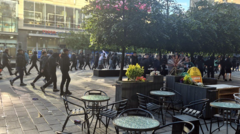
Urban civil unrest is frequently mischaracterized as a spontaneous eruption of localized animosity. This perspective is analytically flawed. The street violence in Glasgow on June 9, 2026—which resulted in five documented injuries, including two police officers, alongside broader disruptions across Edinburgh, Aberdeen, and Northern Ireland—must instead be modeled as a predictable output of a multi-tiered transmission ecosystem. The event occurred within a broader regional contagion sparked by a stabbing incident in Belfast involving a Sudanese suspect.
The standard public narrative frame categorizes these events purely as a stain on civic reputation. This moral framework fails to account for the actual operational logistics, digital amplification loops, and political shifts that make such violence possible. To mitigate or predict these structural breakdowns, analysts must isolate and quantify the specific variables that govern how a localized external trigger transforms into active street-level disorder within a specific urban geography.
The Tri-Partite Transmission Framework
The transformation of an external geopolitical or regional event into physical street violence requires three interconnected vectors. If any single vector is absent, the system fails to achieve the critical mass necessary for open disorder.
[Trigger Event: Belfast Knife Attack]
               │
               ▼
┌──────────────────────────────────────────────┐
│  Vector 1: Decentralized Digital Overlays     │
│  (Algorithmic Amplification & Disinfo)       │
└──────────────┬───────────────────────────────┘
               │
               ▼
┌──────────────────────────────────────────────┐
│  Vector 2: Localized Electoral Shifts        │
│  (Normalization of Populist Rhetoric)        │
└──────────────┬───────────────────────────────┘
               │
               ▼
┌──────────────────────────────────────────────┐
│  Vector 3: Operational Street-Level Logistics│
│  (Masked Mobilization & Flash Tactics)       │
└──────────────┬───────────────────────────────┘
               │
               ▼
     [Physical Urban Unrest]
1. Decentralized Digital Overlays
The primary velocity vector for modern social unrest is no longer localized organization, but rather cross-border digital orchestration. Following the Belfast incident, data streams across platforms like X and Telegram experienced an immediate spike in coordinated disinformation. The mechanisms of this digital layer operate via specific informational feedback loops:
- Identified Misattribution: In the initial hours of an incident, digital actors deliberately misstate the nationality, legal status, or religious background of a suspect to align with pre-existing political friction points. In this specific cycle, the suspect was initially misidentified as Somali before official police sources confirmed the individual was a 30-year-old Sudanese national holding leave to remain until 2028.
- Algorithmic Promotion Metrics: Highly visible international platforms amplify localized content via recommendation algorithms that prioritize engagement density over factual verification. High-profile international commentary serves to scale local grievances into a globalized narrative, lowering the behavioral threshold for individuals to participate in physical mobilization.
2. Localized Electoral Shifts
Street-level violence does not occur in a political vacuum. It requires a baseline level of rhetorical normalization that reduces the perceived social cost of engaging in overt racial hostility. The 2026 local and parliamentary elections in Scotland directly altered this baseline.
The election of 17 Reform UK candidates to the Scottish Parliament, including two representatives within the Glasgow region, served as an institutional validation of populist, anti-immigrant rhetoric. When mainstream political discourse consistently highlights the restriction of migration as a primary policy objective, the ideological distance between institutional policy and extra-legal street action shrinks. This structural shift provides a psychological cover of mainstream alignment for fringe actors.
3. Operational Street-Level Logistics
The final stage of the transmission pipeline is the tactical execution on the ground. The mobilization of approximately 400 masked individuals through Glasgow city centre, specifically concentrated around major infrastructure points like the Buchanan Street Steps, demonstrates a deliberate exploitation of urban choke points.
The deployment of black attire, face coverings, and flash-mob tactics serves a dual operational purpose. First, it complicates post-incident forensic identification and strains law enforcement resources. Second, it creates a visual uniform that projects an illusion of disciplined, collective scale, which maximizes intimidation while minimizing the probability of immediate, targeted arrests during the kinetic phase of the riot.
The Cost Function of Urban Deterrence
The persistent failure of municipal authorities to suppress these flash-points stems from an asymmetry in the enforcement cost function. For street-level bad actors, the immediate cost of participation is historically low, driven by three operational factors:
$$C_{actor} = (P_{arrest} \times P_{prosecution} \times S_{sentence}) - G_{ideological}$$
Where:
- $P_{arrest}$ represents the probability of immediate physical detention on the street.
- $P_{prosecution}$ represents the likelihood of the state securing a conviction based on available evidence.
- $S_{sentence}$ represents the severity of the legal penalty.
- $G_{ideological}$ represents the perceived social or political capital gained within the actor's network.
In the early stages of urban unrest, $P_{arrest}$ drops significantly because law enforcement strategies prioritize containment and public safety over mass detention. For instance, during the initial phase of the Glasgow counter-mobilizations and far-right marches, zero immediate arrests were reported despite documented physical altercations and injuries to personnel. This operational choice by policing bodies inadvertedly lowers the short-term cost for the rioter, signaling that the state lacks either the capacity or the immediate tactical appetite for overwhelming legal reprisal.
Conversely, the state's cost function for managing unrest is exceptionally high, involving direct resource diversion, infrastructure damage, and the long-term economic degradation of the city’s commercial core. When a municipal environment like Glasgow city centre is forced to halt commerce, block transport arteries across the River Clyde, and deploy sustained riot containment units, the economic friction damages local growth far longer than the duration of the physical confrontation.
Structural Resilience and Counter-Mobilization Mechanics
To understand the trajectory of urban friction, analysts must also evaluate the counter-mobilization capacity of the host city. Glasgow’s civic dynamics are heavily influenced by deep-seated trade union histories and anti-racist networks, such as Stand Up to Racism (SUTR) and Positive Action in Housing. These entities operate on a parallel logistical model designed to re-occupy the physical spaces claimed by far-right actors.
The counter-mobilization strategy relies on mass-density deterrence. By organizing high-volume, highly visible public rallies at the identical geographic coordinates—such as the Buchanan Street Steps—civic organizations attempt to artificially inflate the social and physical cost of far-right assembly. When anti-racist mobilizations achieve a numerical superiority (frequently exceeding several hundred to thousands of participants), they effectively price out smaller far-right networks by shifting the risk equation against them.
The structural limitation of this approach is its reactive nature. Because civic counter-mobilizations rely on formal democratic organizing principles, trade union approvals, and scheduled public permits, they possess a longer operational latency than the decentralized, digitally accelerated flash networks of the far right. Consequently, the state is consistently left exposed during the critical 24-to-48-hour window following an external trigger event.
Tactical Reconfiguration for Municipal Governance
Relying on rhetorical condemnation or appeals to historical civic pride is insufficient for managing modern, digitally accelerated urban unrest. Municipal authorities and law enforcement frameworks must transition to a proactive operational posture built on specific tactical changes:
- Dynamic Friction Zoning: Law enforcement must shift away from passive containment lines at major civic landmarks. Instead, they must implement rapid, pre-emptive physical blockades at identified transit interfaces (such as the bridges over the Clyde and central rail terminals) the moment a digital trigger event crosses critical engagement thresholds online.
- Algorithmic Risk Accounting: Public safety frameworks must integrate real-time digital telemetry. Monitoring the velocity of specific disinformation keywords within localized geographic clusters allows for the deployment of physical assets prior to the physical assembly of masked actors, thereby raising $P_{arrest}$ at the exact moment of formation.
- Targeted Legal Expediency: To permanently alter the cost-benefit equation for far-right organizers, the judiciary must establish dedicated fast-track prosecution protocols for individuals wearing face coverings or carrying weapons during periods of declared civil strain, mirroring the strict sentencing strategies deployed during the 2024 UK-wide riots.
Without these structural adjustments to the enforcement model, urban centers will remain highly vulnerable to regional informational shocks, allowing external disruptions to dictate the security, stability, and commercial viability of local metropolitan spaces.