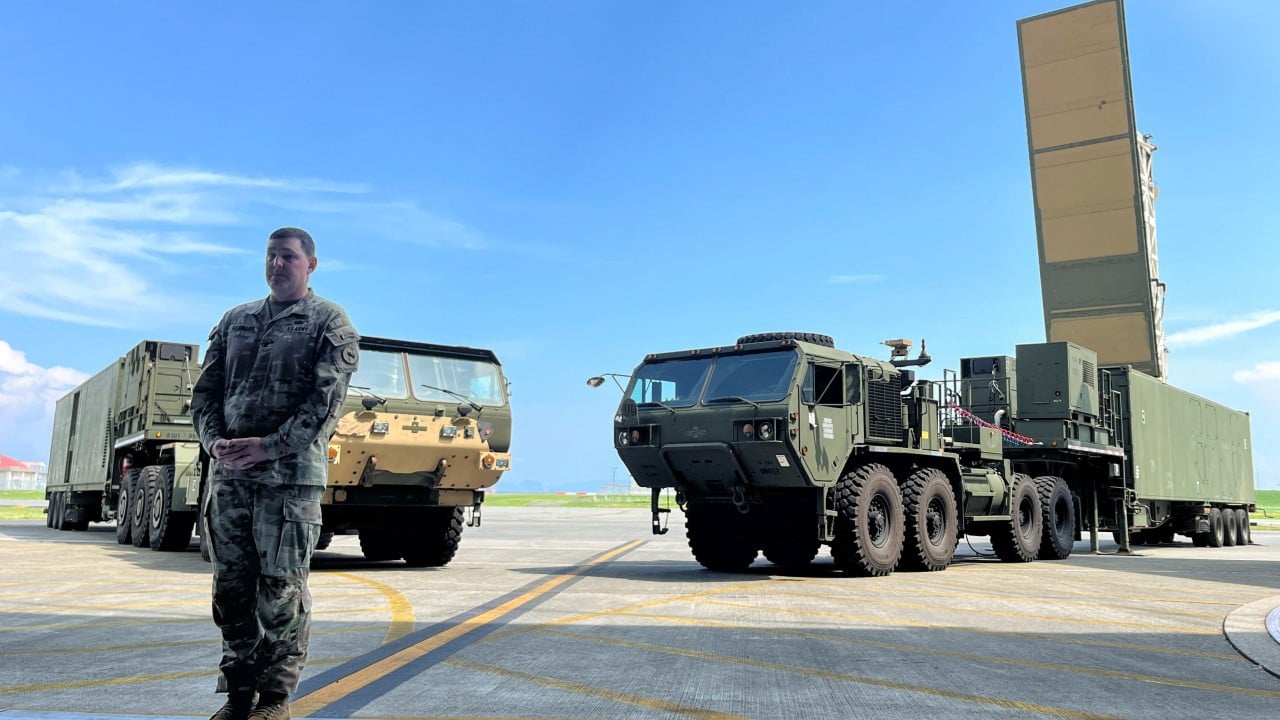
The physical introduction of the U.S. Army’s Strategic Mid-Range Capability, known as the Typhon weapon system, to Kanoya Air Base in Kagoshima Prefecture alters the ballistic mathematics of East Asia. Moving beyond political rhetoric regarding regional stability, this deployment shifts the operational risk calculus for the People's Liberation Army (PLA) by establishing an unpredictable ground-based strike vector. By utilizing standard, highly mobile shipping containers to house vertical launch cells, the system introduces severe tracking complications for adversarial satellite reconnaissance.
Understanding the true strategic impact of Typhon requires assessing the system's precise hardware parameters, geometric constraints, and the asymmetric costs it imposes on air defense networks in mainland China.
The Hardware Calculus: Range and Target Profiles
The Typhon system does not rely on experimental technology; it is a mechanical synthesis of existing naval architecture adapted for ground mobility. Each Typhon battery consists of four primary launcher vehicles built on modified heavy expanded mobility tactical truck chassis, a mobile operations center, and support vehicles. The structural core of the platform is the Mk 41 Vertical Launch System, adapted to fire two primary munitions.
- The Tomahawk Land Attack Missile (TLAM): Operating with a nominal strike range of approximately 1,600 kilometers, this subsonic, terrain-following cruise missile presents a low radar cross-section. When launched from Kagoshima Prefecture, the missile's flight envelope encompasses primary economic and military hubs across eastern and central China, including Shanghai, Hangzhou, and Hangzhou’s interior military infrastructure.
- The Standard Missile 6 (SM-6): Modified for a surface-to-surface role, the SM-6 possesses a range exceeding 300 kilometers. Traveling at supersonic speeds, it serves as a high-velocity option to target littoral surface vessels or fast-reacting land targets within the East China Sea and the first island chain.
The geographical reality of installing these systems in southwestern Japan establishes a permanent, low-visibility strike threat. Unlike naval assets—such as Arleigh Burke-class destroyers or Virginia-class submarines, which must navigate constrained maritime chokepoints like the Miyako Strait—a land-based Typhon battery utilizes Japan's dense, mountainous terrain to mask its positioning.
The Cost-Imposition Function of Mobile Ground Launchers
The core strategic utility of Typhon lies in an economic and mathematical asymmetry known as the cost-imposition function. For an adversary to neutralize a land-based, highly mobile launcher, it must expend an disproportionate volume of intelligence, surveillance, and reconnaissance (ISR) assets and offensive precision-guided munitions.
The Search Area Problem
A mobile Typhon launcher can remain hidden within hardened foliage or civilian industrial infrastructure, emerge to fire, and relocate within minutes. For a satellite constellation executing synthetic aperture radar or electro-optical passes, the probability of detection ($P_d$) drops exponentially as the target's mobility increases. The equation governing the search asset requirements to track a single mobile launcher across a designated area $A$ with a velocity $v$ demonstrates that the required number of reconnaissance passes scales geometrically with time.
Interception Economics
The financial and volume exchange rates favor the attacker. A Tomahawk cruise missile costs roughly $1.5 million to $2 million. Intercepting a low-flying, terrain-masking cruise missile requires advanced surface-to-air missile systems, such as the PLA’s HQ-9 or Russian-supplied S-400 batteries. These defensive interceptors often cost significantly more per unit than the incoming target.
Furthermore, a saturation strike utilizing multiple land-based Tomahawks can deplete the target's magazine depth. Once an air defense battery expends its ready-to-fire missiles, the radar tracking systems become vulnerable to secondary strikes.
The Strategic Bottleneck: Air Defense Saturation in Eastern China
The deployment at Kagoshima shifts the defensive requirements of China’s Eastern Theater Command. Historically, mainland defense networks could optimize their radar geometries toward the maritime approaches of the Pacific Ocean and Taiwan. Typhon expands the threat arc significantly.
This expansion forces a reallocation of early warning systems. Radars must now monitor a continuous northern vector stretching from the Japanese mainland down through the Ryukyu Islands. Because Tomahawk missiles can alter their flight paths mid-course to execute non-linear approaches, defensive installations located deep inside Chinese territory must maintain a 360-degree high-readiness state, accelerating the wear and tear on complex radar components and increasing tracking system degradation.
The system's ambiguity introduces a critical challenge. Because the Typhon launcher uses standard shipping containers, distinguishing a live missile battery from a standard commercial transport vehicle via satellite imagery becomes exceptionally difficult. This structural camouflage requires Chinese intelligence to monitor hundreds of civilian logistics routes throughout southern Japan, diluting their focus away from high-priority tracking tasks.
Systemic Vulnerabilities and Operating Constraints
Despite its tactical advantages, the Typhon system operates under severe physical and political constraints that prevent it from becoming an absolute strategic solution.
- The Logistics Tail: Each battery requires a massive logistics train for maintenance, security, and ammunition resupply. The transport of reload missiles relies on heavy cargo aircraft like the C-17 or specialized maritime sealift vessels, making these supply lines vulnerable to interdiction during a high-intensity conflict.
- Political Host-Nation Dependences: Ground-based deployment requires absolute political alignment with Tokyo. Kanoya Air Base is a shared environment; local political resistance regarding noise, target profile creation, and safety risks can lead to sudden operational restrictions, limiting the areas where these launchers can deploy during peacetime exercises.
- Magazine Limitations: A single Typhon battery carries 16 ready-to-fire cells. In a high-end conflict scenario involving dense integrated air defense systems, 16 missiles are insufficient to guarantee penetration against hardened targets, meaning Typhon must function strictly as a supplementary node within a broader, multi-domain strike network.
The Operational Play
The deployment of the Typhon system between June and September confirms a transition from occasional rotational exercises to permanent regional infrastructure integration. To maximize the strategic value of this posture, the operational focus must center on continuous logistical dispersion.
Batteries must avoid static positioning within Kanoya Air Base during heightened tension phases. The operational mandate should prioritize random, unannounced dispersal drills throughout the commercial transport networks of Kyushu and Okinawa. By embedding these launchers within domestic maritime ferry lines and civilian road networks, the alliance creates a high-fidelity deception framework that dilutes adversarial strike planning and forces the reallocation of targeting assets away from primary theater command hubs.