The convergence of a catastrophic seismic event and a highly volatile geopolitical environment has transformed the humanitarian response in Venezuela into a complex study of logistics, infrastructure repair, and international power projection. On June 24, 2026, northern Venezuela was struck by a dual-fault rupture: a magnitude 7.3 earthquake along the northeastern terminus of the Boconó Fault, followed 39 seconds later by a magnitude 7.4 mainshock along the right-lateral San Sebastián Fault. This rapid succession generated surface displacements of approximately 30 centimeters and destroyed critical maritime, civil, and medical infrastructure across Caracas and the state of La Guaira. The subsequent mobilization of United States military assets and capital marks a distinct shift in regional intervention strategies, prioritizing immediate infrastructure rehabilitation over long-standing diplomatic isolation.
Understanding the efficacy of this response requires dissecting three primary variables: the structural vulnerabilities of the local infrastructure, the logistics of the capital deployment, and the tactical execution of deep-water port restoration.
The Structural Vulnerability Cascade
The severity of the crisis is directly correlated with pre-existing structural deficits in Venezuelan civic architecture, compounded by the shallow 10-kilometer depth of both seismic ruptures. The primary failure point occurred within the transport and logistics network, specifically at the Port of La Guaira, which handles a significant portion of inbound cargo for northern Venezuela.
The physical destruction can be modeled through three distinct structural failure vectors:
- Maritime Berth Failure: Structural displacement along the coastline rendered primary docks unusable for standard cargo vessels, creating an immediate maritime bottleneck.
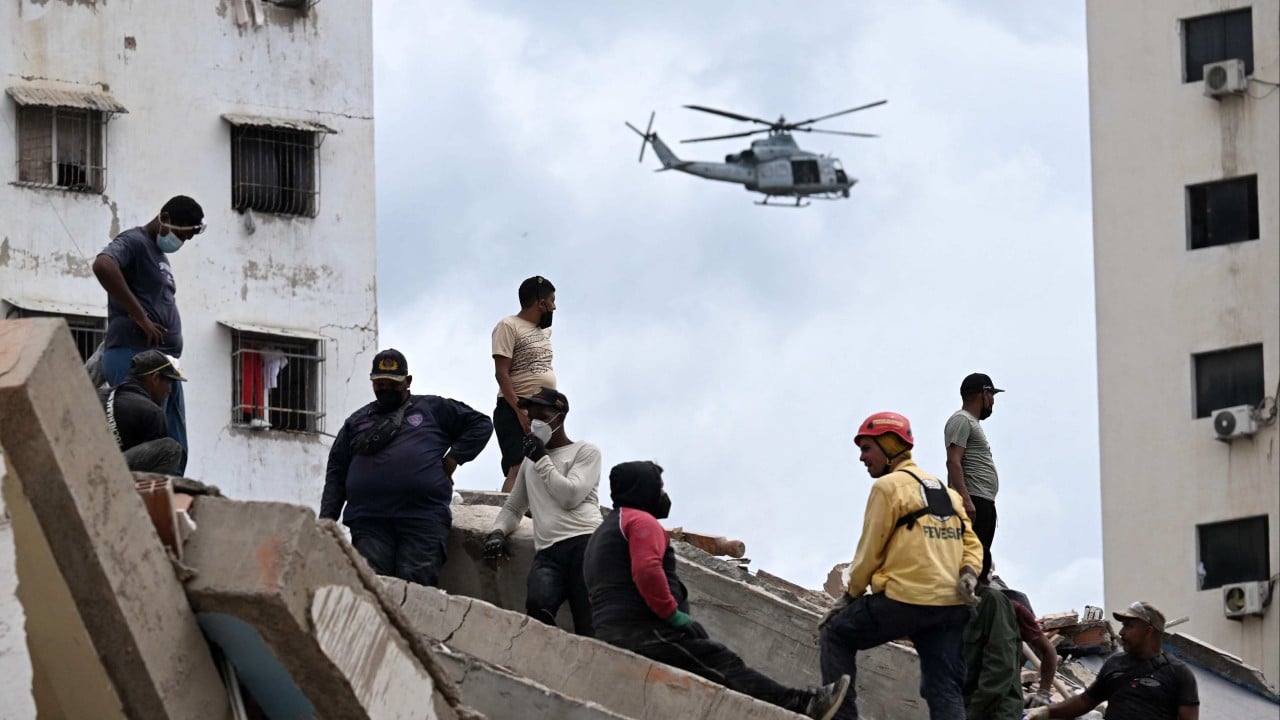
- Civil Infrastructure Collapse: Dense urban sectors, such as the San Bernardino neighborhood in Caracas, suffered catastrophic failures of residential and commercial structures due to non-ductile concrete designs unable to withstand the horizontal peak ground acceleration.
- Medical Facility Saturation: Healthcare centers near the epicenter collapsed or became structurally unsound, forcing medical staff to triage patients on open ground, which instantly decoupled emergency medical capacity from the surging demand.
The immediate consequence of these failures was the total interruption of supply chains. Because air infrastructure sustained parallel damage, the maritime bottleneck at La Guaira prevented civilian aid organizations from distributing essential life-support materials, shifting the operational requirement from basic cargo delivery to heavy engineering and port reconstruction.
The Mechanics of Capital and Regulatory Mobilization
The financial and regulatory framework established by the United States government represents an unprecedented reallocation of resources for a regional disaster. The intervention utilizes a dual-track strategy combining direct capital deployment with a strategic pause in economic restrictions.
Total Mobilized Capital ($300M)
├── Emergency Pool Allocation ($100M to UN Pooled Fund)
├── Implementing Partners ($50M to WFP & International Medical Corps)
└── Direct Bilateral & Faith-Based Grants ($150M)
The financial architecture relies on an initial $150 million commitment, which was subsequently doubled to $300 million to fund emergency medical care, water purification, and temporary shelter. This capital is structured to bypass local bureaucratic friction by routing directly through specific operational channels, including faith-based aid groups, United Nations agencies, and the World Food Programme.
Simultaneously, the regulatory mechanism driving the response hinges on a temporary Office of Foreign Assets Control (OFAC) sanctions waiver, active until October 23, 2026. This legislative suspension serves a specific economic function: it allows the Venezuelan government to execute temporary financial transactions dedicated exclusively to disaster relief. Without this specific carve-out, international banking compliance protocols would automatically freeze transactions meant for local procurement, stalling the acquisition of regional supply chains.
Tactical Execution of Port Rehabilitation
Because civilian transport could not navigate the damaged berths at La Guaira, the operational focus shifted to military engineering. The deployment of the USS Fort Lauderdale, an amphibious transport dock warship, provided a mobile command platform capable of operating independently of shore-based infrastructure.
The repair of the Port of La Guaira by a specialized team of US Marines follows a strict sequence of operational engineering priorities:
- Hydrographic Surveying: Assessing underwater topography and debris field layouts to map safe approach corridors for deep-draft vessels.
- Structural Stabilization: Reinforcing cracked quay walls and compromised pier foundations using ship-to-shore engineering equipment.
- Berth Clearing: Removing collapsed crane infrastructure and structural debris from the primary shipping channels to restore basic docking functionality.
The primary limitation of this engineering effort is time. The National Assembly has indicated that the survivability index for individuals trapped beneath urban rubble decays exponentially after the 96-hour mark. Therefore, the rapid restoration of the port is not merely a long-term economic recovery objective; it is the absolute prerequisite for offloading the heavy earth-moving equipment, mobile field hospitals, and water-generation units necessary to support urban search and rescue teams on the ground.
Geopolitical Realignment and Comparative Doctrines
The scale of this mobilization indicates a structural pivot in foreign assistance frameworks. The strategy contrasts sharply with previous relief doctrines executed under similar diplomatic conditions. For example, during the March 2025 earthquake in Myanmar—which resulted in over 3,500 casualties—the administration's response was limited to $9 million in aid and a minimal assessment team, leaving a geopolitical vacuum that was rapidly filled by a $137 million bilateral aid package from China.
The current response in Venezuela reflects an explicit policy update designed to counter regional strategic competitors. While China has committed 100 million yuan ($14.7 million) in free emergency relief supplies, the United States has leveraged its proximity and naval logistics to establish operational dominance over the theater of relief. The post-authoritarian transition in Venezuela has heightened Washington's motivation to stabilize the region directly, transforming disaster response into a mechanism for establishing security partnerships and verifying structural influence on South America's northern coast.
The immediate operational priority requires maintaining the separation between humanitarian logistics and regional political objectives. The integration of international search and rescue units from El Salvador, Mexico, Colombia, and various European nations creates a congested operational environment. Success depends entirely on whether the newly repaired berths at La Guaira can seamlessly process multi-national cargo streams under a unified military-to-civilian coordination framework before local supply lines completely exhaust their remaining capacity.