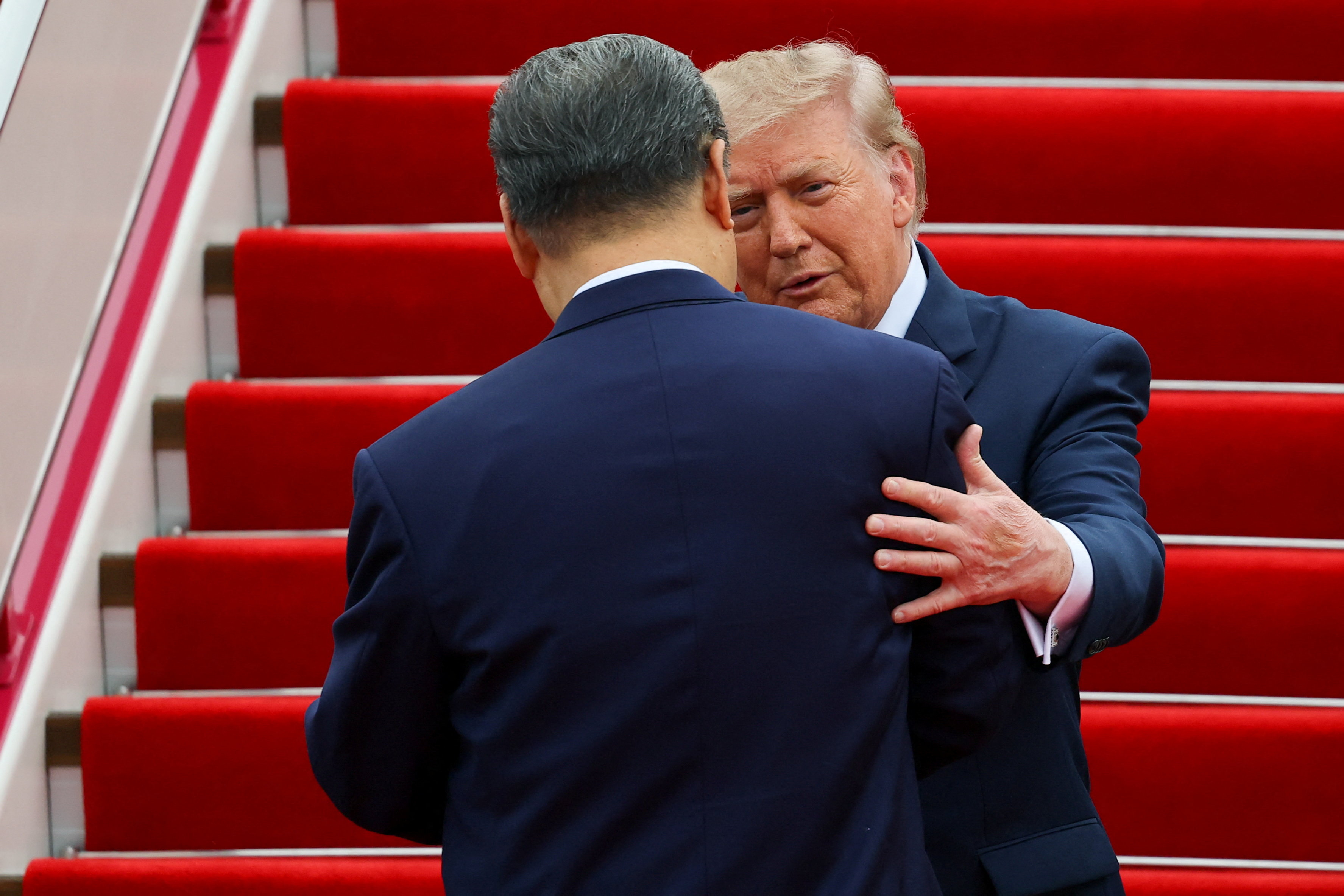
Standard diplomatic reporting treats physical gestures between heads of state as emotional barometers. When Xi Jinping greets Donald Trump on a Shenzhen tarmac with a grand ceremonial reception and an uncharacteristic physical embrace, mainstream coverage frames the event through personal rapport. That analytical framework is fundamentally flawed. In great power competition, high-level protocol is never spontaneous; it is an engineered signaling mechanism designed to alter the payoff matrix of bilateral negotiations before formal talks begin.
To evaluate the strategic utility of the Shenzhen airport reception, analysts must strip away journalistic adjectives and examine the event through three operational lenses: diplomatic protocol theory, geographic signaling, and domestic audience costs.
The Protocol Deviation Framework
State visits operate on strict, pre-negotiated scripts. Every variable—from the length of the red carpet to the seniority of the welcoming delegation—is calibrated by ministries of foreign affairs to reflect the exact temperature of bilateral relations.
In Chinese diplomatic tradition, physical contact is tightly constrained. The standard greeting for visiting heads of state is a measured handshake held for a predetermined duration to accommodate state media photography. Departures from this baseline are statistically rare and operationally deliberate. When a leader breaks protocol to initiate an embrace, the action functions as a high-visibility signal within a game-theoretic bargaining model.
Costly Signaling vs. Cheap Talk
In international relations theory, verbal commitments to cooperation are classified as "cheap talk" because they carry negligible upfront costs and can be reversed without penalty. Physical deviations from rigid cultural norms, conversely, function as costly signals.
By initiating a rare embrace on live broadcast, Beijing incurs an immediate domestic political cost. State media has spent years cultivating an image of Xi Jinping as an unyielding, dignified authority figure standing firm against Western pressure. Breaking that posture introduces cognitive dissonance for domestic observers.
A rational actor only absorbs that domestic friction if the expected external return exceeds the cost. The return, in this scenario, is a structural shift in the psychological framing of the summit. The embrace is designed to achieve three tactical outcomes:
- Asymmetric Concession Extraction: By offering high-status personal validation upfront, the host creates a subtle psychological debt, pressuring the visiting leader to reciprocate with tangible policy flexibility once behind closed doors.
- Bilateral Ring-Fencing: Personal warmth visually isolates the two leaders from their respective institutional hawks, signaling to global markets that executive authority overrides bureaucratic inertia.
- Media Narrative Hijacking: A singular, unexpected visual dominates global news cycles, crowding out critical coverage of structural disputes such as tariff schedules, export controls, or maritime friction.
The Limitations of Personalist Diplomacy
Relying on protocol theatrics to manage structural rivalry carries severe operational risks. Personal warmth does not alter underlying economic incentives or national security imperatives.
When a state substitutes ceremonial grandeur for substantive alignment, it creates an expectation gap. Global equity markets and supply chain managers often misread visual cordiality as an imminent policy pivot. If the subsequent closed-door negotiations fail to produce concrete reductions in trade barriers or regulatory friction, the resulting market correction is sharper than if the summit had maintained a neutral tone. Personal rapport can lubricate the mechanics of a deal, yet it cannot manufacture overlapping interests where zero-sum competition dominates.
Geographic Signaling and the Shenzhen Variable
The selection of Shenzhen as the entry point for a high-stakes bilateral meeting is a calculated spatial variable. Historically, state visits to China anchor in Beijing, the seat of centralized political power and ideological orthodoxy. Diverting a premier diplomatic arrival to Shenzhen shifts the analytical frame from geopolitics to geo-economics.
Shenzhen is the physical manifestation of China’s post-1978 economic integration into global supply chains. As the primary hub for hardware manufacturing, cross-border capital flows, and technological scaling, the city represents the exact domain where US and Chinese economic interests remain deeply entangled despite ongoing decoupling pressures.
The Three Pillars of Venue Selection
Choosing Shenzhen over Beijing executes a specific strategic communication plan aimed at foreign capital and domestic business elites:
- Commercial De-escalation: Hosting in a special economic zone signals that the primary agenda prioritizes trade, investment, and industrial supply chains over ideological disputes or territorial friction.
- Technological Leverage Display: Shenzhen serves as the headquarters for China’s premier technology champions. Bringing a US delegation directly into this ecosystem functions as a subtle demonstration of domestic innovation capacity, countering Western narratives that semiconductor sanctions have crippled Chinese technological progress.
- Sub-National Channel Activation: Positioning the summit in Guangdong province elevates local commercial actors and provincial administrators, reminding foreign executives that regional economic pragmatism remains operational even when central government rhetoric hardens.
The constraint of this geographic strategy is its transparency. Western trade representatives and national security analysts recognize venue selection as a curated stage set. Walking a tarmac in a commercial hub does not erase intellectual property disputes, industrial overcapacity, or state subsidy regimes. It merely changes the backdrop against which those intractable variables are debated.
Audience Costs and Asymmetric Media Control
To understand why the Shenzhen reception was engineered with maximum visual grandeur, one must account for the structural asymmetry in how the two leaders manage domestic audience costs. Audience costs refer to the domestic political penalties a leader suffers if they make threats or commitments and subsequently back down.
The Centralized Information Environment
In Beijing, the state apparatus maintains total control over the domestic information ecosystem. State media filters, crops, and contextualizes every frame of the tarmac arrival.
- Domestic Framing: For internal consumption, the grand welcome and the embrace are broadcast as evidence of China’s magnanimity and global centrality. The narrative emphasizes that foreign leaders travel to China to seek engagement, positioning Xi as the gracious, dominant host.
- Risk Mitigation: Because state censors can suppress dissenting commentary that might frame the embrace as appeasement, Beijing faces minimal downside risk from displaying overt warmth. The state retains full editorial control over the meaning of the gesture.
The Fragmented Information Environment
In Washington, the visiting leader operates within a hyper-fragmented, adversarial media environment where visual optics are immediately weaponized by domestic political opponents and amplified by algorithmic news feeds.
- Validation Dynamics: For Donald Trump, whose political brand relies heavily on projecting personal dominance and deal-making prowess, a grand reception and a rare physical embrace from a peer superpower leader serve as high-value political capital. It validates the premise that his personal leadership style achieves breakthroughs that conventional diplomacy cannot.
- Vulnerability to Counter-Narratives: Simultaneously, the visual exposes the visiting delegation to immediate domestic criticism from legislative hawks who view overt cordiality with Beijing as a dilution of strategic deterrence.
Beijing’s protocol architects understand this asymmetry. By providing Trump with a visual triumph tailored for Western broadcast networks, China delivers an immediate, zero-cost political deliverable to the visiting leader. In exchange, Beijing expects that this upfront delivery of prestige will soften the US delegation's opening posture on substantive economic demands.
Operationalizing Diplomatic Optics for Market Strategy
Corporate strategists, institutional investors, and supply chain directors frequently misinterpret high-level diplomatic theater. Treating a tarmac embrace as a buy signal for cross-border exposure is a primary failure mode in geopolitical risk management.
To separate diplomatic noise from actionable policy shifts, analysts must apply a strict filtering protocol to summit coverage:
- Discount Ceremonial Variance: Assign a near-zero weight to deviations in greeting rituals, banquet menus, or motorcade sizes. These are tactical inputs designed to manage media cycles, not leading indicators of regulatory change.
- Track Bureaucratic Representation: Audit the secondary figures standing behind the principals on the tarmac. The presence or absence of specific cabinet secretaries, trade negotiators, and central bank governors reveals the actual working agenda far more accurately than the principals' body language.
- Monitor Joint Communiqué Specificity: Compare post-summit readouts for asymmetric language. When the US readout emphasizes "candid exchanges" while the Chinese readout highlights "mutual respect and win-win cooperation," the underlying structural deadlock remains intact regardless of how warm the arrival appeared.
- Verify Capital and Tariff Mechanics: Delay capital allocation decisions until diplomatic warmth translates into published regulatory changes, such as updated entity lists, modified tariff exclusions, or ratified bilateral investment treaties.
The grand welcome in Shenzhen demonstrates that Beijing is willing to expend significant protocol capital to stabilize the optics of the US-China relationship. Yet optics are a depreciating asset. Unless the closed-door sessions produce verifiable mechanisms to resolve structural imbalances in industrial manufacturing and technology transfer, the Shenzhen embrace will remain an isolated anomaly—a masterclass in statecraft theater that temporarily masked, rather than resolved, a deepening systemic rivalry. Institutional actors should treat the resulting market optimism as a liquidity window to hedge cross-border supply chain exposure rather than a signal to expand it.