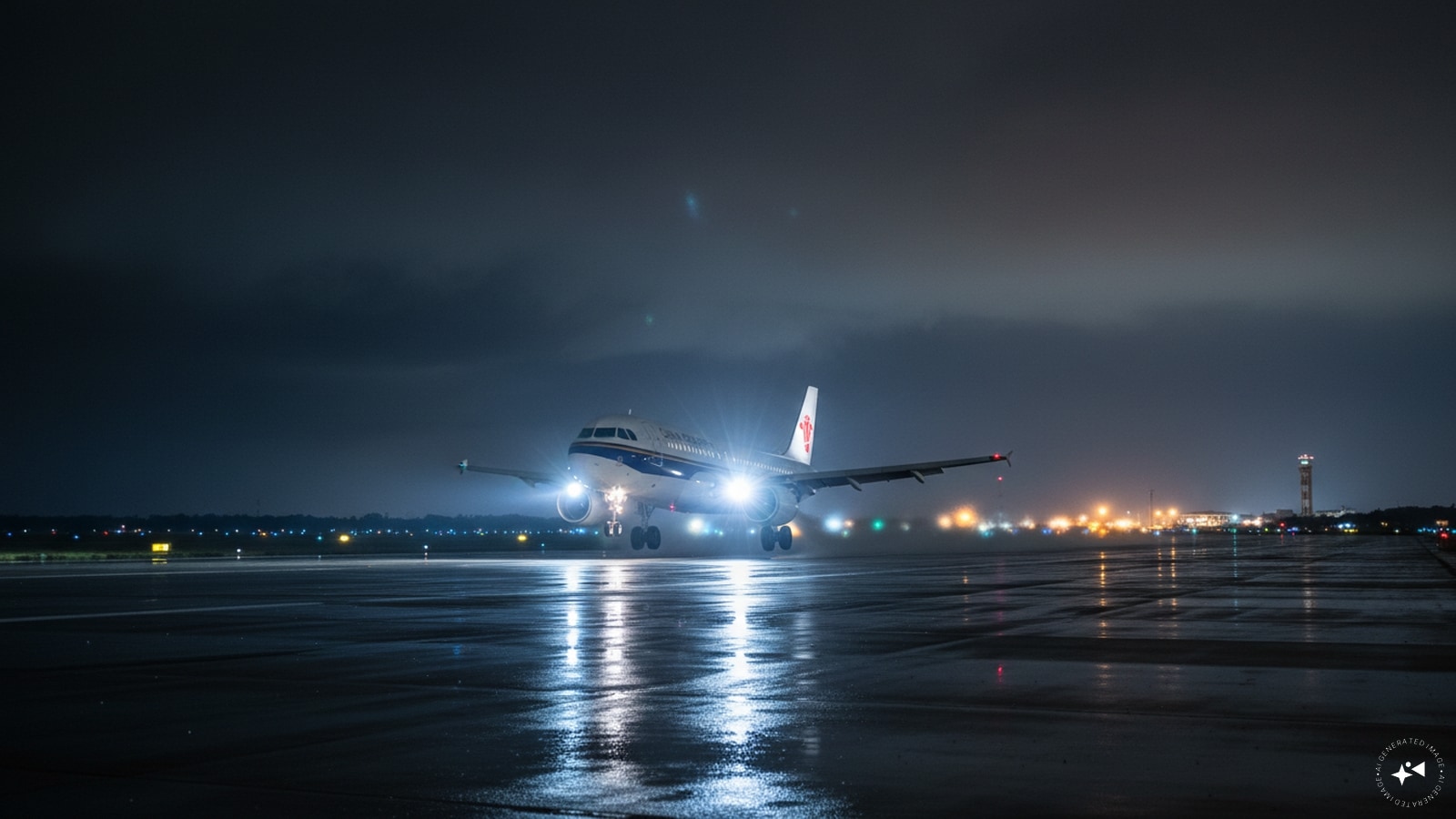
An aborted landing is not a system failure; it is the execution of a primary safety protocol designed to prevent catastrophic runway excursions. While mass media framing categorizes a missed approach—commonly known as a go-around—as an emergency driven by panic, aviation engineering and operational reality dictate otherwise. A go-around is a highly planned, standard operating procedure executed when specific stabilized landing criteria are breached. Analyzing these events requires shifting the focus from passenger psychological responses to the kinetic, aerodynamic, and structural variables that govern flight deck decision-making during high-stress recovery maneuvers.
The Triad of Stabilized Approach Parameters
To understand why a flight crew aborts a landing, one must evaluate the strict envelope of a stabilized approach. Airlines prescribe precise parameters that a aircraft must meet by a specific altitude—typically 1,000 feet above airfield elevation under instrument meteorological conditions (IMC), or 500 feet under visual meteorological conditions (VMC).
If any of the following three core pillars are compromised, international aviation regulations mandate an immediate missed approach:
- Energy Management: The aircraft must maintain a target airspeed, typically within a narrow margin of 5 knots below or 10 knots above the calculated reference speed ($V_{REF}$). Deviations indicate an unsafe energy state, risking stall or excessive stopping distance.
- Trajectory Calibration: The flight path must align precisely with the runway centerline, and the descent rate must not exceed a specified threshold, generally 1,000 feet per minute.
- Configuration State: The airframe must be fully configured for landing, meaning landing gear is locked down and flaps/slats are deployed to the mandatory aerodynamic detent.
When wind shear, microbursts, or sudden mechanical variations disrupt these variables, the flight deck enters a binary decision matrix. Continuing a destabilized approach introduces an unacceptable risk profile, forcing the crew to transition from a landing mindset to an energy-addition mindset.
The Physics of the Missed Approach Sequence
Executing a go-around requires an instantaneous re-configuration of the aircraft's energy state. The pilot flying initiates the maneuver by advancing the thrust levers to the Takeoff/Go-Around (TOGA) detent while simultaneously rotating the aircraft to a target pitch angle (typically 15 degrees). This creates an acute mechanical and physiological transition.
[Low Energy / Descent State] -> [TOGA Thrust Engagement] -> [Kinetic Energy Transition] -> [Positive Rate of Climb]
This sequence triggers a cascade of rapid physical changes inside the cabin. High-bypass turbofan engines require three to five seconds to spool up from near-idle taxi states to maximum thrust. During this latency period, the aircraft experiences a temporary drop in pitch-relative speed before the kinetic energy can overcome inertia. The sudden onset of G-forces, paired with the auditory roar of engines operating at maximum thermal capacity, generates acute sensory mismatch for passengers.
The inner ear interprets rapid linear acceleration and upward pitch as a sensation of falling backward or flipping. Without external visual references—such as during low-visibility cloud penetration—the human vestibular system misinterprets these forces, creating localized panic, physiological distress, and secondary physical symptoms like nausea.
Wind Shear and Gust Allocations: The Boundary Layer Problem
A double aborted landing almost exclusively points to localized, high-frequency atmospheric instability. Wind shear—a radical change in wind speed or direction over a short distance—alters the airspeed over the wings instantaneously, independent of ground speed.
$$\Delta V = V_{wind_final} - V_{wind_initial}$$
When an aircraft encounters a sudden performance-decreasing shear (a transition from a headwind to a tailwind), lift drops quadratically relative to the velocity loss.
If this occurs near the ground, the autopilot or human pilot must compensate by demanding immediate maximum thrust to restore the lost lift coefficient. If a second attempt encounters identical boundary layer turbulence, standard risk management principles dictate that the crew divert to an alternate airport with more favorable meteorological metrics. Running a third approach under identical atmospheric conditions introduces compounding cognitive fatigue for the crew and tests the thermal limits of braking systems if successive heavy configurations are mismanaged.
Human Factors and Flight Deck Resource Distribution
The execution of successive missed approaches tests the efficacy of Crew Resource Management (CRM). During a go-around, the division of labor splits cleanly between two roles: the Pilot Flying (PF) and the Pilot Monitoring (PM).
The PF focuses entirely on flight path control, tracking pitch, roll, and power settings. The PM manages configuration changes—retracting flaps to the intermediate go-around setting, commanding gear up once a positive rate of climb is verified—while simultaneously executing radio communications with Air Traffic Control (ATC).
This high-workload environment relies on standardized, monosyllabic callouts to eliminate ambiguity. The primary vulnerability during repeated aborted landings is task saturation. The crew must balance navigating a complex missed approach procedure, programming the Flight Management System (FMS) for a hold or a diversion, and managing fuel reserves.
The Mathematical Constraints of Fuel and Diversion Timeframes
Every commercial flight operates under a strict legal fuel architecture. A flight cannot simply attempt landings indefinitely; the total fuel load is calculated via a rigid formula:
$$\text{Total Fuel} = \text{Taxi Fuel} + \text{Trip Fuel} + \text{Contingency Fuel} + \text{Alternate Fuel} + \text{Final Reserve Fuel}$$
Final reserve fuel is legally non-negotiable, requiring enough fuel to fly for 30 minutes at holding speed 1,500 feet above the alternate destination. The moment the fuel total drops to a level where a subsequent approach and a subsequent miss would breach the alternate fuel allocation, the decision matrix closes. The crew must abandon the primary destination. Diverting after a second aborted landing is a math-driven requirement to preserve the mandatory safety buffer, removing human emotion or optimization bias from the equation.
Structural Strategy for High-Turbulence Anomalies
Airlines and flight crews must approach these volatile operational windows through a standardized protocol that minimizes exposure while prioritizing resource preservation.
- Establish Hard Limits on Approach Attempts: Fleet managers must enforce standard operating guidelines that cap the maximum number of approaches at a single airport to two under severe convective or wind shear conditions. A third attempt introduces exponential risk without proportional data indicating weather clearing.
- Pre-emptive Diversion Planning: Before initiating the first approach in marginal weather, the flight crew must configure the FMS with the exact routing, holding patterns, and fuel targets for the secondary airport. This reduces cognitive load during the high-workload go-around phase.
- Transparent Cabin Deck Communications: While the flight deck must remain isolated during sterile cockpit phases (below 10,000 feet), providing objective, operational status updates to the cabin immediately following a stabilized climb minimizes passenger anxiety. Replacing ambiguous silence with clinical explanations of "wind shear limits" stabilizes the cabin environment, reducing the operational burden on flight attendants managing physiological distress on board.