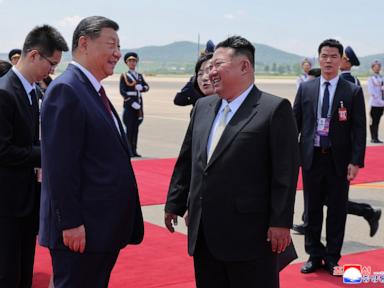
General Secretary Xi Jinping’s return to Beijing following his state visit to Pyongyang marks a structural realignment in East Asian geopolitics, moving beyond symbolic socialist solidarity into a calculated, transactional equilibrium. Standard journalistic narratives frame these state visits through the lens of optics—parades, synchronized mass games, and rhetorical displays of everlasting friendship. A rigorous strategic analysis, however, strips away this performative layer to reveal a cold calculus governed by security dilemmas, leverage asymmetry, and parallel bargaining tracks with Washington.
The relationship between the People's Republic of China (PRC) and the Democratic People's Republic of Korea (DPRK) operates under a fundamental paradox. While bound by the 1961 Sino-North Korean Treaty of Friendship, Co-operation and Mutual Assistance—which remains China’s only active formal defense treaty—the operational reality is defined by deep mistrust, conflicting end-states, and a constant struggle for systemic leverage.
The Strategic Trilemma of Beijing’s Korean Peninsula Policy
China’s policy toward North Korea is constrained by three competing, often mutually exclusive strategic imperatives. Maximizing performance in one vector invariably degrades stability in another, forcing Beijing to constantly recalibrate its enforcement of international sanctions and its provisioning of economic lifelines.
                  [No War (Stability)]
                          /\
                         /  \
                        /    \
                       /      \
                      /________\
     [No Collapse (Buffer)]    [No Nukes (Denuclearization)]
1. The Denuclearization Imperative (No Nukes)
A nuclear-armed North Korea introduces severe systemic risks for Beijing. It provides a structural justification for the United States to expand its ballistic missile defense infrastructure in the Asia-Pacific, such as the Terminal High Altitude Area Defense (THAAD) deployment in South Korea. This hardware directly degrades China's own nuclear deterrent capabilities. Furthermore, Pyongyang's nuclear proliferation risks triggering a regional arms race, potentially incentivizing Seoul or Tokyo to reconsider their non-nuclear status.
2. The Regime Stability Imperative (No Collapse)
Beijing views the DPRK as a critical geographical buffer zone preventing a US-aligned, democratic, unified Korean nation directly on its northeastern border (across the Yalu and Tumen rivers). The collapse of the Kim regime would likely result in an influx of millions of refugees into Northeast China, loose nuclear materials, and the eventual forward deployment of US military forces up to the Chinese border. Therefore, maintaining the baseline survival of the North Korean state is a non-negotiable security requirement for the People’s Liberation Army (PLA).
3. The Regional Peace Imperative (No War)
Any kinetic conflict on the Korean Peninsula would catastrophically disrupt China’s economic engine. Northeast Asia contains vital maritime trade routes and industrial hubs. A war would force China to choose between honoring its 1961 treaty obligations—risking direct military confrontation with the United States—or abandoning Pyongyang, which would destroy China's credibility as a security partner globally.
The Leverage Asymmetry and the Cushion Function
A common analytical error is treating North Korea as a compliant client state of China. In reality, Pyongyang possesses significant reverse leverage over Beijing, rooted in its capacity to trigger systemic instability.
China provides approximately 90% of North Korea’s external trade volume, including vital deliveries of crude oil via the Dandong-Sinuiju pipeline and shipments of refined petroleum, chemical fertilizers, and grain. On paper, this creates an absolute economic dependency. If Beijing were to entirely halt the flow of oil, the DPRK military and economy would grind to a halt within months.
Yet, China cannot deploy this economic leverage to force denuclearization because executing the threat would trigger the "No Collapse" failure state. The Kim regime understands this bottleneck perfectly. Pyongyang utilizes its own vulnerability as a shield, knowing that China will always supply a baseline level of food and fuel to prevent a catastrophic systemic collapse. This dynamic transforms China's economic dominance into a passive cushion rather than an active steering mechanism.
The timing of Xi Jinping's visit illustrates how this leverage is weaponized on the global stage. By arriving in Pyongyang immediately prior to the G20 summit and high-level trade negotiations with the United States, Beijing signaled to Washington that the road to managing North Korea’s nuclear ambitions runs exclusively through China. North Korea is deployed as a strategic asset to alter the bargaining architecture of broader Sino-American competition. When US-China tensions are high, Beijing relaxes its enforcement of UN Security Council sanctions on North Korea, allowing ship-to-ship oil transfers and illicit coal exports to resume in the Yellow Sea. When Beijing seeks stabilization with Washington, it tightens the economic valve on Pyongyang.
The Paralysis of the Denuclearization Architecture
The complete stall in denuclearization talks since the aborted 2019 Hanoi Summit between Kim Jong Un and Donald Trump stems from an irreconcilable divergence in the sequencing of concessions. The United States demands Complete, Verifiable, and Irreversible Dismantlement (CVID) prior to any sanctions relief—a position of upfront capitulation that North Korea views as strategic suicide, citing the historical precedents of Muammar Gaddafi in Libya and Saddam Hussein in Iraq.
Pyongyang favors an incremental, action-for-action approach. Under this model, North Korea disables specific, easily replaceable nuclear facilities (such as parts of the Nyongbyon nuclear scientific research center) in exchange for the permanent lifting of sector-specific UN sanctions targeting its textile, seafood, and mineral exports.
China structurally aligns with the North Korean sequencing through its advocacy for the "dual-suspension" track. This framework demands that North Korea suspend its nuclear and missile testing in exchange for the United States and South Korea halting their large-scale joint military exercises. While this approach ostensibly positions Beijing as an objective mediator, it structurally favors Pyongyang by freezing the status quo: North Korea retains its existing nuclear stockpile and fissile material production capabilities while degrading the operational readiness of the US-ROK combined forces command.
The Strategic Calculation for Regional Policymakers
A cold assessment of the Sino-North Korean relationship yields specific, actionable parameters for intelligence analysts and defense planners managing regional security.
- Sanctions Cap: Economic sanctions alone will never achieve the denuclearization of the Korean Peninsula. Because China views a nuclear North Korea as preferable to a collapsed North Korea, Beijing will structurally subvert any international sanctions regime that threatens the core survival of the Kim regime. The efficacy of sanctions has reached its structural limit.
- The Symmetrical Threat Matrix: Attempts by Western powers to increase pressure on Beijing to "solve" the North Korea issue will yield diminishing returns. If Washington increases its military footprint in the Second Island Chain to deter China, Beijing will respond by tightening its strategic embrace of Pyongyang, treating the DPRK as an outsourced security asset designed to tie down US military assets in Northeast Asia.
- The Buffer Priority: Beijing's primary objective on the Korean Peninsula is not denuclearization; it is status quo management. Western diplomatic strategies that rely on convincing China that a unified, denuclearized Korean Peninsula is in its long-term interest fail to account for the PLA's deeply ingrained doctrine regarding geographical buffer zones.
Rather than pursuing the diplomatic mirage of rapid denuclearization via Chinese pressure, regional strategy must shift toward a long-term containment and deterrence framework. This requires the United States, South Korea, and Japan to formalize trilateral intelligence-sharing networks, harden missile defense architectures, and reinforce extended nuclear deterrence without expecting Beijing to act as an enforcement mechanism against its own perceived security interests. The Sino-North Korean alliance is not born of shared ideological enthusiasm, but of cold, geographical necessity, rendering it highly resilient to external diplomatic maneuvers.