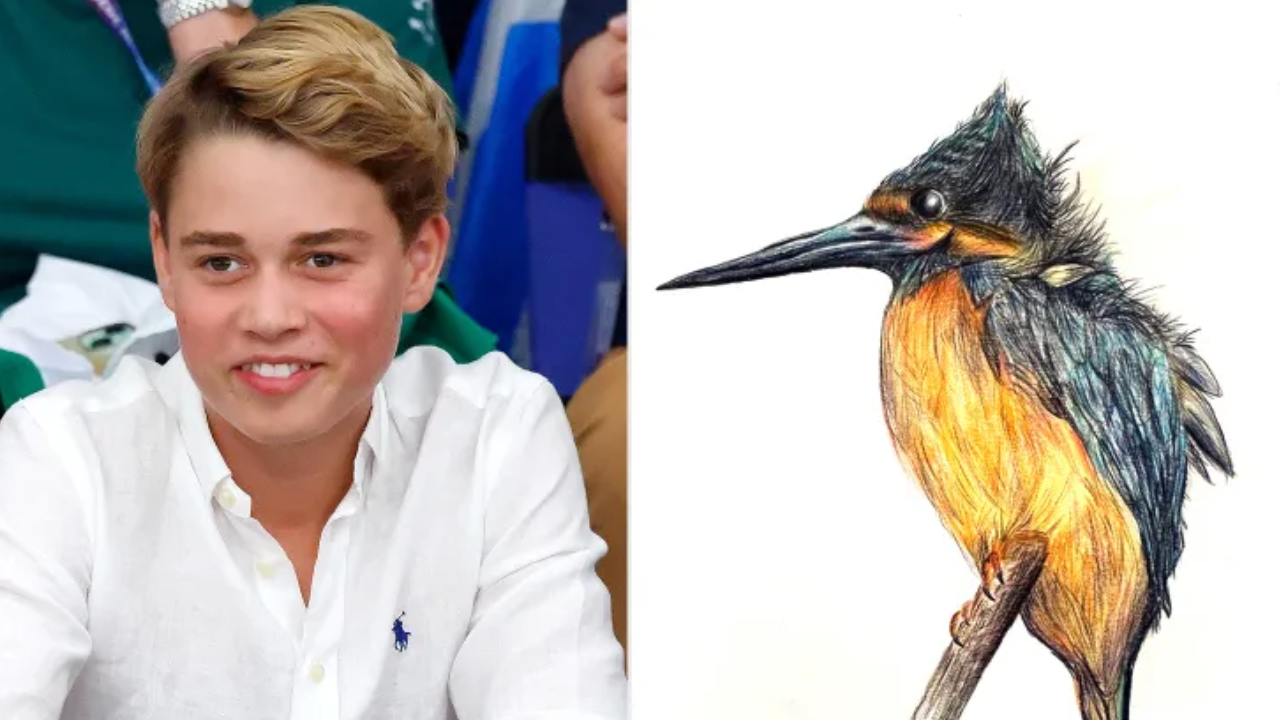
Public releases of artwork created by senior members of a hereditary monarchy rarely function as mere domestic snapshots; they operate as calibrated instruments of institutional continuity. When an illustration of a kingfisher by Prince George enters the public domain alongside references linking three generations, the event exposes how visual artifacts bridge age cohorts, reinforce dynastic identity, and manage public visibility without exposing private family life. Conventional coverage treats such moments as heartwarming human-interest items, missing the underlying architecture of media timing, symbolic selection, and intergenerational signaling. This analysis deconstructs how a single drawing connects three generations, maps the cause-and-effect chains governing public reception, and outlines how communications teams optimize controlled disclosures while accounting for structural constraints.
The Three Pillars of Intergenerational Visual Signaling
A drawing that links three generations works through three distinct mechanisms: chronological anchoring, symbolic continuity, and controlled accessibility. Treating them as separate operational levers clarifies why a simple nature sketch carries institutional weight beyond its aesthetic merit.
Chronological Anchoring Across Age Cohorts
Hereditary institutions face a recurring structural challenge: maintaining relevance across birth cohorts with divergent media habits and expectations. A young royal represents future longevity; a middle-aged parent represents active executive stewardship; an older generation represents historical memory and accumulated legitimacy. When a child's artwork is paired with earlier or parallel works, observers place all three figures on a shared timeline.
This alignment alters how audiences process succession. Instead of viewing succession as an abstract constitutional transfer or a distant calendar event, viewers see a continuous line of individuals observing the same natural world. The mechanism relies on temporal juxtaposition: placing a juvenile rendering next to adult or historical reference points invites the viewer to compare skill, perspective, and context across time. Because a child's drawing naturally carries modest technical execution compared with finished studio art or formal portraiture, its authenticity feels immediate rather than staged. That perceived immediacy lowers audience skepticism toward curated public communications.
Symbolic Continuity Through Natural Motifs
Selecting a kingfisher as the subject introduces specific ecological and cultural associations that differ sharply from martial regalia, heraldic beasts, or state architecture. A kingfisher is small, swift, visually striking, and tied to clean aquatic habitats. In visual communication, nature motifs act as low-friction symbols: they evoke attentiveness, craft, and environmental observation without triggering partisan debates or policy disputes.
The cause-and-effect chain operates in two steps. First, depicting a specific bird signals observational focus—someone sat still long enough to register proportions, plumage contrast, and posture. Second, linking that motif across three generations turns a single natural detail into a recurring family reference point. Whether the generational link rests on shared artistic interest, past gifts, parallel creative output, or a common appreciation for wildlife and outdoor spaces, the motif supplies a thread that text alone struggles to sustain. A shared visual subject gives audiences an immediate point of comparison across age groups.
Controlled Accessibility and Boundary Management
Monarchical communications constantly balance public demand for access against the institutional need for privacy. Full biographical transparency erodes mystique and strains family boundaries; total opacity breeds detachment and speculation. Visual artifacts like a drawing sit in a narrow middle zone: they offer a window into personal inclination while withholding unscripted daily life.
Here lies a critical cause-and-effect relationship that surface commentary often overlooks. Releasing a creative work satisfies curiosity about a young figure's personality without placing the child in a speaking role or subjecting them to high-pressure public performance. At the same time, framing the piece around three generations shifts attention from an individual child to a broader family dynamic, distributing scrutiny across multiple figures rather than concentrating it on one minor.
Structural Distinction Between Known Facts and Educated Hypotheses
Rigorous analysis requires separating verified observable mechanics from interpretive claims. Because a brief reference headline provides a premise rather than a complete archival dossier, analysts must distinguish what is structurally certain from what remains inferred.
Known structural facts include the following:
- Visual media travels faster and achieves broader cross-demographic comprehension than long-form prose announcements.
- Multi-generational framing invites comparative reading across age groups, prompting audiences to look for similarities, contrasts, or inherited habits.
- Nature subjects such as birds offer recognizable visual hooks that translate easily across headlines, social feeds, and broadcast segments.
Educated hypotheses include the following:
- The release likely aims to project warmth, developmental normalcy, and quiet continuity during a period when institutional attention might otherwise focus on formal duties or administrative transitions.
- Linking three generations probably serves to reinforce internal cohesion and external stability simultaneously, signaling alignment across senior, mid-career, and junior branches.
- Selecting a kingfisher may reflect genuine personal interest within the household alongside a deliberate choice to avoid overused or overly formal emblems.
Confusing these two categories leads to overreach. Treating a plausible communications motive as proven intent—or assuming an artistic link implies identical training or identical artistic ability across generations—weakens analytical credibility. A child's sketch and an adult's work or historical reference operate under completely different cognitive and technical conditions; comparing them is useful for narrative resonance, not for measuring artistic equivalence.
The Cost Function of Controlled Cultural Disclosures
Every public release carries an operational cost function. Even when no financial outlay is required to share an image, communications teams incur reputational, strategic, and attention costs that compound over time.
Attention Depletion and Novelty Decay
Audience attention follows a predictable decay curve. High-impact visual disclosures lose marginal impact if deployed too frequently or without clear differentiation. If every minor creative effort or family moment receives ceremonial framing, the audience recalibrates downward, treating future releases as routine filler rather than meaningful touchpoints.
To prevent novelty decay, releases must align with natural cadence and genuine thematic weight. A three-generation link adds structural depth precisely because it introduces comparison and lineage rather than repeating a single static pose. Yet even a strong concept loses force if over-explained or recycled too often.
Over-Interpretation and Narrative Drift
A major hidden cost of releasing ambiguous or poetic artifacts is narrative drift. Without firm framing, commentators and audiences project their own preoccupations onto the material. A drawing of a kingfisher can be read as a nod to conservation, a reflection of family bonding, an indicator of educational priorities, or a metaphor for fleeting glimpses of clarity.
Some interpretive latitude is helpful because it lets diverse readers find a personal entry point. Excessive ambiguity, however, creates friction when commentators invent elaborate backstories that outrun the facts. Communications teams pay this cost whenever a light touch leaves too much vacuum around context, forcing secondary outlets to fill the gap with conjecture.
Comparative Scrutiny Across Generations
Linking three generations invites side-by-side evaluation, which cuts both ways. While it highlights continuity, it also exposes differences in visibility, role clarity, and public standing among the three cohorts. Audiences may ask why one generation is foregrounded, how another generation's legacy is being framed, or whether the connection feels organic or engineered.
This comparative dynamic creates a trade-off between depth and simplicity. A single-person release is easy to read but thin on lineage; a three-generation release is rich in lineage but more complex to calibrate so no single figure feels sidelined or over-instrumentalized.
Operational Mechanics Behind Multi-Generational Storytelling
Practitioners managing public visibility around high-profile families or legacy institutions treat storytelling as a system of constraints rather than a pure creative exercise. Executing a multi-generational visual release cleanly requires disciplined sequencing across several operational steps.
- Establish the core thesis before selecting the asset. Decide whether the primary objective is demonstrating intergenerational bond, highlighting a specific interest such as wildlife or drawing, or providing a calm counter-balance to heavier institutional news.
- Verify factual anchors for each generational link. Confirm what genuinely connects the three generations—shared subject matter, past correspondence, artistic tradition, or family heritage—so the framing rests on verifiable connections rather than strained analogies.
- Calibrate contextual copy to guide without over-scripting. Provide enough factual grounding so observers understand why the three generations are linked, while avoiding melodramatic claims that invite pushback.
- Protect developmental boundaries for younger participants. Ensure the presentation respects age-appropriate privacy, avoids placing performative pressure on a child, and keeps the focus on the shared artifact and generational thread.
- Monitor reception for narrative drift. Track how coverage frames the connection across outlets to identify whether the intended theme holds or whether audiences are latching onto unintended subtexts.
In practice, teams running this playbook often discover that restraint outperforms elaboration. Over-engineered messaging makes a modest human artifact look stiff, whereas clear, grounded context lets the visual link speak for itself.
Limitations and Failure Modes of Symbolic Framing
No communications framework eliminates risk. Symbolic visual strategies face clear operational limits that practitioners must account for upfront.
First, symbolism cannot substitute for substantive alignment. A drawing linking three generations can project harmony and continuity in a given moment, but it cannot override real-world friction, institutional strain, or policy controversies if those exist elsewhere. Audiences quickly spot a gap between gentle imagery and hard realities.
Second, generational comparisons can feel forced if the link is thin. If the connection among three generations relies on a loose coincidence rather than a recognizable thread, audiences may view the framing as contrived. Authenticity depends on a clear, believable bridge across the age groups.
Third, aesthetic and cultural readings vary widely. What one observer sees as a charming sketch of a kingfisher, another may view as unremarkable or overly curated. Visual artifacts rarely produce uniform reactions; they widen the range of possible interpretations rather than locking in a single consensus.
Fourth, repetition erodes the boundary between public duty and private life. If personal or creative moments become a standard tool for managing news cycles, audiences may start viewing private expression as a transactional instrument, diminishing its emotional credibility over time.
Strategic Play for High-Stakes Visual Releases
To maximize the durable value of a multi-generational visual disclosure, communications leads should pair restrained contextual anchoring with disciplined cadence control: release the artifact with concise, accurate details explaining the three-generation connection, resist adding elaborate interpretive spin, and space subsequent personal or creative disclosures widely enough that each remains a distinct marker of continuity rather than a recurring media crutch.