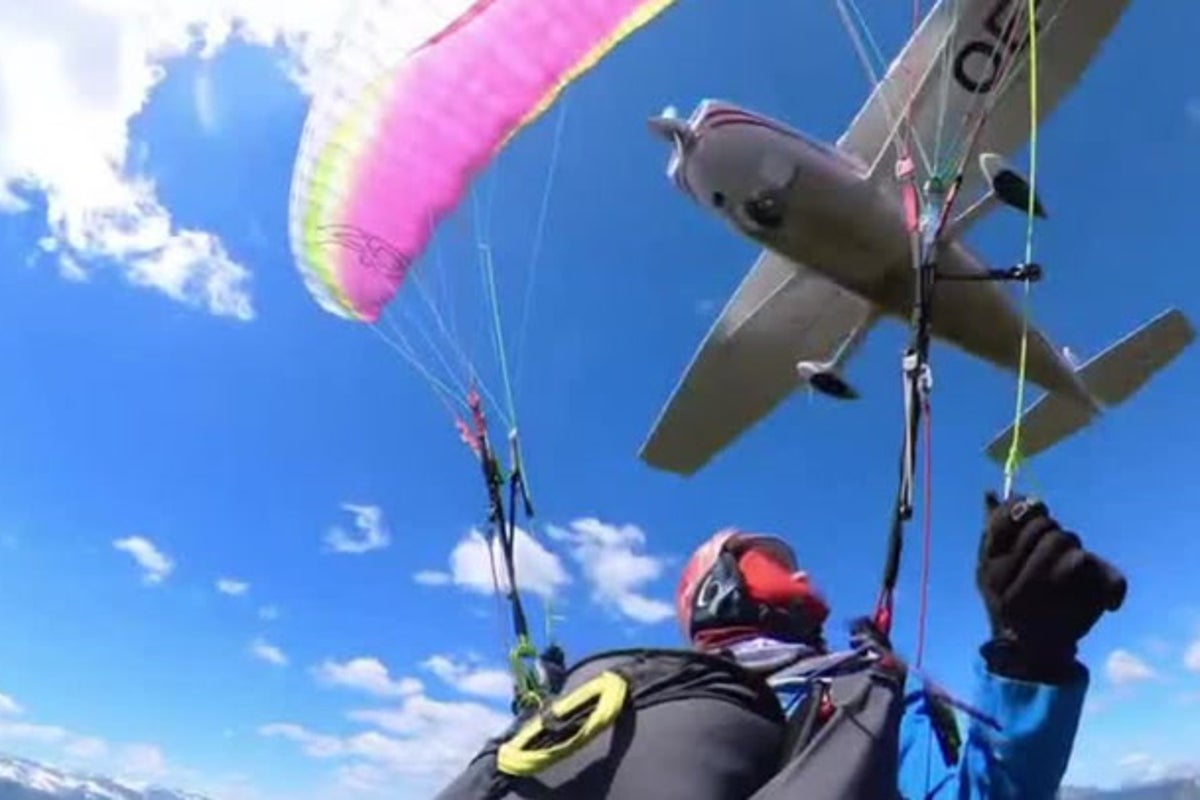
A mid-air collision between a non-powered paraglider and a powered aircraft represents a rare failure modes intersection within visual flight rules (VFR) airspace. When an Austrian paraglider survived a direct impact with a light aircraft, mainstream accounts treated the outcome as a statistical miracle. Relying on luck as an explanatory variable masks the underlying physics, structural dynamics, and airspace management frameworks that dictate survival probabilities in low-altitude airspace conflicts.
Understanding this event requires breaking down the encounter into three distinct operational domains: aerodynamic energy dissipation, visual acquisition geometry, and the regulatory limitations of shared airspace.
The Kinematic Decoupling of Low-Mass Civil Aviation Collisions
The survival of a paraglider pilot during a mid-air impact depends primarily on energy transfer. In standard aviation accidents involving two powered aircraft, the kinetic energy ($E_k = \frac{1}{2}mv^2$) of both bodies is massive, leading to catastrophic structural failure upon impact. When a light aircraft intersects with a paraglider, the collision dynamics alter due to the extreme asymmetry in mass and velocity.
[Aircraft: High Mass / High Velocity] ------>
                                              \ (Deflection / Energy Dissipation)
                                               v
                                      [Paraglider: Ultra-low Mass / Low Velocity]
This structural asymmetry introduces three distinct engineering variables:
- Mass Asymmetry and Momentum Transfer: A typical light aircraft (such as a Cessna 172 or a Piper PA-28) has a maximum takeoff weight between 1,000 and 1,150 kilograms and cruises between 100 and 130 knots. A fully loaded paraglider operates with a total launch weight between 90 and 110 kilograms, traveling at an airspeed of 20 to 25 knots. Because the aircraft possesses roughly ten times the mass and five times the velocity, the momentum vector of the aircraft dominates the interaction. The paraglider functions as a low-inertia obstacle, causing it to be accelerated away or deflected rather than absorbing the full force of a rigid-body impact.
- Structural Compliance vs. Rigid Destruction: A paraglider canopy is a non-rigid, air-filled textile structure held open by internal ram-air pressure and stabilized by high-tensile Kevlar or Dyneema lines. When a rigid object like an aircraft wing or propeller strikes a paraglider wing, the canopy deforms instantly. This compliance acts as a mechanical crumple zone, extending the duration of the impulse ($F \cdot \Delta t = \Delta p$). By lengthening the time of energy transfer ($\Delta t$), the peak impact force ($F$) experienced by the pilot decreases significantly.
- The Propeller Strike Variable: The highest risk factor in this specific collision geometry is the aircraft's propulsion unit. If the paraglider wing or suspension lines contact a spinning propeller, the textile components sever instantly, leading to immediate catastrophic deflation and a free-fall scenario. Survival indicates the point of contact occurred away from the propeller arc—most likely involving the aircraft's wingtip or landing gear—allowing the paraglider to slide off the aluminum or composite skin of the plane.
Visual Acquisition Failures in Shared VFR Airspace
The primary defense mechanism in Class G or E airspace is the "see-and-avoid" principle. The breakdown of this mechanism that leads to a mid-air collision is caused by a combination of human physiology and relative geometry.
The See-and-Avoid Blind Spot
Paragliders present an extremely small cross-sectional area when viewed directly from the front or rear. A paraglider pilot flying in a straight line presents a visual profile of less than two square meters to an oncoming aircraft.
This profile becomes even harder to see because of relative motion blindness. If two aircraft are on a collision course, their relative bearing remains constant. To both pilots, the other aircraft appears stationary in the windscreen, growing larger only in the final moments before impact. Human vision is highly sensitive to peripheral movement but struggles to detect small, stationary objects against a complex background, like the Austrian Alps.
Glint, Contrast, and Environmental Masking
The physical environment of mountain flight safety introduces severe visual noise.
High-Contrast Terrain (Alps) -> Camouflages Paraglider Canopy
Low Airspeed of Paraglider   -> Eliminates Relative Motion Clues
Cockpit Structure            -> Creates A-Pillar Blind Spots for Power Pilot
A paraglider canopy flying below the horizon line of an aircraft blends directly into the multicolored rock, vegetation, and shadow patterns of the terrain. Conversely, if the aircraft approaches from a higher altitude, the paraglider pilot's upward vision is entirely obstructed by their own canopy. This canopy creates a permanent 180-degree blind spot directly above the pilot's head.
The Airspace Paradox: Regulatory Limitations of Non-Transponder Aircraft
The coexistence of ultra-light sports aviation and general aviation highlights a major vulnerability in modern airspace management: the reliance on visual separation without digital coordination.
Electronic Conspicuity Gaps
Most commercial and standard general aviation aircraft rely on transponders (Mode S or ADS-B) to transmit altitude and position data to air traffic control and other aircraft fitted with Traffic Collision Avoidance Systems (TCAS). Paragliders, due to strict weight, power, and space limitations, rarely carry these transponders.
Instead, foot-launched aviation relies on localized, low-power electronic safety gear like FLARM or mobile-app-based tracking systems. These systems operate on different radio frequencies and protocols than commercial general aviation hardware. As a result, the light aircraft's onboard avionics cannot detect the paraglider, leaving the pilot without any electronic warnings prior to the visual sighting.
Priority Inversion in Mountainous Terrain
According to international aviation regulations (such as those set by EASA and the FAA), non-powered aircraft always have the right-of-way over powered aircraft. A paraglider has limited maneuvering options and cannot quickly climb or accelerate to avoid an oncoming plane.
However, this regulatory priority breaks down in mountain valleys. A light aircraft navigating a narrow valley may have limited space to turn due to terrain constraints, high density altitude, or wind shear. When both aircraft operate under these tight spatial limitations, the theoretical right-of-way matters less than the physical limits of each aircraft's turning radius.
Post-Collision Dynamics and Reserve Parachute Extraction Mechanics
Once a collision occurs, the survival of the paraglider pilot depends on their emergency equipment. When a paraglider wing collapses or suffers structural failure at low altitudes, the pilot must manually deploy a reserve parachute.
Collision Event -> Structural Failure of Canopy -> High-G Spiral Entry -> Manual Throw -> Inflation Line Tension -> Terminal Velocity Deceleration
This emergency deployment requires navigating three critical phases:
- Instability and High-G Rotational Forces: A damaged paraglider wing often enters a rapid, asymmetric spiral dive. This rotation subjects the pilot to high centrifugal forces, which can disorient them and make it difficult to reach the reserve deployment handle located on the harness.
- Deployment Height and Time Deficit: Standard emergency parachutes require a minimum of 30 to 50 meters of vertical drop to strip the deployment bag, extend the lines, and inflate completely. If the collision happens close to the ground, the time required for manual deployment may exceed the remaining flight time.
- Entanglement Dynamics: The primary risk during a mid-air collision deployment is entanglement with the aircraft or the damaged main paraglider canopy. If the reserve parachute gets caught in the structural debris of the plane or the twisted lines of the main wing, it cannot inflate fully, preventing it from slowing the pilot down to a survivable descent speed.
Systemic Safety Upgrades for Mixed-Use Airspace
Relying on luck to survive mid-air collisions is an unsustainable safety strategy for general aviation and air sports. Reducing the risk of these accidents requires structural changes in technology integration and airspace rules.
The first step is mandating dual-protocol electronic safety gear. Light aircraft should use ADS-B In systems that can receive low-power FLARM signals, which are widely used by gliders and paragliders. Software updates to existing cockpit displays can overlay these distinct data streams onto a single moving map, giving pilots a clear picture of nearby traffic regardless of the aircraft type.
The second step involves updating flight training protocols for both groups. Power pilots need specific training on where to expect paragliders, focusing on ridge-soaring areas and thermal hotspots along popular VFR routes. At the same time, paraglider pilots must learn to avoid high-traffic VFR arrival corridors and aviation choke points, like valley passes and low-altitude transit routes.
Finally, aviation authorities should establish dedicated air-sports boxes within high-risk mountain regions during peak flying seasons. This approach uses geographic separation rather than visual avoidance, lowering the risk of encounters between aircraft with vastly different speeds and sizes.