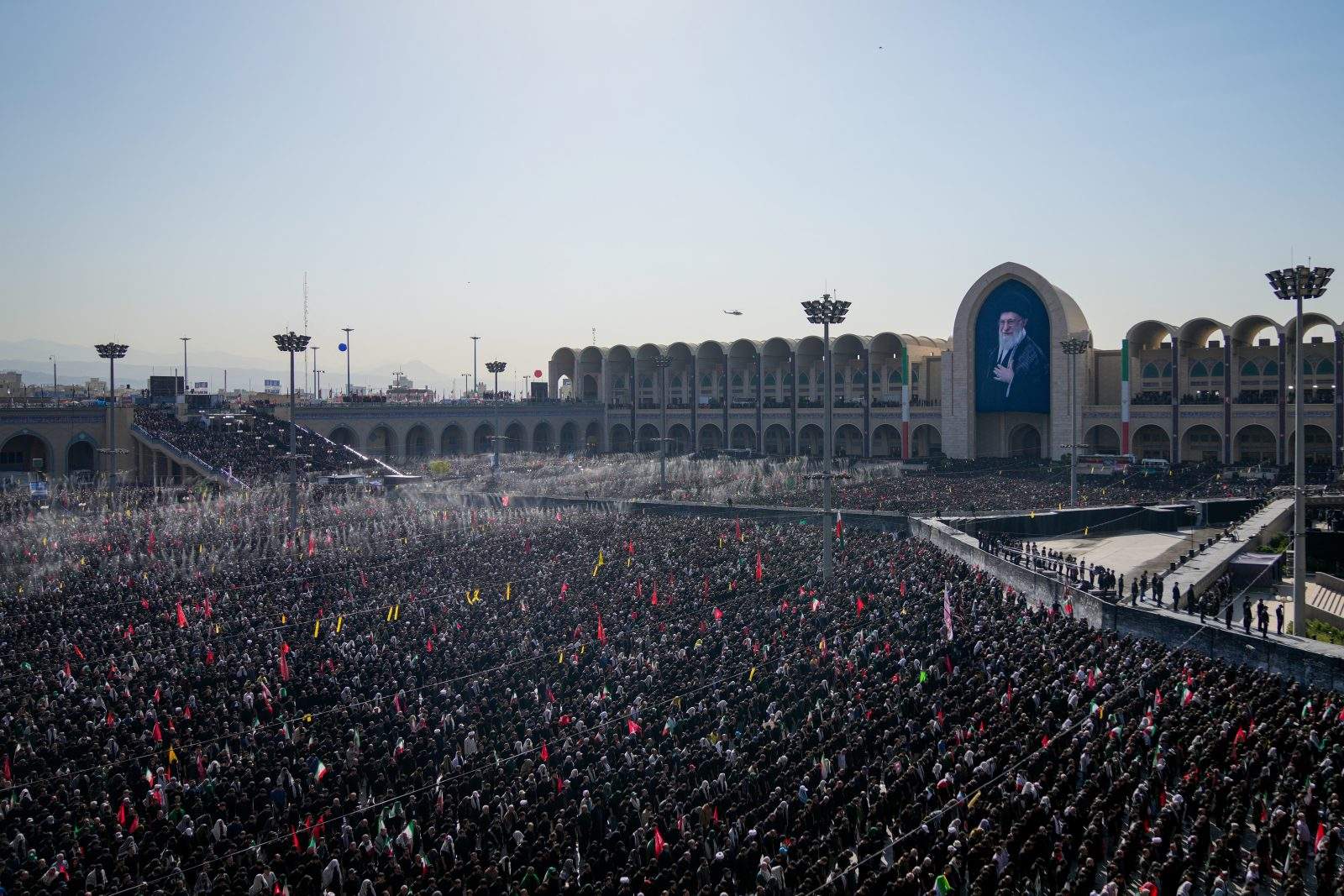
The death of a Supreme Leader in the Islamic Republic of Iran triggers a highly institutionalized yet fundamentally opaque succession mechanism that tests the equilibrium between the clerical establishment and the military apparatus. The public gathering of top officials for funerary rites is not merely a display of grief; it functions as a highly choreographed signaling mechanism designed to project internal continuity and deter external opportunism during a period of structural vulnerability. Understanding the trajectory of the state requires bypassing the symbolic rhetoric of state media and analyzing the concrete constitutional frameworks, factional alignments, and security vectors that dictate the transfer of absolute authority.
The Constitutional Framework and the Assembly of Experts
The formal architecture of succession is governed by Article 107 and Article 111 of the Constitution of the Islamic Republic of Iran. These provisions designate the Assembly of Experts—an elected body of 88 clerics specializing in Islamic jurisprudence—as the sole entity empowered to select the new Supreme Leader.
The operational timeline operates under strict constraints:
- Immediate Interim Council: Upon the vacancy of the leadership, a temporary council assumes presidential duties if necessary, while the Assembly of Experts is convened immediately. This council historically comprises the President, the Chief Justice, and one of the clerics from the Guardian Council.
- Qualifications Evaluation: The Assembly evaluates candidates based on the criteria outlined in Article 5 and Article 109, which demand high proficiency in Islamic jurisprudence (Ijtihad), political insight, justice, piety, and administrative capability.
- Voting Threshold: A candidate must secure a two-thirds majority of the Assembly of Experts to be confirmed as the next Rahbar (Supreme Leader).
This formal legal process masks an underlying informal selection matrix. The Assembly of Experts does not operate in a vacuum; its members are heavily vetted by the Guardian Council before election, ensuring that the candidate pool is pre-filtered to align with the core ideological tenets of the regime. The voting outcome is invariably determined by consensus reached within elite networks prior to the formal casting of ballots.
The Dual-Legitimacy Framework and Security Deterrence
The stability of the transition relies on balancing the dual sources of legitimacy inherent in the Iranian political system: the divine-clerical legitimacy (Velayat-e Faqih) and the revolutionary-security legitimacy. During the immediate post-transition window, the primary objective of the ruling elite is the minimization of perceived vulnerability.
The public assembly of military commanders, judiciary heads, and parliamentarians at the funeral serves a specific deterrence function. It signals to domestic dissident networks that the security apparatus remains unified and ready to enforce order. Simultaneously, it demonstrates to regional adversaries that state command-and-control structures are fully operational, preventing any miscalculation regarding the country's defense posture.
The strategic imperative during this phase is the containment of fractional friction. The regime utilizes state media to project an image of absolute unanimity, temporarily suppressing the deep-seated ideological and economic rivalries that exist between the pragmatic conservatives, the ultra-hardliners, and the technocratic factions.
The Role of the Islamic Revolutionary Guard Corps
While the Assembly of Experts holds the constitutional authority to elect the leader, the Islamic Revolutionary Guard Corps (IRGC) functions as the definitive veto actor in the succession process. The IRGC has evolved from a purely military force into a vast institutional conglomerate with deep penetration into the domestic economy, intelligence infrastructure, and foreign policy execution.
The IRGC evaluates potential successors through a strict matrix of institutional survival:
- Ideological Continuity: The candidate must maintain a hardline stance against Western integration and preserve the foundational anti-imperialist doctrine of the revolution.
- Economic Protectionism: The new leader must protect the extensive financial interests of the IRGC, including its control over major construction, energy, and telecommunications firms through conglomerates like Khatam al-Anbiya.
- Regional Strategic Alignment: The successor must remain committed to supporting the Axis of Resistance, ensuring the uninterrupted flow of logistical and financial aid to regional proxies.
A candidate who lacks the explicit backing of the IRGC command structure cannot realistically sustain power, regardless of their clerical credentials. The relationship is symbiotic; the new Supreme Leader requires the coercive power of the IRGC to secure domestic compliance, while the IRGC requires the religious legitimacy of the Supreme Leader to justify its extra-constitutional influence.
Economic Security and Market Stabilization Vectors
A transition of this magnitude introduces immediate shocks to the domestic economy, which is already constrained by international sanctions and structural inefficiencies. The state must deploy specific economic containment protocols to prevent capital flight and currency devaluation.
The Central Bank of Iran and affiliated financial institutions typically intervene in the open market to stabilize the Iranian Rial against major foreign currencies. The government frequently enforces strict capital controls, limiting large-scale foreign currency withdrawals and monitoring cross-border financial transactions to mitigate capital flight. State-backed investment funds inject liquidity into the Tehran Stock Exchange to project an artificial sense of market confidence and prevent panic selling by domestic investors.
The long-term economic outlook depends on the new leader's stance on economic reform. If the incoming administration favors privatization and a reduction of the IRGC's economic monopoly, it could spark internal friction. Conversely, if the new leadership doubles down on the "Resistance Economy" model, it will likely entrench the existing economic stagnation while preserving the financial privileges of the ruling elite.
Geopolitical Implications and Foreign Policy Trajectories
The selection of the next Supreme Leader establishes the baseline for Iran's foreign policy for decades. Western analysts frequently mischaracterize the potential outcomes as a choice between moderation and radicalization. In reality, the structural constraints of the Iranian state limit the scope of foreign policy divergence.
The strategic posture regarding the nuclear program is highly institutionalized. The decision to advance uranium enrichment or re-engage in diplomatic negotiations is determined by the Supreme National Security Council, subject to the final approval of the Supreme Leader. A new leader may alter the tactical execution of diplomacy but is highly unlikely to abandon the strategic deterrence capability that the nuclear program represents.
Regional policies will maintain their current trajectory due to the institutional autonomy of the IRGC's Quds Force. The networks established across Iraq, Syria, Lebanon, and Yemen operate on long-term strategic blueprints that survive individual leadership transitions. The primary variable will be the degree of direct oversight the new Supreme Leader chooses to exercise over these external operations.
Strategic Forecast for the Transition Period
The transition process will follow a predictable operational sequence designed to maximize regime survival. The Assembly of Experts will likely announce the new Supreme Leader within a compressed timeframe, potentially within 48 to 72 hours of the official announcement of the vacancy, to prevent the formation of alternative power centers.
The chosen successor will almost certainly be a figure who represents a compromise between the senior clerical establishment in Qom and the high command of the IRGC. This individual will likely possess sufficient ideological credentials to satisfy the traditional conservative base, combined with a demonstrated history of cooperation with the security services.
The immediate aftermath of the announcement will be marked by an intensification of domestic security measures, including increased digital surveillance, internet throttling, and heightened security presence in major urban centers. These steps are designed to preemptively neutralize any attempts by civil society groups or opposition factions to exploit the transitional window for political mobilization.