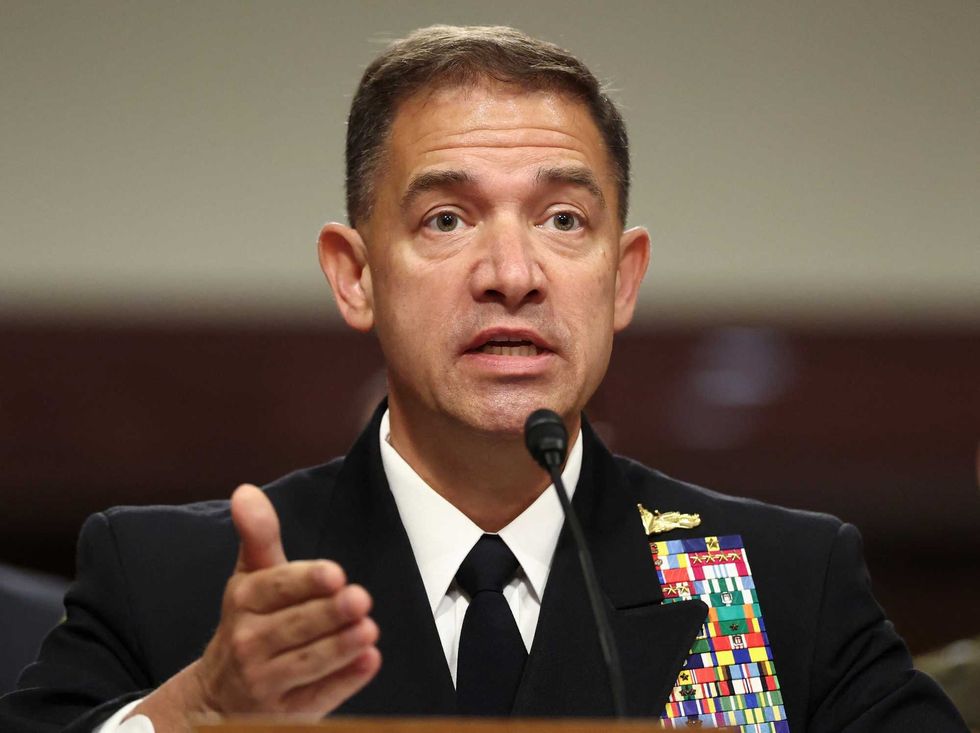
The friction between operational command and intelligence synthesis creates a systematic failure point in national security architecture. When General Michael Kurilla, Commander of U.S. Central Command (CENTCOM), provided sworn testimony regarding Iran’s nuclear weaponization status and regional trajectory, he utilized a strategic lens that diverged sharply from the consensus established by the U.S. Intelligence Community (IC). This divergence is not merely a difference of opinion; it is a structural byproduct of how different agencies define "intent," "capability," and "red lines." Understanding this gap requires deconstructing the intelligence cycle against the requirements of theater-level combatant commands.
The Taxonomy of Intelligence Divergence
The conflict centers on whether Iran has "resumed" its nuclear weapons program. To analyze this, we must categorize the disagreement into three distinct layers of data interpretation: Don't forget to check out our recent coverage on this related article.
- The Threshold Definition: The IC distinguishes between "nuclear activities" (enrichment, research) and "weaponization" (designing a warhead, mating it to a delivery vehicle). Operational commanders often view these as a continuous spectrum, whereas analysts view them as discrete, trigger-based phases.
- The Intent Gap: Intelligence agencies rely on covert signaling and intercepted communications to determine if a political decision has been made. Commanders prioritize "capabilities-based planning," assuming that if the technical means exist, the intent will follow or is already implicit.
- Signal vs. Noise in Proxy Networks: There is a fundamental disagreement on the degree of Iranian "command and control" over the "Axis of Resistance." Where analysts see local autonomy among groups like the Houthis or Kata'ib Hezbollah, commanders often see a monolithic hierarchy directed from Tehran.
The Logic of the Intelligence Community Consensus
The Office of the Director of National Intelligence (ODNI) maintains a high-confidence assessment that Iran is not currently undertaking the key nuclear weapons-development activities necessary to produce a testable nuclear device. This position rests on a rigorous monitoring framework of the Iranian "Nuclear Hedging" strategy.
The Hedging Cost Function
Iran operates on a cost-function logic. By increasing uranium enrichment to 60% purity, they reduce the "breakout time" (the time required to produce enough weapons-grade material for one bomb) to approximately one to two weeks. However, staying at 60%—just below the 90% weapons-grade threshold—serves as a geopolitical lever. If you want more about the background here, USA Today offers an in-depth breakdown.
The IC's data suggests that the "Final Decision Variable"—the supreme leader's directive to weaponize—has not been toggled. Their evidence includes:
- IAEA Safeguards Data: Continued monitoring of declared sites, though restricted, provides a baseline of material flow that hasn't shifted toward a dedicated military program.
- Atmospheric Signaling: Lack of detected high-explosive testing or miniaturization research at known sensitive sites like Parchin.
- Financial Allocation: The Iranian budget prioritizes regional proxy stabilization and internal security over the massive capital expenditure required for a secret, crash-program weaponization phase.
The Commander’s Divergence: Operational Realism vs. Analytical Precision
General Kurilla’s testimony suggested a more imminent threat, implying that Iran’s activities have progressed beyond the "frozen" state described by the IC. This perspective is shaped by the Theater Risk Assessment Model.
A combatant commander (COCOM) is responsible for the lives of thousands of troops in the line of fire. Their tolerance for "analytical ambiguity" is lower than that of an analyst in Langley. For CENTCOM, the distinction between a 60% enriched stockpile and a 90% stockpile is a tactical technicality when the delivery systems (ballistic missiles) are already flight-tested and deployed.
The Proxy Integration Variable
A critical point of failure in the public discourse surrounding this testimony is the mischaracterization of Iranian influence. The IC views the relationship between Iran and its proxies as a Franchise Model:
- Tehran provides the brand, the supply chain, and the training.
- Local actors (the "franchisees") make tactical decisions based on local market conditions (Lebanese politics, Yemeni tribal dynamics).
In contrast, the strategic command often views it as a Direct Subsidiary Model. If a Houthi missile strikes a commercial vessel, the commander sees the Iranian components and concludes "Iranian action." This leads to a higher threat assessment because it attributes every regional escalation directly to Tehran’s central planning, even if intelligence suggests a lack of specific prior knowledge by the IRGC-QF (Islamic Revolutionary Guard Corps-Quds Force).
Structural Bottlenecks in Assessment Verification
The debate over "debunking" testimony highlights three bottlenecks in the U.S. national security apparatus that prevent a unified view of Iran.
1. The Information Silo Effect
Technical intelligence (TECHINT) and signals intelligence (SIGINT) often reside within the IC. While commanders receive "finished intelligence" products, they may not always be privy to the raw nuance of the sourcing. If a commander sees an increase in Iranian drone shipments to Russia or regional proxies, they logically extrapolate a heightened state of aggression that may not yet be reflected in the formal "National Intelligence Estimate" (NIE), which moves at a slower, more deliberate pace.
2. The Definition of "Nuclear Program"
The term "Nuclear Program" is used loosely in congressional testimony. For the IC, the program is a set of specific technical tasks. For a commander, the program is the entirety of the state's power projection. This semantic slippage leads to headlines claiming testimony has been "debunked" when, in reality, the two parties are measuring different variables.
- IC Metric: Progress on the $S_w$ (Weaponization) variable.
- CENTCOM Metric: The sum of $E$ (Enrichment) + $M$ (Missile Delivery) + $P$ (Proxy Aggression).
3. Verification Gaps
The degradation of the Joint Comprehensive Plan of Action (JCPOA) monitoring creates a "blind spot" risk. When the IC says they have "no evidence" of weaponization, a rigorous analyst must ask if that is "evidence of absence" or "absence of evidence." The commander’s testimony often errs on the side of "absence of evidence," assuming the worst-case scenario to ensure force protection.
The Cost of Analytical Dissonance
When the public and policymakers receive conflicting reports from the "spies" (IC) and the "soldiers" (COCOMs), it creates a strategic vacuum. This vacuum is typically filled by political narratives rather than data-driven policy.
The primary risk is the Preemption Feedback Loop. If a commander acts on a "capabilities-based" threat assessment that the IC insists is not backed by "intent-based" data, the U.S. might take kinetic action that inadvertently triggers the very Iranian decision to weaponize that the IC was tracking.
Conversely, if the IC maintains a "no weaponization" stance while Iran achieves a "silent breakout"—using decentralized, small-scale facilities—the commander is left with a theater of operations where the deterrent threshold has been crossed without a corresponding shift in U.S. posture.
Strategic Forecast: The Shift Toward Ambiguous Escalation
The delta between General Kurilla’s testimony and IC assessments indicates that we are entering a period of "High-Threshold Ambiguity." Iran has likely calculated that the cost of actual weaponization (global sanctions, potential Israeli/U.S. strikes) outweighs the benefits, provided they can maintain a credible "turnkey" capability.
In this environment, expect the following technical and strategic shifts:
- Incremental Enrichment Normalization: Iran will continue to normalize 60% enrichment, treating it as a standard civilian benchmark to desensitize the international community.
- Dual-Use Sophistication: Accelerated development of satellite launch vehicles (SLV), which provide the "cover" for Intercontinental Ballistic Missile (ICBM) heat-shield and staging technology without technically being a "weapons program."
- Command Disconnect as Deterrence: Iran may intentionally foster the perception of proxy autonomy to provide Tehran with "plausible deniability" while simultaneously signaling to U.S. commanders that they can trigger regional chaos at will.
The strategic play for the U.S. is not to determine who is "right" between the IC and CENTCOM, but to integrate these two views into a Dual-Track Response Framework. This requires treating the IC’s "No Weaponization" finding as a diplomatic window, while simultaneously treating the Commander’s "Aggression" assessment as the operational reality for force posture. Failing to bridge this gap leads to a "Schrödinger’s Threat"—a nuclear program that is simultaneously dormant and imminent, depending entirely on which briefing the policymaker attends.
The immediate requirement is a synchronized audit of the "Transition Indicators." These are the specific, observable actions—such as the diversion of UF6 gas to clandestine facilities or the testing of non-nuclear triggers—that would reconcile the IC's caution with the Commander's urgency. Until those indicators are standardized across the civilian-military divide, the risk of miscalculation remains the highest variable in the Middle East theater.