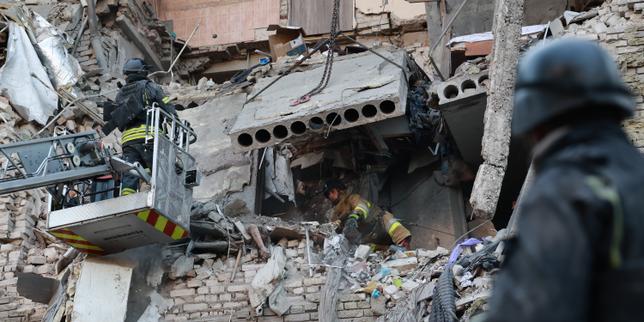
The Structural Shift in Aerial Campaigning
A single quantitative threshold reveals the current trajectory of the aerial campaign over Ukraine: the documented deployment of more than 8,300 guided glide bombs within a single thirty-day period. Kyiv officials registered this peak metric in July, exposing a fundamental transformation in force application. Tactical aviation no longer operates exclusively in contested airspace for direct close air support; instead, it projects mass munitions from stand-off ranges. This evolution alters the operational calculus for air defense systems, logistical distribution nodes, and structural fortification integrity across the front line.
Evaluating this development requires moving past nominal tallies to dissect the underlying variables. The surge in guided munitions utilization is not a random statistical spike. It represents the convergence of industrial adaptation, munitions conversion technology, and an explicit tactical doctrine aimed at attriting fortified defensive lines through sustained volumetric pressure. If you enjoyed this article, you might want to read: this related article.
The Industrial and Technological Mechanics
Three distinct components drive the current scale of deployment. Understanding how these elements interact explains why traditional intercept methodologies face diminishing returns.
The Conversion Economy
Building precision-guided munitions from scratch demands complex supply chains, microelectronics access, and long production timelines. The current campaign relies heavily on retrofit kits attached to unguided legacy stockpiles. Universal modules for gliding and correction transform standard high-explosive aerial bombs into precision-guided weapons with extended glide ranges. For another look on this event, see the recent coverage from NPR.
The economic efficiency of this approach alters resource allocation. Air forces can expend high volumes of ordnance without depleting restricted inventories of sophisticated cruise or ballistic missiles. The cost per unit remains a fraction of traditional precision weaponry, while the destructive output against static infrastructure scales linearly with production speed.
Stand-Off Delivery and Kinetic Risk Mitigation
Airborne platforms face prohibitive threat environments near contested frontlines due to medium and long-range surface-to-air missile systems. To mitigate this risk, tactical bombers release glide munitions from distances well beyond the engagement envelope of short and medium-range mobile air defense assets.
This delivery method shifts the operational risk equation. Aircraft remain within friendly airspace or over occupied territory, releasing munitions that use inertial navigation systems and satellite guidance to hit coordinates miles away. The tactical trade-off involves altitude and velocity at launch, which directly dictates the glide range and final impact energy of the weapon.
Volumetric Saturated Targeting
When munition volume exceeds a certain threshold, the objective shifts from targeting individual assets to systemic exhaustion. Dropping over 8,300 guided bombs monthly means an average density exceeding two hundred strikes daily across concentrated sector axes.
Defensive engineering relies on reinforced concrete, subterranean bunkers, and dispersal patterns. Heavy glide bombs equipped with warheads scaling from two hundred and fifty to fifteen hundred kilograms generate structural collapse through sheer kinetic and explosive energy transfer, bypassing even robust field fortifications through structural fatigue.
The Operational Cost Function and Defensive Bottlenecks
Defending against high-volume glide bomb deployments exposes fundamental resource asymmetries. Intercepting a converted glide bomb requires expending surface-to-air interceptors that are often exponentially more expensive than the incoming threat.
The Interceptor Cost Asymmetry
Air defense economics dictate that defenders cannot sustainably expend high-tier interceptors against mass-produced tactical glide weapons. When the attacker's marginal cost of deployment decreases via retrofitted legacy munitions, the defender's marginal cost of mitigation rises. This creates a severe economic squeeze on defensive missile stocks.
Reaction Time Constraints
Because glide bombs are unpowered after release, their radar signatures and flight profiles differ from ballistic or cruise missiles. Their low radar cross-section during the terminal glide phase, combined with short flight times from launch points near the front, compresses the decision-making cycle for tactical air defense operators. Traditional radar warning networks struggle to cue mobile anti-aircraft artillery or electronic warfare assets rapidly enough to disrupt incoming trajectories.
Infrastructure Degradation Curves
The cumulative effect of sustained glide bomb usage manifests as non-linear degradation of logistics hubs, bridges, and command nodes. Unlike artillery strikes, which dissipate over wide areas without precise correction, heavy guided munitions ensure high-probability hits on structural joints and foundational supports. Once a threshold of cumulative strikes is reached on a logistics node, the facility's throughput capacity drops to zero, forcing immediate supply chain rerouting.
Strategic Adaptation Pathways
Mitigating the tactical impact of high-volume guided munitions requires addressing the kill chain at its origin rather than relying solely on terminal interception.
Denying the launch platform is the primary mechanism for disrupting this operational model. This requires pushing air defense capabilities forward to threaten the delivery aircraft, or utilizing long-range precision strikes against forward-deployed tactical airbases where bombers rearm and refuel.
Concurrently, electronic warfare integration must focus on signal degradation for satellite-guided navigation packages. While inertial backup systems mitigate total disruption, introducing cumulative drift over extended glide paths degrades terminal accuracy, reducing the efficacy of mass volumetric strikes against pinpoint targets.
Prioritize the decentralization of logistics nodes and command architecture. Hardening static sites yields diminishing returns under a regime of multi-ton explosive deployment; therefore, operational resilience depends entirely on mobility, dispersion, and rapid reconstitution capabilities rather than stationary fortification.


