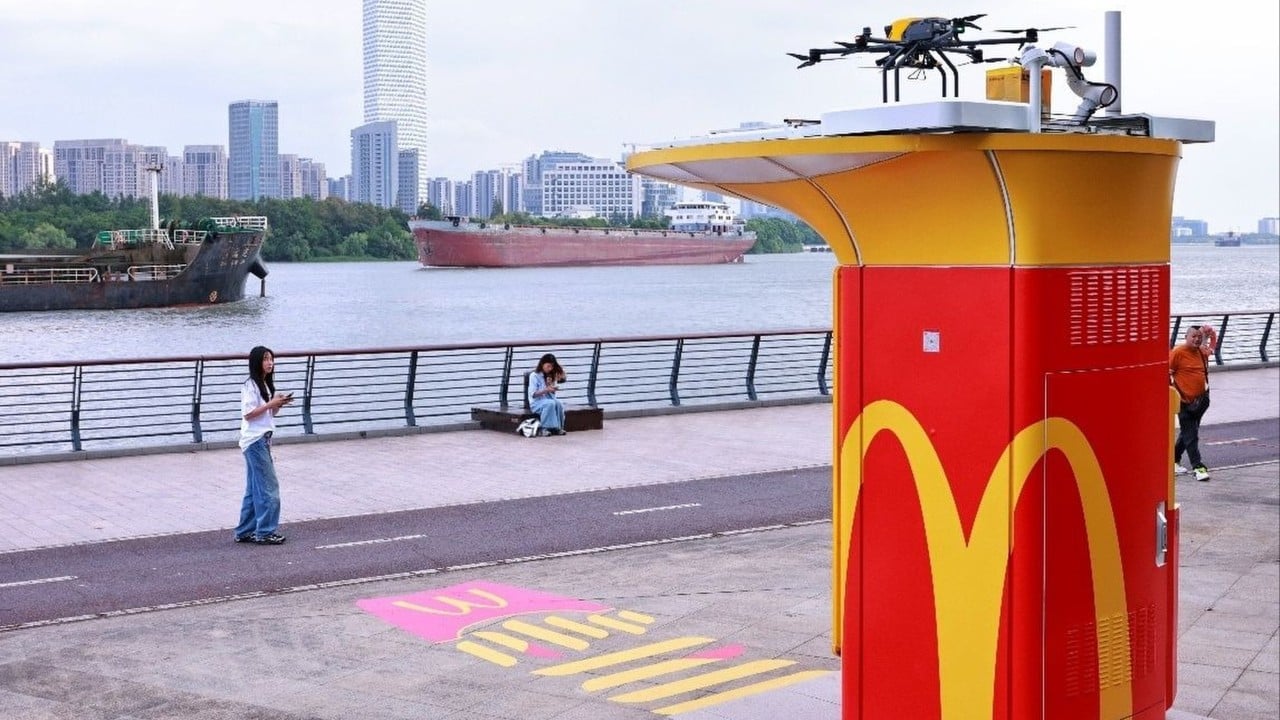
Every tech blog and financial analyst on the planet is currently swooning over the latest corporate press release out of Shanghai. McDonald’s and Meituan teamed up to launch a commercial drone delivery route, dropping lukewarm fries and Big Macs onto rooftop landing pads and designated drop-off lockers. The headlines write themselves. The future of fast food has arrived. Autonomous quadcopters buzzing through the concrete canyons of a mega-city, bringing grease straight to your balcony.
It is a masterclass in corporate theater. And it is completely, fundamentally economically illiterate.
I have spent the better part of two decades watching companies burn venture capital and public equity on shiny toys designed to distract investors from rotting balance sheets. Every few years, Silicon Valley and its international imitators wheel out some high-profile logistics stunt, wrap it in utopian rhetoric about efficiency, and watch the stock price tick upward. First it was delivery robots that got stuck in snowdrifts and kicked by pedestrians. Then it was autonomous cars that required remote human drivers in office parks in India to steer them around traffic cones. Now, we have multibillion-dollar restaurant chains strapping a McDonald's paper bag to a motorized blender and pretending they have solved the urban last mile.
Let us dismantle the polite fiction. Drone delivery of fast food is not a revolutionary leap forward in urban logistics. It is an expensive, fragile, energy-inefficient marketing stunt wrapped in regulatory exemptions, acoustic pollution, and physics-defying unit economics that will never pencil out at scale.
If you want to understand why your Big Mac will never arrive via quadcopter on a Tuesday afternoon, you have to stop reading PR copy and start looking at the cold, hard math of weight, power, and human behavior.
The Unit Economics Delusion
The foundational lie of drone delivery is that automation eliminates labor costs. Proponents look at a delivery driver demanding a living wage, hazard pay, and fuel reimbursement, and they contrast it with a battery-powered robot that allegedly requires no sleep, no health insurance, and no tips.
What they leave out of the ledger is the catastrophic capital expenditure and maintenance overhead of aviation hardware operating in hostile urban environments.
Consider the typical McDonald’s order. It is cheap. In China, a standard value meal runs around thirty to forty yuan, roughly four to six dollars. The profit margin on that transaction for the franchisee is razor thin, measured in single-digit percentages. Now, attach that meal to a commercial-grade delivery drone.
A high-payload commercial delivery drone capable of navigating urban wind shear, carrying a hot meal, and maintaining food safety standards is not a cheap piece of consumer electronics. We are talking about hardware that costs thousands of dollars upfront, requires specialized telemetry systems, redundant GPS modules, automated landing guidance, and secure payload release mechanisms.
More importantly, aviation hardware breaks down. Propellers get nicked by airborne debris. Motors burn out under continuous thermal stress. Batteries degrade rapidly when subjected to high-amp discharge rates required for vertical takeoff and landing with heavy loads. Every single flight hour accumulates wear and tear that requires certified technician intervention.
When a human delivery rider’s scooter breaks down, they push it to a curb, fix the chain, or rent another e-bike for fifty yuan. When a delivery drone experiences a motor controller failure over a high-density commercial district in Shanghai, it does not pull over to the side of the road. It falls out of the sky. The recovery, insurance, and liability costs of a single mid-air malfunction wipe out the profit margins of ten thousand hamburgers.
Physics Does Not Care About Your Press Release
There is an immutable law of aerodynamics that urban tech utopians consistently choose to ignore: the energy cost of vertical lift.
An electric delivery scooter rolls on rubber tires over asphalt. It overcomes rolling resistance and aerodynamic drag, both of which scale favorably relative to vehicle weight. A drone, by contrast, must continuously fight gravity by displacing vast amounts of air downward. Every gram of additional payload requires exponentially more thrust, which demands exponentially more electrical current, which rapidly drains the battery.
This creates the payload paradox of fast food. A McDonald’s order is not just a burger; it is a thermal cardboard box, a plastic cup of soda, dipping sauces, and french fries that begin losing their structural integrity the moment they leave the fryer. To keep that food hot and secure, you need insulated payload containers mounted underneath or inside the drone.
Every extra ounce of insulation and structural housing steals valuable battery capacity. The range of these urban drones is severely constrained, typically measured in single-digit kilometers from the dark kitchen or fulfillment hub. You cannot fly a drone from a suburban distribution center into the heart of Shanghai. You have to place expensive, high-rent launch hubs dotted all over the densest, most expensive real estate in the world.
When you calculate the total cost of land acquisition for urban launch pads, battery charging infrastructure, power management systems, and constant hardware maintenance, the cost per calorie delivered through the air is astronomical compared to an underpaid human on an electric scooter weaving through traffic.
The Weather Wall
Shanghai is not a climate-controlled wind tunnel. It experiences typhoons, heavy seasonal downpours, high humidity, dense fog, and severe urban wind turbulence generated by skyscrapers creating wind-tunnel effects at street level.
Proponents of drone delivery love to show promotional videos filmed on crisp, sunny autumn afternoons with gentle breezes. They never show what happens at three o'clock on a Tuesday in July when a torrential tropical storm hits the Pudong district.
Commercial multirotor drones have strict operational limits regarding crosswinds, precipitation, and icing conditions. The moment wind speeds exceed twenty knots or heavy rain threatens water ingress into sensitive flight controllers, the entire fleet is grounded.
What happens to the business model when your delivery infrastructure operates at one hundred percent capacity on clear days and zero percent capacity thirty percent of the year? Fixed capital costs do not take a vacation when it rains. The real estate leases on the launch pads remain due. The depreciation on the idle drones continues. The engineering staff must still be paid.
A delivery network that is weather-dependent is not a utility; it is a novelty. Consumers do not want an app that tells them, "Sorry, your lunch is grounded because of a passing cloud front, please use a human driver instead." If you have to maintain a shadow human delivery network anyway to handle foul weather, peak dinner rushes, and heavy family-sized orders, then the drone fleet is not replacing labor. It is an expensive, redundant luxury toy bolted on top of an existing, functioning delivery stack.
The Acoustic Nightmare
Let us talk about the sound.
Tech executives who champion urban drone delivery live in low-density suburban enclaves or gated corporate campuses where the ambient noise floor is already high. They imagine a gentle, unobtrusive buzzing, like a bumblebee visiting a flower.
They have never stood under a swarm of heavy commercial quadcopters operating at scale in a high-density residential neighborhood.
Multiple propellers spinning at thousands of RPM create a high-frequency, directional whining sound that cuts straight through double-pane glass. Multiply that by hundreds of flights a day servicing fast-food orders across a sprawling metropolis like Shanghai. It is an acoustic nightmare.
Cities are already loud. Adding thousands of autonomous lawnmowers buzzing through the sky above residential apartment balconies will trigger an immediate, furious public backlash. Urban residents tolerate delivery scooters because they are part of the existing street infrastructure, constrained by roads and traffic laws. They will not tolerate private corporate drones invading their visual and acoustic airspace twenty-four hours a day to drop off a side of McNuggets.
Noise pollution ordinances will choke urban drone delivery long before technological limitations do. Municipal governments facing citizen revolts over noise will restrict flight corridors, limit operating hours, and impose draconian zoning rules that render continuous commercial operations financially impossible.
Regulatory Purgatory and Liability Traps
In aviation, safety is bought with redundancy, certification, and control. When commercial airlines fly, every single component is meticulously tracked, inspected, and certified by international aviation authorities.
The regulatory framework governing low-altitude urban airspace is currently in a state of chaotic transition. In China, low-altitude airspace management is heavily restricted and tightly controlled by civil aviation authorities and military oversight. Every commercial drone route requires explicit clearance, geo-fenced flight paths, and real-time telemetry tracking.
The Meituan and McDonald's partnership is operating inside tightly curated, heavily sanitized pilot zones where regulatory friction has been temporarily smoothed over by municipal governments eager to showcase high-tech innovation for political optics.
Scale that model across ten thousand neighborhoods without government-managed corridors, and you enter a legal labyrinth. Who is liable when a delivery drone loses GPS lock due to urban canyon interference, drifts off course, and smashes into the windshield of a moving vehicle on an elevated highway? Who pays when a poorly secured french fry box detaches from three hundred feet up and impacts a pedestrian on a crowded sidewalk?
Insurance underwriters look at low-altitude autonomous urban delivery and see a liability nightmare. The premiums required to insure a fleet of autonomous flying delivery robots against third-party property damage, personal injury, and catastrophic aviation failure in a densely populated urban core will make the operating margins look like a mathematical error.
The Real Agenda
So why are McDonald's and Meituan doing this?
Follow the money. Neither company believes that drones are going to replace traditional delivery riders as the primary mechanism for moving food across Shanghai. The total addressable market of food delivery volume is simply too massive, too cheap, and too flexible for quadcopters to ever make a dent in the core unit volume.
This is a marketing play disguised as an operations strategy.
For Meituan, it positions them as a cutting-edge technology platform rather than a logistics employer grappling with labor rights and unionization pressures for millions of delivery workers. Highlighting autonomous delivery shifts the narrative away from human labor costs and regulatory scrutiny over worker welfare.
For McDonald's, it is headline bait. In a hyper-saturated fast-food market where product differentiation is nearly zero, generating global press coverage about flying burgers is infinitely cheaper and more effective than traditional advertising. It captures the imagination of tech-obsessed consumers and reassures equity markets that the brand is forward-thinking.
It is a public relations stunt designed to inflate valuations and distract from the brutal, unglamorous reality of margin compression, inflation, and labor overhead.
Stop Falling for Sky-High Fairy Tales
The next time you see a promotional video of a drone neatly placing a paper bag onto a rooftop landing pad, remember what is happening off-camera.
Remember the massive venture capital incinerators, the weather groundings, the battery degradation curves, the acoustic pollution lawsuits, and the army of technicians required to keep three fragile quadcopters in the air while ten thousand human riders on electric scooters quietly deliver millions of meals right to apartment doors without dropping a single french fry.
The future of fast food delivery is not flying through the clouds. It is rolling on rubber wheels, navigating congested streets, and relying on human adaptability to solve the messy, unpredictable realities of urban life.
Ignore the hype. Keep your feet on the ground. And if you see a drone hovering over your balcony with a bag of lukewarm burgers, duck. It is probably out of battery anyway.