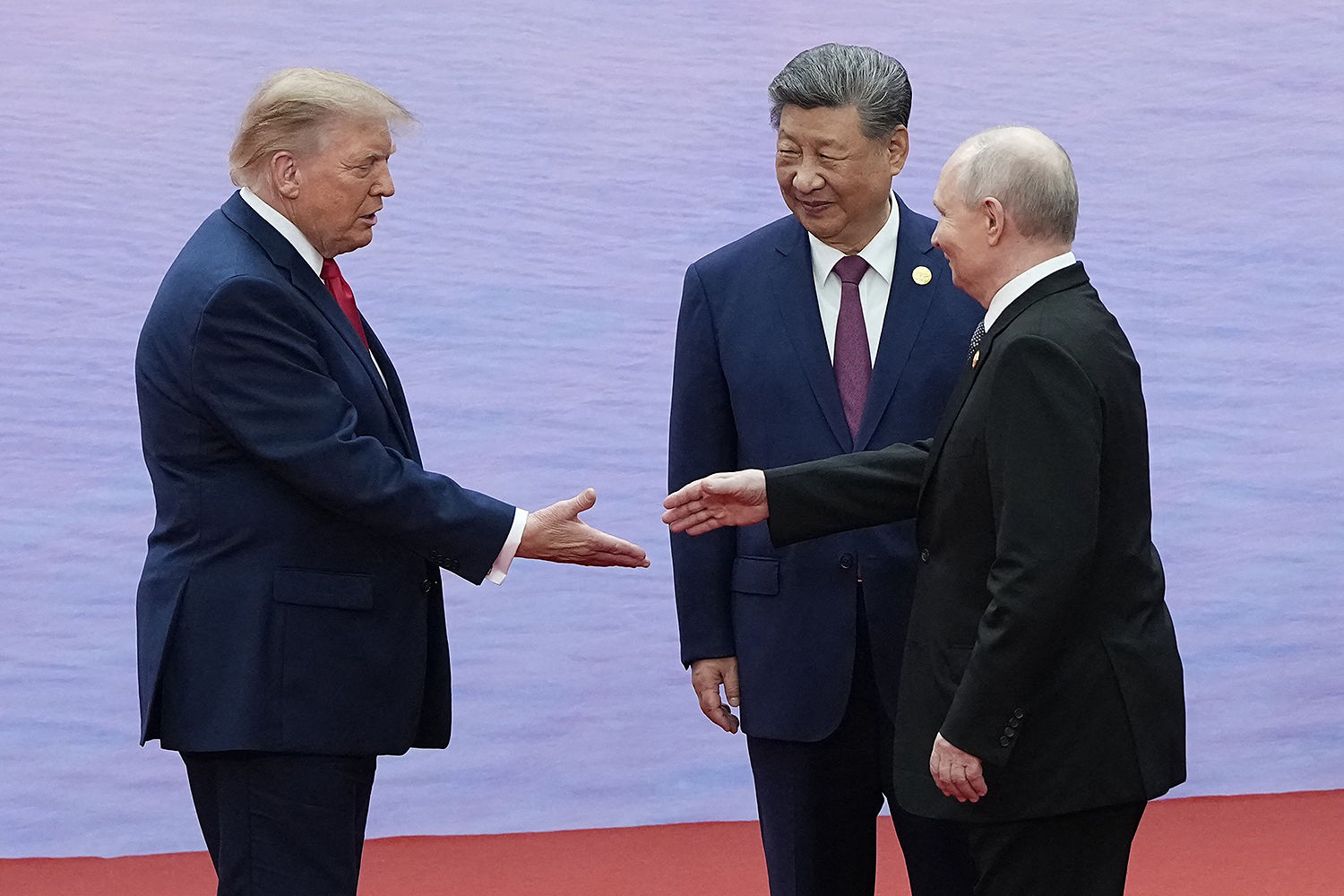
Donald Trump’s push for a three-way nuclear arms control treaty with Russia and China is stalled before negotiations can even begin because the math of global deterrence makes a trilateral cap impossible right now. Following the November 19, 2026 summit in Shenzhen—where Trump, Vladimir Putin, and Xi Jinping signed a vague "Declaration toward Peace" after the February expiration of New START—Beijing and Moscow have zero incentive to lock in limits. China refuses to freeze an arsenal of roughly 620 warheads against two rivals holding thousands, while Russia refuses to negotiate without counting British and French weapons or addressing American missile defenses.
The diplomatic theater in southern China looked historic on television. For the first time, the leaders of the three superpowers sat in the same room at Kylin Villa to discuss strategic stability. Yet the joint communiqué they produced contained no warhead ceilings, no verification protocols, and no timelines. It merely repeated the 1985 Reagan-Gorbachev truism that a nuclear war cannot be won and must never be fought. Beneath that polite phrasing lies a structural deadlock that has defeated two successive American administrations and left the world without a single legally binding nuclear arms treaty for the first time in over half a century.
The Asymmetry Trap in Beijing
To understand why Xi Jinping smiles through trilateral photo opportunities while his diplomats block actual treaties, look at the raw inventory numbers. According to 2026 estimates from the Stockholm International Peace Research Institute, Russia holds roughly 4,400 warheads in its military stockpile and the United States holds approximately 3,700. China sits at an estimated 620.
In Washington, defense planners view China’s rapid construction of hundreds of new missile silos in Gansu and Xinjiang—and Pentagon projections that Beijing could cross 1,000 warheads by 2030—as an urgent threat requiring immediate containment. In Beijing, those exact same numbers tell a completely different story.
China spent four decades maintaining a "minimum deterrence" posture, keeping a small force designed only to survive a first strike and retaliate against a handful of cities. That strategy worked when American missile defense was primitive and U.S.-China tensions were manageable. It no longer works for Xi. Chinese strategists worry that advanced U.S. intelligence, precision conventional strikes, and ballistic missile interceptors could neutralize a small retaliatory force in a crisis over Taiwan. Beijing is not racing to match American numbers; it is racing to build a survivable second-strike capability that Washington cannot disarm.
Asking China to join a three-way nuclear deal right now is asking Beijing to codify permanent military inferiority. Chinese Foreign Ministry officials have stated plainly that joining negotiations while their arsenal is a fraction of the American and Russian stockpiles is neither reasonable nor realistic. Until the United States and Russia cut their own forces down to Chinese levels—something Trump admitted in a White House briefing is "very hard" to imagine doing—Beijing will keep pouring concrete in its western deserts.
The Verification Bottleneck
Even if Xi agreed in principle to a cap, verifying a Chinese nuclear limit would require dismantling decades of operational secrecy. For China, opacity is a weapon. Because Beijing has fewer missiles than Washington, hiding where those mobile launchers are located—and whether a given silo holds a real missile or a decoy—is how China prevents an adversary from targeting them.
Traditional arms control treaties like New START relied on intrusive on-site inspections, biannual data exchanges, and bans on concealing missile telemetry. Submitting to American inspectors walking through People's Liberation Army Rocket Force bases would strip away the very ambiguity that protects China’s deterrent. Beijing has offered only one alternative in its recent arms control white papers: a mutual no-first-use pledge among the five permanent UN Security Council members. Washington rejects that outright as an unenforceable promise that cannot be verified by satellites or inspectors.
Moscow's Shifting Leverage
If Beijing is reluctant because it is too small, Moscow is reluctant because nuclear weapons are the only card it has left to play at the superpower table.
When New START officially expired on February 5, 2026, it ended 54 years of continuous bilateral limits between Washington and Moscow. Russia suspended its participation in the treaty’s inspection regime back in 2023, and by early 2026, the Kremlin declared itself free of all binding constraints. Putin’s calculus is straightforward. Russia’s conventional military has been battered and exposed in Ukraine, and its economy remains locked in wartime distortion. Its nuclear arsenal—specifically its massive stockpile of non-strategic, or tactical, nuclear warheads—is the sole instrument guaranteeing that NATO does not intervene directly in Eastern Europe.
Trump’s pitch to Putin is that a three-way deal saves money and prevents a ruinous arms race. Putin is not interested in saving money on warheads if it costs him strategic leverage. Instead, Moscow has attached poison-pill conditions to any future talks:
- Allied Arsenals: Russia insists that any multilateral treaty must include the nuclear forces of the United Kingdom and France. Together, London and Paris hold roughly 500 warheads. Both European capitals flatly refuse to enter reduction talks, and Washington has no legal authority to negotiate away its allies' sovereign deterrents.
- Missile Defense: The Kremlin demands strict limits on American global missile defense interceptors and space-based sensors, arguing that an American shield threatens Russia's nuclear sword. The U.S. Senate would never ratify a treaty that kneecaps homeland missile defense.
- Conventional Strike: Moscow wants restrictions on long-range, non-nuclear precision weapons—such as American hypersonic missiles and conventional cruise missiles—which Russian planners fear could destroy their nuclear command bunkers without Washington ever crossing the nuclear threshold.
By entertaining Trump’s trilateral framework in Shenzhen without committing to specifics, Putin achieved two goals at zero cost. He broke out of Western diplomatic isolation on a global stage alongside the American president, and he watched Washington waste diplomatic capital chasing China while Russia builds exotic delivery systems like the Poseidon nuclear-powered torpedo and the Burevestnik nuclear-powered cruise missile.
The Collapse of the Old Guardrails
The tragedy of the current stalemate is that the window to preserve the existing bilateral architecture closed while Washington pursued an unattainable trilateral dream.
Arms control treaties are slow, grueling exercises in technical engineering. New START took a year of intense, round-the-clock negotiation in Geneva by teams of physicists, lawyers, and military officers—and that was merely to update an existing framework from the 1990s. Negotiating a brand-new, three-party treaty from scratch, defining how to count strategic versus tactical warheads, dual-capable missiles, and sea-launched cruise missiles across three entirely different military doctrines, would easily take five to eight years.
By letting New START expire without a temporary bilateral freeze or a follow-on agreement, the United States lost its eyes and ears inside Russia’s nuclear enterprise. For three years now, there have been no American inspectors on Russian soil verifying warhead counts on intercontinental ballistic missiles. Intelligence agencies have had to rely entirely on spy satellites and signals intercepts, which can count missile silos and submarines but cannot see inside a nose cone to confirm whether a missile carries one warhead or eight.
When uncertainty rises, military planners on all sides plan for the worst-case scenario. If the Pentagon cannot verify that Russia is keeping its deployed warheads below 1,550, pressure mounts in Congress to upload reserve warheads onto existing U.S. Minuteman III missiles and Trident submarines. Once Washington starts uploading warheads to hedge against both Russia and China simultaneously—a posture defense analysts call the "two-peer problem"—Moscow and Beijing will accelerate their own production in response.
What Can Actually Work
A grand, legally binding three-way treaty slashing arsenals by half is a political fantasy. Continuing to demand all-or-nothing trilateral disarmament guarantees that the world gets nothing at all. If the White House wants real results rather than summit headlines, it has to abandon the pursuit of a single overarching treaty and break the problem into smaller, asymmetrical pieces.
The first step is decoupling Russia from China. Washington and Moscow already share a common language on strategic stability and decades of institutional memory. Even with relations at rock bottom, both capitals understand the mechanics of bilateral caps. A simple executive agreement to voluntarily observe the old New START numerical limits while teams negotiate a successor—paired with a return of basic data notifications—would immediately cap the largest threat to the American homeland without requiring a single Senate vote or Chinese signature.
The second step is shifting the China track from arms reduction to risk reduction. Beijing will not cap its warheads today, but Xi Jinping has no desire to stumble into an accidental nuclear exchange caused by a misread radar signal or a rogue AI-assisted early warning system. Practical, non-binding guardrails are within reach if Washington focuses on them:
- Ballistic Missile Launch Notifications: Bringing China into the existing U.S.-Russian framework where nations notify each other 24 hours before testing any ballistic missile, preventing a routine test from being mistaken for a surprise attack.
- Crisis Hotlines: Establishing dedicated, tested military-to-military communication links directly between the U.S. Strategic Command and China’s Rocket Force leadership, bypassing the slow political bottlenecks in Beijing.
- Human-in-the-Loop Pledges: Formalizing a trilateral commitment that artificial intelligence will never be given autonomous authority to launch nuclear weapons.
None of these measures will deliver the sweeping, Nobel-worthy headline of a three-way disarmament pact. They will not stop China from building silos or force Russia to scrap its intermediate-range missiles. What they will do is keep a cold war from turning into a nuclear miscalculation while the diplomats wait for the geopolitical math to change. Until Washington accepts the difference between a photo op in Shenzhen and the hard, unglamorous mechanics of deterrence, the nuclear clock will keep ticking forward unchecked.