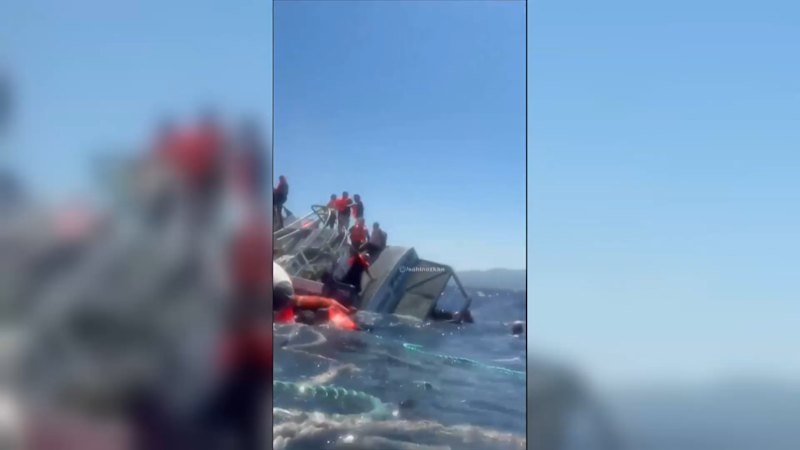
Marine accidents do not happen through isolated human errors; they occur when systemic vulnerabilities align across operational, environmental, and mechanical dimensions. When a passenger vessel capsizes in open waters, the event exposes the underlying fragility of modern maritime transport scheduling, stability management, and regulatory compliance. The sinking of a ferry off the coast of Cyprus serves as a clinical case study in how cumulative operational pressures override fail-safe mechanisms, transforming standard transit routes into high-risk environments.
The Tripartite Failure Model in Marine Transit
Understanding why a vessel loses positive stability requires moving past simplistic attributions of bad weather or pilot error. Marine incidents of this magnitude operate through a predictable tripartite failure model: structural stability degradation, operational velocity pressure, and emergency response latency.
Stability Degradation and Free Surface Effect
Every floating vessel relies on a delicate center of gravity (G) and metacenter (M) relationship. When cargo, vehicles, or passenger masses shift unexpectedly, the metacenter drops below the center of gravity, eliminating the righting arm that naturally returns a vessel to an upright position.
In ferry operations, vehicle decks present a chronic hazard known as the free surface effect. Unsecured heavy transport vehicles or pooling water on wide, unobstructed decks create fluid momentum shifts. As the vessel rolls to port or starboard, liquid or shifting cargo moves in the direction of the roll, compounding the angle of heel. If drainage systems fail or ballast management is improperly executed, this dynamic shift accelerates the transition from a recoverable list to total capsizing.
Operational Velocity Pressure
Commercial operators face relentless economic incentives to maintain tight schedules. High fuel costs and port turnaround deadlines create an environment where adherence to timetable trumps environmental risk assessment.
When adverse meteorological conditions materialize—such as rogue wave action, unforecasted gale-force winds, or heavy swells—captains face a financial and operational penalty for delays. Pushing a vessel at standard operating speeds into deteriorated sea states dramatically increases slamming loads on the bow and green water shipped onto the deck. This operational velocity pressure forces vessels into hydrodynamic regimes they were not engineered to sustain under loaded conditions.
Emergency Response Latency
The survival rate of passengers in a maritime disaster correlates directly with evacuation initiation speed and search-and-rescue (SAR) notification time. Emergency response latency comprises three distinct intervals: recognition time, muster execution time, and distress transmission lag.
On older or poorly drilled vessels, crew coordination breaks down during high-stress heel angles. Watertight doors that should seal automatically often remain open to allow passenger movement, compromising subdivision bulkheads. Once water breaches primary compartments, the timeline for abandoning ship collapses from hours to minutes, rendering standard evacuation protocols obsolete before deployment.
The Cost Function of Regulatory Enforcement Gaps
Maritime safety depends on international frameworks such as the International Convention for the Safety of Life at Sea (SOLAS) and flag state inspections. However, enforcement mechanisms suffer from structural blind spots that commercial operators routinely exploit.
Port State Control (PSC) inspections are inherently probabilistic rather than deterministic. Inspectors cannot audit every critical system on every vessel before departure. Consequently, operators operate under a calculated risk framework where the expected fine for non-compliance with stability book updates or safety equipment maintenance is lower than the cost of operational downtime.
Furthermore, sub-regional variations in oversight create flags of convenience and loopholes. Vessels operating in enclosed or semi-enclosed seas like the Eastern Mediterranean often navigate between differing jurisdictional enforcement standards. When oversight is fragmented among multiple coastal states, accountability disperses. No single authority maintains continuous telemetry and stability verification for transit vessels passing through international waters between sovereign zones.
Systemic Vulnerabilities in Passenger Vessel Design
Ferries present a unique naval architecture challenge because they must balance high-volume passenger capacity with large, open vehicular decks. This architectural necessity creates inherent compromise.
Traditional cargo ships utilize deep holds and compartmentalized storage that maintain a low center of gravity. Ferries, conversely, require high superstructures to accommodate passenger amenities and expansive garage decks. This configuration raises the vertical center of gravity, making the vessel sensitive to weight distribution errors during loading.
When loading marshals rush boarding procedures to clear ports on time, weight distribution logs frequently rely on estimated rather than actual axle weights. An unchecked accumulation of heavy commercial trucks on one side of the vehicle deck silently shifts the transverse center of gravity. The crew remains unaware of this latent instability until environmental forces trigger an unrecoverable roll.
Strategic Operational Redesign for Coastal Transit
Mitigating future marine disasters requires structural intervention rather than superficial policy updates. Operators and regulatory bodies must abandon reactive compliance models in favor of predictive risk architecture.
Real-time telemetry systems must become mandatory for all commercial passenger vessels exceeding specific tonnage thresholds. Static stability books maintained in the wheelhouse are obsolete; they must be replaced by dynamic onboard sensors that continuously calculate the real-time center of gravity based on automated strain gauges and tank level indicators.
Port authorities must implement strict, automated gating protocols that halt departures when meteorological data exceeds predefined thresholds, removing the burden of decision-making from commercial captains who face economic coercion from shipowners. Independent safety audits must be unannounced, targeting operational readiness and crew drill execution rather than paperwork compliance.
The sinking off Cyprus highlights an unforgiving reality: the maritime industry operates on tolerances that leave zero margin for cumulative error. Until structural economic incentives are aligned with absolute physical safety limits, transit routes will continue to test the breaking point of human and mechanical resilience.