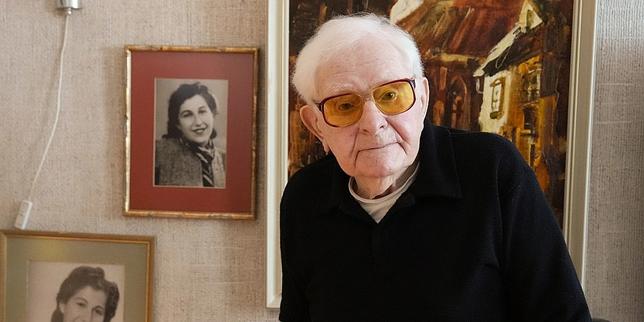
Margers Vestermanis did not merely survive the twentieth century. He outlived the official narratives that tried to sanitize how a small Baltic nation consumed its Jewish population. When Vestermanis died at the age of one hundred, the obituary notices from major international desks dutifully checked the boxes. They mentioned his age. They noted his survival of the Riga Ghetto and the Kaiserwald concentration camp. They praised his founding of the Museum of the Jews in Latvia.
They largely missed the structural violence of the silence he spent his entire life trying to break.
To understand Vestermanis is to understand the unique horror of the Holocaust in the Baltics. Unlike the industrialized death factories operating in occupied Poland, the destruction in Latvia was largely intimate, local, and immediate. Neighbors turned on neighbors before the German Einsatzgruppen even reached the provincial towns. The Rumbula forest massacre swallowed tens of thousands of souls in a matter of days at the end of nineteen forty-one. Vestermanis lived through the machinery that turned a multi-ethnic European society into an execution ground.
He emerged from that darkness not with a desire for quiet retirement, but with a stubborn, exhausting compulsion to document the exact mechanics of mass murder.
The Archive as an Act of Defiance
For decades, historical inquiry in Latvia operated under heavy ideological constraints. During the Soviet era, the specific Jewish identity of the victims was routinely flattened into a generic category of "Soviet citizens who perished at the hands of fascist occupiers." This semantic erasure served a dual purpose for Moscow. It obscured local collaboration while stripping the Jewish community of its distinct cultural and demographic weight.
Vestermanis understood the danger of this institutional amnesia long before Western historians began paying attention to the archival gaps behind the Iron Curtain. Working largely on his own initiative, he began gathering fragments. He tracked down eyewitness accounts, salvaged discarded documents, and mapped the execution sites that local authorities preferred to leave unmarked.
When Latvia regained its independence in nineteen ninety-one, the historical challenge shifted rather than dissolved. A newly liberated nation was eager to construct a heroic narrative of resistance against Soviet occupation. Confronting the uncomfortable truth of native collaboration during the Nazi years required a rare kind of institutional courage. Vestermanis provided that courage, often at great personal cost to his standing among contemporaries who preferred a cleaner, more heroic national myth.
In nineteen ninety-three, he established the Museum of the Jews in Latvia in a modest building in Old Riga. It was not a grand state-funded institution backed by millions in corporate grants. It was a labor of historical preservation built against the grain of political convenience. Vestermanis sat as its director for years, welcoming visitors, scholars, and skeptics, insisting that the dead deserved precise accounting rather than polite generalizations.
The Geography of Complicity
To walk through the history Vestermanis documented is to abandon any comforting illusions about how totalitarian regimes take root. The destruction of Latvian Jewry did not happen in a vacuum of state obedience. It relied on active, enthusiastic local participation through organizations like the Arajs Kommando.
Vestermanis spent his academic career documenting these mechanisms. He showed how ordinary men—teachers, civil servants, shopkeepers—transformed into executioners with terrifying speed. He refused to let the narrative hide behind the convenient excuse of foreign coercion. The German occupiers provided the framework, but the local actors supplied the local knowledge, the identification lists, and often the physical labor of rounding up their former classmates and neighbors.
This insistence on local accountability made Vestermanis an uncomfortable figure in various political cycles. History, in the view of many nation-states, is supposed to serve as a unifying myth. Vestermanis treated it as an unyielding audit. He demonstrated that collective memory is not something that simply happens to a society; it is something that must be fought for against the natural human instinct to forget, excuse, or rewrite the past.
The loss of Vestermanis marks the fading of the last direct, living connection to a world that was systematically exterminated. The generation that bore witness directly to the barbed wire and the mass graves is nearly gone. What remains are the archives they built, the oral histories they recorded, and the uncomfortable questions they forced into the public square.
As the political climate across Europe shifts once again toward historical revisionism and the rehabilitation of wartime collaborators, the absence of figures like Vestermanis becomes acutely felt. He was a historian who did not have the luxury of academic detachment. For him, every recovered document was a rescue mission, and every corrected statistic was a refusal to grant the perpetrators the final victory of complete erasure.
He lived to one hundred years old, carrying a weight that most can scarcely imagine, and he used every year of that borrowed time to ensure that the ghosts of Riga would not be allowed to rest in quiet obscurity.