Stand in the port of Singapore at midnight, and you can smell the salt, the bunker fuel, and the heavy, sweet scent of distant rain. Look up, and you see a constellation of crane lights blinking red against the equatorial dark, loading steel boxes that hold the contents of the modern world. Every second, a container moves here. Every hour, billions of dollars in commerce whisper through fiber-optic cables buried deep in the seabed beneath your boots.
It is an empire built on efficiency. It is a city that mastered the art of being the absolute center of the maritime map.
Now, look at a globe. Shift your thumb five thousand miles northwest, past the jagged teeth of the Himalayas, past the sun-bleached expanse of the Taklamakan Desert, and land on the high-altitude steppes of Central Asia. Almaty. Tashkent. Bishkek. Cities carved from the ancient dust of the Silk Road, where merchants once traded silk for jade under skies so vast they make your chest ache.
These two places—the hyper-modern island republic of the tropics and the landlocked expanse of the former Soviet heartland—should have nothing to say to each other. They are separated by oceans of sand, fragile geopolitical fault lines, and a maze of customs borders that can turn a simple truck journey into a bureaucratic medieval torture test.
Yet, Singapore wants to be the natural choice to bridge them.
To understand why this ambition is either a masterstroke or a hallucination, you have to talk to someone like Timur. (Note: Timur is a hypothetical logistics coordinator, built from composite interviews with operators working the Eurasian rail corridors).
Timur sits in a glass-walled office in Astana, watching snow fall over concrete apartment blocks built in the brutalist style of the Soviet era. On his desk sits a porcelain teacup and a laptop displaying a frantic spreadsheet. His problem is simple to state and impossible to solve: he has three containers of medical diagnostics equipment sitting in a warehouse in Frankfurt, and a buyer in Almaty who needed them yesterday.
He cannot ship them south through Iran—too many sanctions, too many shifting political winds. He cannot ship them easily through Russia right now—the iron curtain of Western export controls and snarled rail networks have turned the northern overland corridors into a minefield of compliance risks.
So he looks south and east. He looks toward the Caspian Sea. He looks toward the chaotic, hopeful, frustrating arteries known as the Middle Corridor.
And then, he looks at Singapore.
Why Singapore? Because when a shipment hits a wall in Kazakhstan—when a customs official demands a bribe, or a rail gauge changes abruptly at a border crossing, or a bill of lading is rejected because of a misplaced comma—Timur does not want poetry. He wants a contract that holds water. He wants an arbitration court that operates with Swiss-watch precision. He wants a bank that can clear a multi-million-dollar transaction in seconds without a compliance officer in New York or Frankfurt freezing the funds out of sheer administrative panic.
This is the invisible stake of the Singapore-Central Asia dialogue. It is not about shipping more spices or selling more microchips. It is about trust.
Trust is a heavy commodity. It cannot be mined. It cannot be loaded onto a 40-foot container. It has to be manufactured through decades of institutional stability, transparent legal frameworks, and a stubborn insistence that a deal signed is a deal kept.
Central Asia is currently undergoing a quiet, desperate scramble for sovereignty. For decades, the region was caught in a gravitational pull between Moscow and Beijing. Every rail line pointed north or east. Every economic artery was tied to a single giant neighbor. To be landlocked was to be locked in.
Today, the nations of the region—Kazakhstan, Uzbekistan, Kyrgyzstan, Tajikistan, Turkmenistan—are desperately trying to pry open new doors. They want a multi-vector foreign policy. They want to trade with Europe, with the Gulf, with Southeast Asia, without having to ask permission from their bigger neighbors every time a train crosses a border.
Enter Singapore.
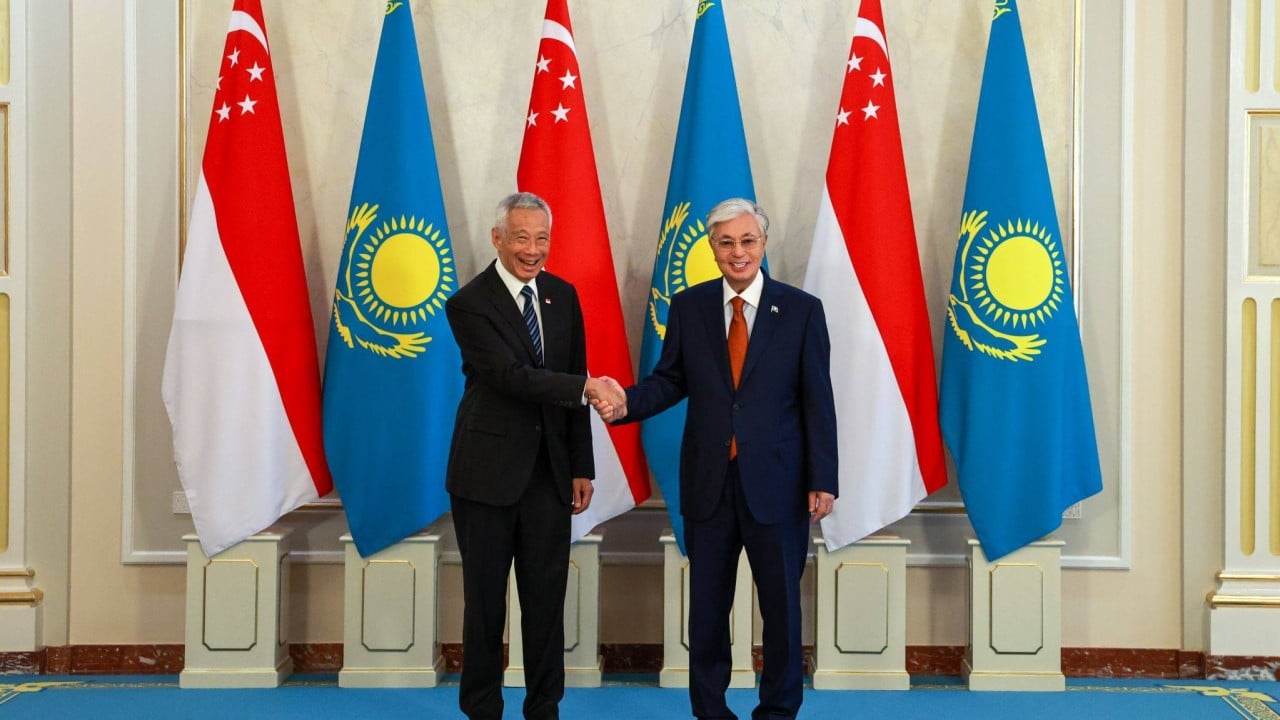
On paper, the connection looks neat. Trade agreements are signed in air-conditioned ballrooms. Memorandums of understanding are exchanged with crisp handshakes and polite smiles for the press cameras. Trade between Singapore and Central Asia has flickered upward, though it remains a drop in the ocean compared to the massive trade volumes both regions do with China or the European Union.
But numbers lie about the future. They only tell you where the ball has already landed.
To see where it is going, you have to look at the training rooms in Singapore’s Civil Service College, where mid-level bureaucrats from Tashkent are taught how to structure public-private partnerships. You have to look at the legal workshops where Central Asian judges study international commercial law. You have to watch how Singaporean firms are quietly investing in logistics hubs, digital customs platforms, and supply chain software across the steppes.
Singapore is exporting its operating system.
It is a bold pitch. Come to us, Singapore says to the leaders of Central Asia. Use our ports as your gateway to the world. Use our financial institutions to finance your infrastructure. Use our legal systems to settle your disputes. We are small, we are neutral, and we have no territorial ambitions. We just want your business to run smoothly.
Yet, skepticism is warranted. In fact, it is mandatory.
Bridges do not build themselves simply because two distant capitals decide they like the sound of each other's names. The physical reality of the geography between Singapore and Central Asia is brutal. Between the skyscrapers of Marina Bay and the cotton fields of Uzbekistan lie some of the most difficult terrain and most complex political landscapes on Earth.
Consider what happens when a shipment leaves Singapore bound for Central Asia. It must traverse maritime chokepoints in Southeast Asia, pass through the congested ports of South or West Asia, find its way across the Caspian Sea—where port congestion can turn a two-day crossing into a three-week parking lot of rusting barges—and then navigate a patchwork of rail and road networks that often still operate on the bureaucratic rhythms of the twentieth century.
Furthermore, local capacity in Central Asia is still maturing. While capitals like Astana and Tashkent are booming with glass-fronted developments and tech incubators, rural infrastructure can be heartbreakingly primitive. A digital customs platform designed in Singapore is only as good as the internet connection in a customs shed on the border of Kyrgyzstan and China—and sometimes, that connection runs on a flickering 3G signal and a generator that runs out of diesel at sunset.
There is also the great power shadow to consider. China’s Belt and Road Initiative is not a theoretical concept in Central Asia; it is paved in asphalt, lit by industrial yards, and measured in miles of newly laid steel tracks. Russia remains an inescapable economic and security presence.
In this arena, Singapore is a mosquito trying to mediate a conversation between eagles.
And yet.
Mosquitoes can be remarkably persistent. Singapore’s entire history is an exercise in defying geographical absurdity. A swampy island with no natural resources, no hinterland, and no fresh water should not have become one of the wealthiest nodes on the planet. It did so by making itself indispensable. It became the place where things worked when they broke down everywhere else.
If Singapore can apply that same logic to Central Asia, it offers the region something China and Russia do not: a pure, unadulterated commercial safe space.
When a Kazakh energy firm or an Uzbek agricultural cooperative wants to deal with the world without becoming a pawn in a great power struggle, where do they go? Western capitals are increasingly bogged down by compliance hurdles, geopolitical friction, and the looming threat of sudden financial lockouts.
Singapore offers an alternative orbit. It is non-aligned, hyper-efficient, and ruthlessly pragmatic.
Timur looks at his screen in Astana. The medical diagnostics equipment has finally cleared customs in Frankfurt. Next week, it will be loaded onto a cargo flight, or perhaps onto a truck winding its way through the Caucasus and across the Caspian. It will arrive late. It will cost more than it should have.
He rubs his eyes, tired of the friction, tired of the invisible walls that separate the map on his wall from the reality on the ground.
He does not care about geopolitical theories. He cares about whether the next shipment can move without breaking his spirit.
Far to the south, beneath the blazing neon skyline of the equatorial night, a container crane drops another heavy steel box into the hold of a ship bound for the horizon, indifferent to the snow falling five thousand miles away, yet quietly preparing the ground for the day the map finally learns how to meet itself.