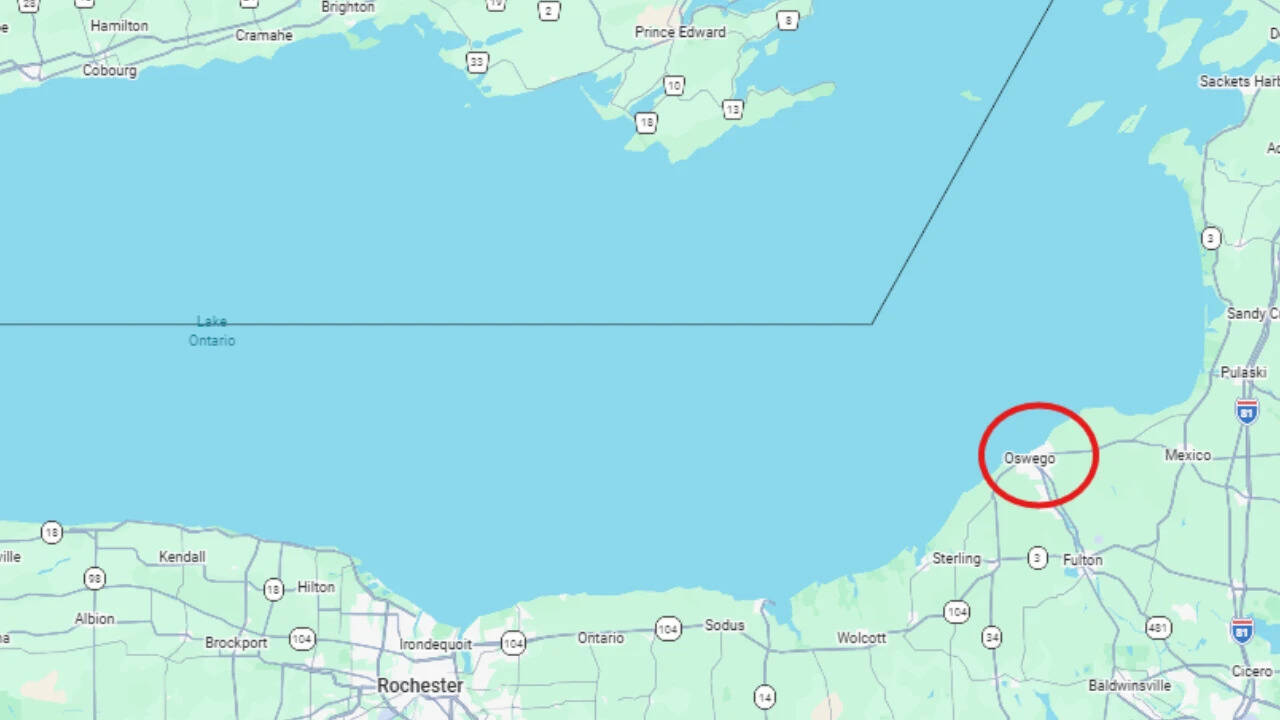
The wind off the water carries a particular kind of chill. It smells of ancient limestone, damp cedar, and a vast, cold depth that refuses to warm up even in the thick of July. Standing on the docks of Oswego, you do not just see Lake Ontario; you taste it on your lips. It is a sharp, metallic tang of raw geography.
When a suggestion floated down from a distance bureaucratic office to rebrand these waters under a unified banner, proposing the blanket moniker of Lake America, the response from the shore was not a polite nod. It was a cold, hard stare.
To understand why a name matters so profoundly, you have to spend an afternoon watching the commercial fishermen mend their nets or talking to the old-timers who can read a sudden squall on the horizon before the barometer even twitches. Names are not mere labels here. They are anchors. They are the shorthand for survival, memory, and a stubborn inheritance that cannot simply be overwritten by a marketing subcommittee three states away.
Republican Mayor Robert Corcoran did not mince words when the proposal drifted into local government channels. He looked at the paperwork, looked out at the slate-gray expanse stretching toward the Canadian horizon, and issued a rejection rooted in something deeper than municipal policy. Lake Ontario, he pointed out, is written directly into the DNA of the people who call these shores home.
Consider what a name actually holds.
For generations, families have built their lives around the moods of this specific body of water. It is the fifth largest of the Great Lakes, a massive freshwater sea that carved the bluffs, fed the Erie Canal trade routes, and defined the industrial heartbeat of upstate New York. When children grow up here, their first scraped knees happen on the rocky shale beaches of Ontario. Their first summers smell of rotting alewives and sunscreen. Their winters are measured in lake-effect snowfalls that bury front porches and transform familiar streets into silent, white mazes.
To call it Lake America would be like looking at a family portrait and renaming the matriarch "Person Number Four." It strips away the specific narrative of the place. It flattens a living, breathing ecosystem of history into a generic corporate asset.
There is a psychological phenomenon at play here, well-documented by sociologists who study regional identity. People require geographic specificity to anchor their sense of self. When a place has a distinct name, it possesses boundaries, character, and a unique set of challenges. Lake Ontario has drowned ships, sustained indigenous nations, powered mills, and tested the mettle of every immigrant who ever stepped off a train in Oswego, Rochester, or Buffalo. It is ancient. It is Mohawk territory by origin, meaning "the lake of shining waters" or "beautiful lake."
Wiping that away for the sake of continental uniformity is an erasure of heritage.
Imagine living in a house built by your grandfather, a place where every floorboard groans in a familiar key and the wallpaper in the pantry still holds the pencil marks of your height when you were seven. Now imagine a stranger walking in and announcing that the address has been changed to a generic zone code for administrative efficiency. You would object. Not because the mail wouldn't arrive, but because the soul of the building has been ignored.
That is precisely how the residents of upstate New York felt.
The push for a name change often stems from a well-intentioned desire for cohesion. In an increasingly globalized world, federal agencies and tourism boards love neat categories. They love systems that scale. They look at the Great Lakes and see a blue chain on a map, a contiguous resource to be branded, marketed, and packaged for cross-country travelers.
Yet, local resistance proves that communities do not exist to be optimized.
Mayor Corcoran’s stance tapped into a primal vein of regional pride. It is a reminder that local government is often the last line of defense against the homogenization of American life. Every small town and coastal city is under subtle pressure to look like every other town and coastal city, to adopt sanitized street names, uniform corporate storefronts, and placeless identities. Resisting a bureaucratic renaming is a quiet form of rebellion. It is a way of planting a flag in the mud and declaring that some things are not for sale, not up for redesign, and certainly not negotiable.
The water does not care what we call it, of course. Lake Ontario will continue to churn up towering waves when the autumn gales sweep down from Canada. It will freeze in bitter Februarys and turn a deep, reflective sapphire under the July sun regardless of the ink used on federal maps.
The residents, however, care deeply.
Because when you wake up to the fog rolling off the harbor, you need to know you are standing somewhere specific. You need to know that the water crashing against the breakwall has a history, a lineage, and a name that honors the millions of lives it has touched before yours. Ontario is more than a body of water. It is the quiet heartbeat of a region that refuses to fade into the background.