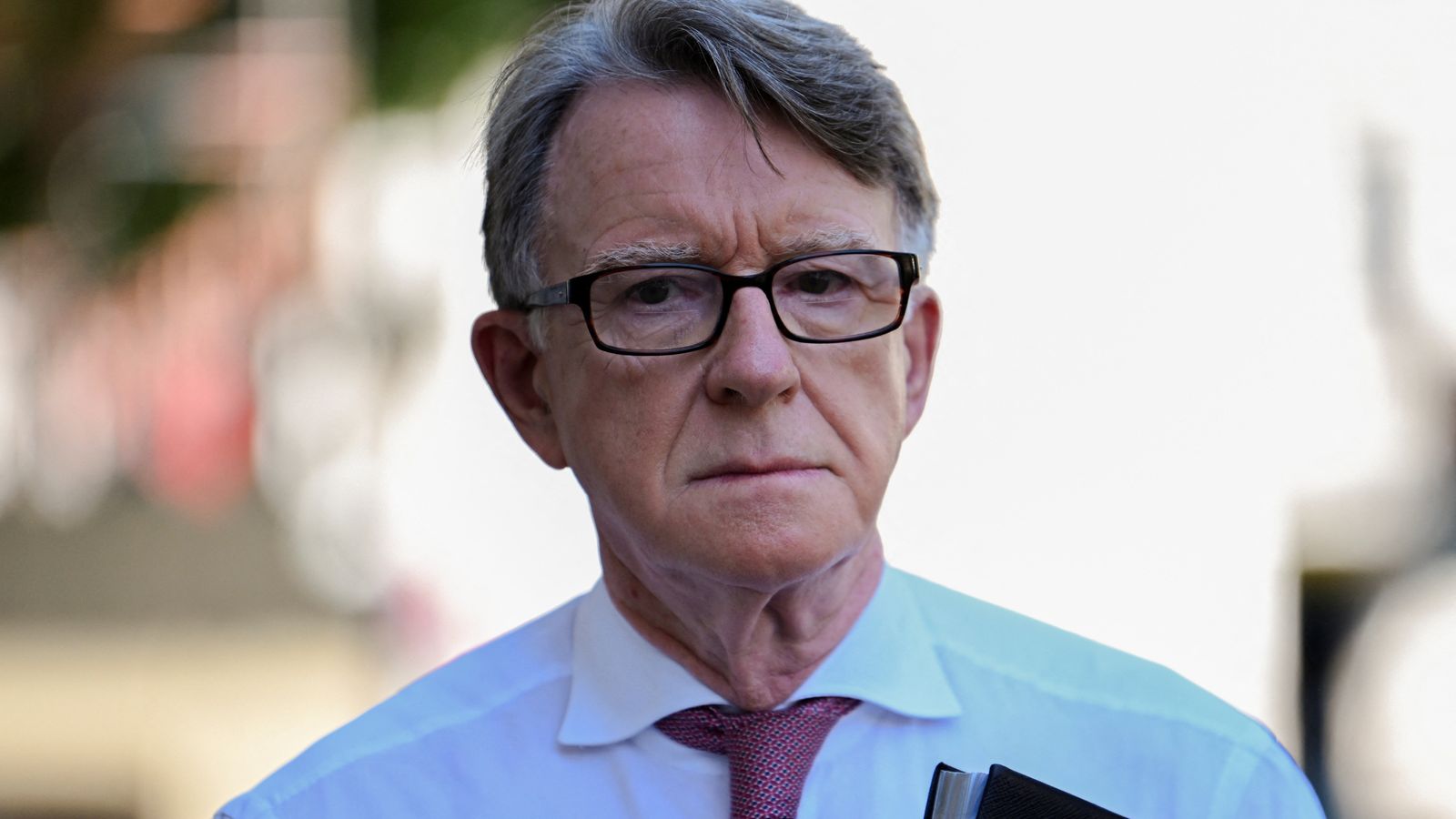
The release of the Mandelson documents by the UK National Archives and the Cabinet Office has finally exposed the internal machinery of one of the most controversial diplomatic appointments in modern British history. These files confirm that senior officials within the British government were fully aware of the "reputational risks" associated with Lord Peter Mandelson’s ties to the late financier Jeffrey Epstein months before his ill-fated appointment as Ambassador to the United States. Despite explicit warnings from national security advisors and top-tier civil servants, the appointment was pushed through in what insiders described as a "weirdly rushed" process, ultimately leading to a predictable and messy collapse that has left the current administration reeling.
A Warning Ignored
In December 2024, as the British government sought to solidify its relationship with the incoming Trump administration, Peter Mandelson was surfaced as the prime candidate for the Washington post. A due diligence report prepared by the Cabinet Office at that time—now public for the first time—detailed Mandelson's extensive history with Epstein. The report noted that the relationship continued well after Epstein’s 2008 conviction for procuring an underage girl. Most damningly, the files reveal that Mandelson reportedly stayed at Epstein’s home in June 2009 while the financier was serving jail time.
Despite these red flags, the vetting process appears to have been bypassed or accelerated. Jonathan Powell, the National Security Adviser, expressed his bewilderment in a September 2025 phone call, describing the entire selection process as "unusual" and "weirdly rushed." Powell wasn't alone in his skepticism; Sir Philip Barton, the permanent under-secretary at the Foreign Office, also harbored significant reservations. However, the political drive to install a "heavyweight" who could bridge the gap to Donald Trump and Elon Musk seemingly overrode the standard safeguards of the British civil service.
The Secret Channels and Market Sensitive Leaks
The true depth of the scandal lies not just in the social association, but in the alleged exchange of information. Documents recently surfaced by the U.S. Department of Justice—and echoed in the UK's own internal memos—suggest a more transactional nature to the Mandelson-Epstein bond. Files indicate that while serving as Business Secretary under Gordon Brown, Mandelson may have shared market-sensitive information regarding government bailouts and bank tax policies with Epstein, who was then working for JP Morgan.
These allegations formed the basis of Mandelson’s arrest on February 23, 2026, on suspicion of misconduct in public office. The dossiers suggest that the government’s initial due diligence "did not expose the depth and extent" of these financial and informational ties. Whether this was a failure of the intelligence services or a deliberate turning of the blind eye by political masters remains the central question of the ongoing Metropolitan Police investigation.
The Severance Standoff
The documents also provide a grimly fascinating look at the endgame of Mandelson’s diplomatic career. After being sacked in September 2025—following the public release of messages in which he referred to Epstein as his "best pal"—Mandelson did not go quietly. He initially demanded a severance package of £547,201, representing the remainder of his four-year fixed-term salary.
The Foreign Office’s HR department, led by Mark Power, found itself in a high-stakes negotiation with a man who was already consulting employment KCs and threatening to sue for unfair dismissal. Internal emails show officials scrambling to settle the matter with "maximum dignity and minimum media intrusion." Eventually, a payout of £75,000 was agreed upon—a figure the Chief Secretary to the Treasury, Darren Jones, later described to Parliament as "inappropriate and unacceptable," yet necessary to avoid a protracted and even more expensive legal tribunal.
The Washington Bridgehead
The rationale for the appointment, as documented in the files, was purely pragmatic. Mandelson himself argued that he could act as a "bridgehead" to the Trump administration and its inner circle, including figures like Nigel Farage and Elon Musk. He viewed the national interest as something served in "weird and wonderful ways," a philosophy that allowed him to justify maintaining a relationship with a convicted sex offender long after it became a liability.
| Date | Key Event | Official Document Note |
|---|---|---|
| Dec 2024 | Initial Due Diligence | "General reputational risk" identified regarding Epstein ties. |
| Feb 2025 | Appointment | Vetting process described by NSA as "weirdly rushed." |
| Sep 9, 2025 | US File Release | Messages emerge of Mandelson calling Epstein his "best pal." |
| Sep 11, 2025 | Dismissal | Sacked as Ambassador; negotiations for severance begin. |
| Feb 23, 2026 | Arrest | Arrested on suspicion of misconduct in public office. |
The fallout has been catastrophic for the government's "ethics-first" branding. By ignoring the documented warnings of the professional civil service in favor of a political "fixer," the administration find itself entangled in a criminal investigation that shows no signs of a quiet resolution. The documents prove that this wasn't a case of being blindsided by new information, but rather a failure to act on information that was already in the room.
Would you like me to analyze the specific legal precedents for "misconduct in public office" as they apply to these declassified government memos?