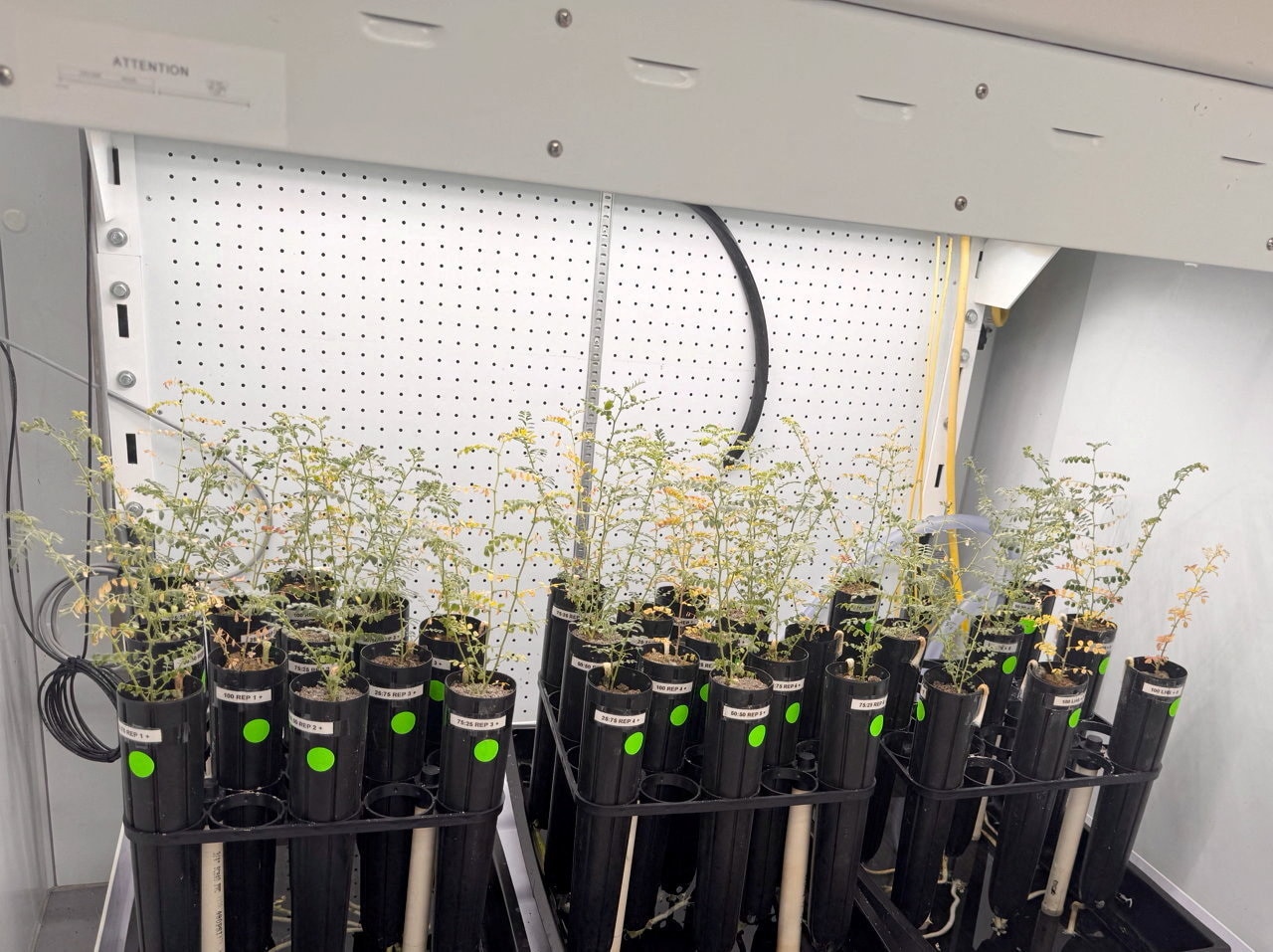
Stop celebrating the lunar legume. The recent headlines cheering for chickpeas grown in "moon dirt" represent the peak of space-exploration theater. We are being sold a romantic vision of orbital homesteading that ignores the brutal physics of the lunar surface and the chemical reality of regolith. Scientists at Texas A&M and other institutions have managed to sprout seeds in lunar simulant by adding vermiculite and fungi. Great. They’ve proven that if you take dead, toxic dust and mix it with life-sustaining Earth materials, life happens.
That isn't a breakthrough. It’s a hobbyist’s science fair project funded by millions of taxpayer dollars.
The "lazy consensus" suggests that being able to grow food on the Moon is the "pivotal" (excuse me, the essential) step toward Mars. It isn't. The obsession with lunar agriculture is a massive misallocation of intellectual capital that ignores the one thing space hates: complexity.
The Toxicity the Headlines Ignore
The moon is not "soil." It is regolith. On Earth, soil is a living matrix of organic matter, air, water, and minerals. Regolith is a jagged, glass-heavy graveyard of pulverized rock created by billions of years of meteorite impacts.
Common media narratives frame the challenge as a lack of "nutrients." That is a sanitized lie. The real problem is chemical warfare. Lunar regolith is packed with crushed silicates that act like microscopic shards of glass, capable of shredding plant root systems at a cellular level. More importantly, it contains high concentrations of heavy metals and reactive oxygen species.
When you introduce water to lunar regolith to "garden," you aren't just making mud. You are triggering chemical reactions that release hydroxyl radicals. These are highly reactive molecules that cause oxidative stress in plants.
- The Mercury Problem: Lunar samples show traces of toxic elements that, if absorbed by a chickpea, would make that chickpea a slow-acting poison for any astronaut who eats it.
- The Chromium Issue: Even in these "successful" experiments, the plants are stunted. They are struggling. They are displaying the botanical equivalent of a scream.
To grow anything safe to eat, you have to "wash" the moon. The amount of water and energy required to leach toxins from regolith—and then dispose of that toxic wastewater in a closed-loop system—is a logistical nightmare that no one is talking about.
The False Economy of Lunar Farming
The argument for lunar chickpeas is always about weight. "It costs $10,000 to send a pound of food to the Moon, so we must grow it there."
This is a math error disguised as an insight.
Let’s look at the infrastructure required for a lunar greenhouse. You need pressurized habitats. You need radiation shielding—because the Moon lacks an atmosphere and a magnetic field. You need specialized LED lighting because "lunar days" last 14 Earth days, followed by 14 days of freezing darkness. You need complex atmospheric scrubbing to manage the oxygen and CO2 levels generated by the plants.
If you calculate the Mass of Infrastructure (Mi) required to grow a single calorie versus the Mass of Stored Food (Ms) required to sustain a human, the break-even point is decades away.
$$Mi \gg Ms$$
For any mission lasting less than ten years, it is cheaper, safer, and more efficient to send vacuum-sealed bags of dehydrated hummus than it is to build a lunar farm. We are building a cathedral to a chickpea when we should be perfecting long-term food preservation and high-density nutrient storage.
The Mycorrhizal Fungi Myth
The Texas A&M study relied heavily on arbuscular mycorrhizal fungi to help the chickpeas survive. These fungi create a symbiotic relationship with roots, helping them pull nutrients from the harsh regolith.
It’s a clever trick. But it’s a terrestrial trick.
We are assuming these fungi will behave predictably under 1/6th gravity and constant cosmic radiation bombardment. High-energy particles don't just hit the plants; they hit the microbes in the soil. We are one mutation away from a fungal colony that stops helping the plant and starts consuming the habitat’s plastic seals or, worse, the astronauts’ lungs.
Bringing a complex microbiome to a sterile environment is begging for biological chaos. The "nuance" the headlines miss is that a sterile hydroponic system—completely decoupled from moon dust—is the only sane way to farm in space. Yet, we insist on "using the land" because it feels more like pioneering. This isn't the Oregon Trail. It's a vacuum.
Stop Asking if We Can, Ask if We Should
People often ask: "When will we have the first lunar farm?"
The better question is: "Why are we trying to turn the Moon into a shitty version of Earth?"
The Moon is a high-vacuum, low-gravity industrial site. It is a place for telescopes, helium-3 mining, and fuel depots. It is not a garden. Trying to grow crops in regolith is like trying to grow roses in a vat of crushed lightbulbs and bleach.
The Actionable Alternative
If we actually want to feed people in space, we need to stop playing in the dirt.
- Bioreactors over Bushels: We should be investing in lab-grown cellular agriculture. Cultured meat and vat-grown nutrient pastes are infinitely more efficient than plants that waste energy growing stems, leaves, and roots we can’t eat.
- Transgenic Extremophiles: Instead of trying to "fix" the moon dust with fungi, we should be CRISPR-editing plants to thrive in high-silicate, high-perchlorate environments. We need plants that treat toxicity as a feature, not a bug.
- Nuclear Power Primacy: You cannot farm the Moon with solar panels. The lunar night will kill your crop every single time. Unless we are willing to put a nuclear reactor next to the greenhouse, the chickpeas are dead on arrival.
I have seen aerospace startups burn through seed rounds trying to solve "space hunger" with vertical farms that are essentially just overpriced salad bars. They fail because they underestimate the sheer hostility of the environment. They treat the Moon as a "new landscape" when it is actually a hostile void.
The chickpea experiment is a feel-good story for a public that wants to believe we can terraform our way out of any problem. It’s a PR win for NASA and a logical failure for long-term colonization. We are domesticating the wrong things. We don't need "moon dirt" farmers; we need engineers who realize that the Moon is trying to kill us, and the last thing we should do is give it more ways to do it.
Lunar farming is a distraction from the cold, hard reality of the stars. It’s time to stop playing with mud and start building the closed-loop chemical systems that will actually keep us alive.
Eat your hummus on Earth. On the Moon, you’ll be lucky to breathe.