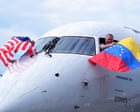
The cabin air smelled of nothing special—just the usual recycled oxygen and faint hints of coffee. But for the 150 souls sitting in the pressurized silence of a Boeing 737, every breath felt heavy. They weren't just passengers on a flight; they were witnesses to the end of a seven-year ghost story.
For nearly a decade, the sky between the United States and Venezuela was a void. Since 2019, the direct corridor had been severed by a wall of red tape, sanctions, and broken diplomacy. If you wanted to get from Miami to Caracas—a distance of barely 1,300 miles—you had to turn a three-hour hop into a grueling twelve-hour odyssey through Panama City or Santo Domingo. Families were separated by more than just borders; they were separated by a logistical nightmare that turned a quick visit into a bank-breaking expedition.
Then, the wheels touched the tarmac at Simon Bolivar International Airport.
The Anatomy of a Void
To understand why a single plane landing is a seismic event, you have to look at the map through the eyes of someone like Elena. Elena is a hypothetical composite of the thousands of people I’ve interviewed who live in the diaspora. She lives in Doral, Florida. Her mother is in Los Teques. For seven years, the distance between them wasn't measured in miles. It was measured in the exhaustion of missed connections and the predatory pricing of "bridge" flights that took advantage of the ban.
When the U.S. Department of Transportation suspended all commercial and cargo flights in 2019, citing safety and security concerns, the sky didn't just close. It hardened. The suspension was a blunt instrument of foreign policy, intended to squeeze a government, but it mostly squeezed the people holding two passports and one heart.
The return of this direct flight isn't a sudden burst of geopolitical friendship. It’s a slow, grinding realization that the status quo had become unsustainable. The flight, operated as a charter under specific licenses, represents a crack in the ice. It is the result of months of back-channel negotiations and a shifting global energy need that has forced old rivals to sit at the same table, or at least share the same runway.
The Metal and the Movement
The logistics of this return are as complex as a watch movement. It wasn't just about fueling a plane and filing a flight plan. Aviation authorities had to navigate a minefield of sanctions. Every piece of ground equipment used to service the aircraft, every gallon of fuel pumped in Caracas, and every security protocol had to be vetted against a backdrop of international law.
Consider the technicality: U.S. carriers are still technically barred from scheduled service, but the loophole of "authorized charters" has provided a way forward. This isn't just about travel; it’s about the movement of goods. Before the ban, the cargo holds of these planes were the lifeblood of small businesses. They carried medicine, specialized car parts, and the tactile proof of a connection that WhatsApp calls can’t replicate.
The "ghost" years saw a decline in the maintenance of Venezuelan runways and radar systems. Reopening this route required a silent, rigorous audit. When that first flight took off, it carried more than people; it carried the validation that the infrastructure was, once again, talking to the rest of the world.
The Invisible Stakes
Why does this matter to someone who has never been to South America? Because it serves as a blueprint for how isolation ends. Isolation is easy to start and incredibly difficult to finish. Once you break a supply chain or a flight path, the muscle memory of that connection withers.
The re-establishment of this link is a signal to the markets. It suggests that despite the rhetoric, there is a pragmatic undercurrent at play. Business leaders are watching the load factors of these flights. They are looking at the cargo manifests. If the planes are full, the argument for broader economic engagement becomes undeniable.
But the real stakes aren't found in a ledger. They are found in the terminal.
On this particular flight, the atmosphere wasn't one of a standard business trip. There was no bored scrolling through tablets. As the plane crossed the Caribbean coastline, passengers pressed their faces to the windows. They saw the jagged green of the Avila mountain range. They saw the red-tiled roofs of the coastal towns.
A Journey Beyond the Tarmac
There is a specific kind of silence that happens right before a plane lands on a long-awaited journey. It’s the sound of 150 people holding their breath.
When the "Fasten Seatbelt" sign chimed for the final descent, it wasn't a chore. It was a promise kept. The wheels hit. The thrust reversers roared. And then, something happened that rarely happens on a Monday afternoon flight: people started to clap.
They weren't clapping for the pilot's skill, though that was certainly appreciated. They were clapping for the bridge. They were clapping because the world had just become three hours wide again, instead of twelve.
The travelers walked through the jet bridge and into the humid, salt-tinged air of Maiquetía. They were met not by protestors or politicians, but by the same bored customs officials and eager taxi drivers that have always populated airports. That normalcy was the most radical part of the entire experience.
The return of the direct flight is a reminder that while governments can draw lines in the dirt and the sky, the human need for proximity eventually finds a way to erase them. The void has been filled. The sky is no longer a wall; it is, once again, a path.
As the sun set over the Caribbean, the same plane began its taxi back toward the runway for the return leg. The lights of the cockpit flickered in the dusk. For the first time in seven years, the flight board didn't show a cancellation or a detour. It showed a destination.
Caracas. Miami. Direct.
The ghost story was over.