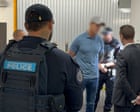
The air inside the courtroom carries a specific, sterile weight. It is the smell of old paper, polished wood, and the oxygen-deprived stillness of people holding their breath. Ben Roberts-Smith, a man whose physical presence once filled the frame of every national news broadcast as a symbol of peak Australian valor, now occupies a different kind of space. He is no longer the titan in the camouflage; he is a man in a suit, waiting for the heavy doors of a prison cell to swing shut behind him.
The news broke with a clinical sharpness. Australia’s most decorated living soldier will remain in custody. He didn't seek bail. He didn't fight the immediate reality of his situation. Instead, he stepped into the silence of the remand system, a move that signals the end of one chapter and the grueling beginning of another. For a nation that built its modern identity on the rugged, unbreakable spirit of the Anzac, this isn't just a legal update. It is a fracture in the foundation.
Consider the weight of that medal, the Victoria Cross. It is a small piece of bronze, theoretically worthless in its raw materials, yet it carries the crushing gravity of an entire country's expectations. When a man wears it, he stops being an individual. He becomes a monument. But monuments don't bleed, and they don't make mistakes in the heat of a desert night. When the monument begins to crack, the dust gets into everyone's eyes.
The Billionaire and the Battlefield
Outside the courtroom, the ripple effect of this custody arrangement reached the highest echelons of Australian industry. Gina Rinehart, a woman whose influence over the Australian economy is as vast as the iron ore mines she oversees, broke her silence with a perspective that felt like a lightning rod. She doesn't understand the justification. To her, and to a significant portion of the Australian public, the prosecution of former soldiers for actions taken in the fog of war is a betrayal of the contract between a state and those it sends to kill in its name.
Rinehart’s stance isn't just about legalities; it’s about a worldview. It’s the belief that the battlefield is a moral vacuum where the rules of the boardroom or the suburban street simply cannot apply. She looks at the men who were sent to the dust of Afghanistan and sees protectors who are now being picked apart by lawyers who have never heard a shot fired in anger.
But the law sees something else.
The legal system operates on the principle that the uniform is not a shroud that hides all sins. The prosecution of war crimes—a term that feels visceral and jagged—is the state’s attempt to prove that even in the chaos of combat, there is a line. If that line disappears, what separates the soldier from the monster? This is the invisible stake. It’s not just about one man in a cell; it’s about whether the Australian military can hold a mirror to itself and survive what it sees.
The Silence of the Cells
The decision not to seek bail is a tactical one, perhaps, but it resonates with a deeper exhaustion. Imagine the transition from the wide, terrifying expanse of the Uruzgan province to the four walls of a remand center. The silence must be deafening.
Roberts-Smith is currently facing charges related to the alleged intimidation of witnesses—a dark sub-plot in an already sprawling epic of reputation and ruin. These aren't the high-stakes maneuvers of a Special Air Service (SAS) operation. These are the desperate, grimy allegations of a man trying to keep a crumbling world together. Justice, in this instance, isn't a swift sword. It’s a slow, grinding millstone.
The public often forgets that between the headlines, there are human beings. There are families watching the news in suburban living rooms, feeling the shame and the pride war within them. There are former brothers-in-arms who are now divided by the truth, some standing in loyalty and others standing in the witness box. The betrayal felt by those who spoke out is just as potent as the betrayal felt by those who believe their hero is being lynched by the elite.
The Fog of Retrospect
We love our heroes simple. We want them to be cardboard cutouts of courage, devoid of the complexities that make us human. When we find out they are complicated—that they might be capable of both immense bravery and immense cruelty—we don't know where to put that information.
The prosecution of former soldiers is a messy, painful process because it forces a society to acknowledge that we sent them there. We are the ones who asked them to go to the edges of the world to do the things we are too afraid to do. When they come back broken or carrying the weight of "justifications" that don't hold up in court, we have a habit of wanting to look away.
Gina Rinehart isn't looking away. She is leaning in, expressing a frustration that many veterans feel: the sense that the people who stayed home are now judging the people who left. It is a powerful, emotional argument. It’s also an argument that ignores the victims—the people on the other side of the barrel who didn't get to choose their role in this story.
The Unending Echo
The legal proceedings will continue. The evidence will be weighed. The witnesses will speak their truths or their lies, and the lawyers will sharpen their arguments like bayonets. But regardless of the verdict, the image of Ben Roberts-Smith in custody is an indelible mark on the Australian psyche.
It serves as a reminder that the medals we give out are not shields against the law. They are, instead, heavy anchors that pull a man deeper into the scrutiny of history.
As the sun sets over the prison walls where a Victoria Cross recipient now sleeps, the question isn't just about his guilt or innocence. It’s about who we are as a people. Are we a nation that demands accountability even from its legends, or are we a nation that prefers the comfort of a lie over the agony of the truth?
The cell door didn't just close on a man. It closed on an era of unquestioned hero-worship, leaving us all standing in the corridor, wondering what happens when the light of the legend finally goes out.



