The conference room in Washington, D.C., smelled faintly of stale coffee and damp rain coats, an aggressively mundane setting for an announcement about shifting the geopolitical and scientific center of gravity for the next century. On the stage, the newly minted NASA Administrator, Jared Isaacman, adjusted his microphone. Behind him, a digital slide hummed to life, displaying a figure that feels abstract to the point of meaninglessness to the average taxpayer: twenty billion dollars.
That money is not being spent to buy a monument. It is being spent to buy muscle memory.
For more than half a century, our relationship with the Moon has been defined by a brief, frantic sprint. We went there because we were terrified of losing a cold war. We took some photos, scooped up some gray dirt, hit a golf ball, and left. If you speak to the engineers who spent their twenties hunched over slide rules in the late 1960s, they will tell you that the true tragedy of the Apollo program wasn’t that it ended, but that it didn't leave anything behind but trash and footprints.
Consider the reality of what happens next. In April, four human beings strapped themselves into a capsule and whipped around the far side of the Moon, staring down at the cratered landscape where Gene Cernan and Harrison Schmitt last walked in 1972. They came back. But a flyby is just a visit. What NASA unveiled this week is an entirely different philosophy. It is a three-phase blueprint designed to ensure that when we go back in 2028, we never have to pack our bags again.
The Price of Dirt
To understand why a permanent base requires $20 billion, you have to understand the sheer hostility of the environment. Imagine a world where the dirt under your feet is made of microscopic, jagged glass shards that have never been smoothed by wind or water. This is lunar regolith. It destroys seals, jams joints, and chews through space suits.
The first phase of the plan, stretching from now until 2029, is less about human glory and more about logistics. It is the unglamorous blueprint of survival.
Later this fall, if everything goes according to script, a stark, white machine called the Blue Moon Mark 1 Endurance lander will touch down near the lunar south pole. Specifically, it is aiming for a jagged expanse known as the Shackleton Connecting Ridge.
The lander won’t contain people. Instead, it will carry stereo cameras designed specifically to watch how rocket thrusters interact with that razor-sharp dirt. When a rocket lands on the Moon, it acts like a cosmic leaf blower, blasting dust outward at supersonic speeds. If we do not figure out how to manage that blast plume, the first permanent habitat we build will be sandblasted to pieces by the arrival of the very next supply ship.
But the real problem lies elsewhere: navigation. The Moon has no GPS. There are no cellular towers. If an autonomous rover rolls over a ridge into the dark, it can become instantly lost in a landscape of permanent shadows. To fix this, the fall mission will also drop a Laser Retroreflective Array. It is a deceptively simple piece of tech—essentially a highly sophisticated mirror that reflects laser light from orbiting spacecraft back to its source. It allows us to pinpoint exactly where our gear is down to the centimeter. It is the first stake driven into the lunar soil for a terrestrial grid.
Heavy Freight and the Ghost Fleet
A few months after that first landing, another machine will drop out of the black sky. Astrobotic’s Griffin lander is scheduled to carry half a ton of cargo to the surface. Tucked inside its belly is a rover named FLIP.
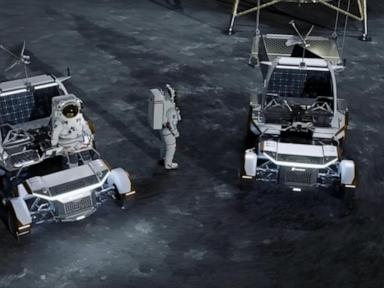
Think of FLIP not as a scientific laboratory, but as a test mule. Its sole job is to drive, to turn, to climb slopes up to twenty degrees, and to survive up to 150 hours in absolute, freezing darkness. It is the precursor to the larger Lunar Terrain Vehicles that astronauts will eventually use to commute to work across a landscape that stretches for hundreds of square miles.
NASA’s moon base program executive, Carlos Garcia-Galan, described the scale of this project not as a single house, but as an empire of infrastructure. He envisions a base camp that eventually covers hundreds of square miles. To keep track of it all, a fleet of small, hopping drones nicknamed MoonFall will be deployed to act as sentries, marking the perimeter of human activity and surveying the deep craters where water ice has remained frozen for billions of years.
The science is spectacular. The third mission planned for this year will carry an instrument called Lunar Vertex, designed to investigate the mysterious "lunar swirls"—bright, sweeping patterns on the surface that look like cosmic fingerprints. Scientists believe these swirls are tied to ancient magnetic fields locked in the crust beneath the surface, acting as natural shields against solar radiation.
But look past the instruments, the acronyms, and the corporate contracts with Blue Origin or SpaceX, and you find the human core of the matter.
The Three Steps to Staying
The architecture of this return is divided into three distinct movements, like a symphony played in slow motion over a decade.
- Phase One (Now–2029): The scouting party. Robots, drones, and uncrewed rovers map the terrain, test the soil, and establish the precise spots where human habitats can be anchored without being destroyed by landing dust.
- Phase Two (2029–2032): The foundation. This is when the heavy infrastructure arrives. Nuclear power systems, initial habitats, and a localized communications network that will allow an astronaut on the ridge to text a technician in Houston.
- Phase Three (2032 and Beyond): Continuous presence. Routine crew rotations. International scientists from Europe, Japan, and South Korea moving in and out of specialized modules like workers on an Antarctic research station.
It is a staggering logistical gamble. To fund it, NASA is doing something that would have been unthinkable during the Apollo era: they are stepping back from owning the rockets. They are pausing the development of the Gateway space station in lunar orbit to focus entirely on the dirt. They are buying rides from the private sector, treating moon landers less like sacred government property and more like cargo freighters.
The Final Shift
There is a profound vulnerability in admitting how hard this is. We like to think that because we went to the Moon in 1969, we know how to do it now. We don't. The people who knew how to do it have largely passed away, taking their tribal knowledge with them. The blueprints for the Saturn V rocket are museum pieces. We are learning how to walk all over again, in a heavier suit, on a tighter budget, under a harsher spotlight.
The true justification for the twenty billion dollars isn't the science modules or the lunar swirls, though they are valuable. The true justification is the shift in human identity.
If this plan succeeds, there will come a day in the early 2030s when a child will look up at the crescent sliver of the Moon in the night sky, knowing that at that exact fraction of a second, someone is waking up in a pressurized bunk on the Shackleton Connecting Ridge. Someone is brewing coffee. Someone is looking out a triple-paned window at the distant, blue marble of Earth, checking the battery levels on a hydrogen fuel cell, and getting ready for a shift.
When that happens, the Moon ceases to be a destination. It becomes a place.
As Garcia-Galan put it at the close of the briefing, the goal is the moment we can look across that gray desert and realize we are permanently here, and we are not giving it up.