In the late summer of 1987, the Persian Gulf was a graveyard for tankers. The Iran-Iraq War had devolved into a maritime slugfest, and the United States was busy "reflagging" Kuwaiti vessels to protect the global oil supply. Amidst this geopolitical powderkeg, a high-profile real estate developer from New York took out full-page ads in the New York Times, the Washington Post, and the Boston Globe. That man was Donald Trump. His message was blunt: the United States should stop protecting others for free and instead "tax" the oil-producing nations or simply seize the means of production. Specifically, he focused on Kharg Island, Iran's primary oil export terminal. Decades later, that 1980s rhetoric has transformed from a private citizen's fringe grievance into the operational bedrock of American foreign policy.
The fixation on Kharg Island is not a new strategic pivot. It is the continuation of a forty-year-old worldview that treats global energy infrastructure as a giant cash register that the United States has every right to ring. For an alternative perspective, check out: this related article.
The Fortress in the Gulf
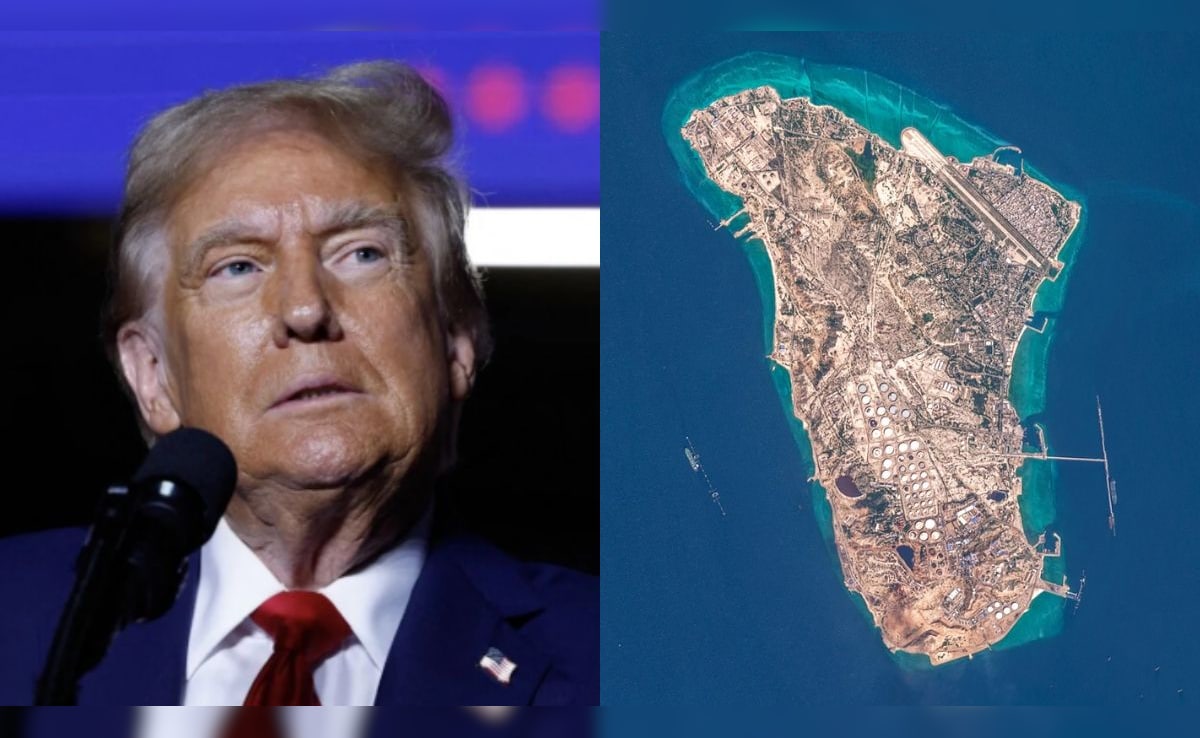
To understand why Kharg Island remains the ultimate target, one must look at the sheer physics of Iranian exports. Located about 25 kilometers off the coast of Iran in the northeastern Persian Gulf, Kharg is a coral island that handles roughly 90% of Iran’s crude oil exports. It is the choke point of a choke point. If the Strait of Hormuz is the throat of the global energy market, Kharg Island is the jugular vein.
The island is a maze of storage tanks, pumping stations, and deep-water berths. Its T-jetty and Sea Island terminals are capable of loading the largest tankers in existence. For an adversary, the strategic appeal is obvious. You do not need to invade the Iranian mainland or engage in a protracted ground war to cripple the Islamic Republic’s economy. You simply need to disable a few square miles of industrial equipment on a patch of rock in the sea. Similar reporting regarding this has been provided by The Washington Post.
In 1987, Trump’s "do a number" comment was dismissed by the foreign policy establishment as the bluster of a man who viewed the world through the lens of a hostile takeover. They saw a complex web of alliances and international law. He saw a missed opportunity to seize "the oil." This fundamental disagreement has never been resolved; it has only been amplified by the passing of time and the rise of the MAGA movement.
Why the Market Fears the Eighties Redux
When the threat of a strike on Kharg Island surfaces today, the global markets react with a specific kind of institutional memory. The "Tanker War" of the 1980s proved that disrupting Gulf oil doesn't just raise prices at the pump in Des Moines; it shatters the insurance markets that allow global trade to function.
Back then, Iraq attacked Kharg Island hundreds of times. They used Exocet missiles and French-made Mirage jets to pummel the facility. Yet, the Iranians were masters of "jury-rigged" repairs. They kept the oil flowing through sheer engineering desperation and a willingness to absorb massive casualties. If a modern strike were to occur, the damage would be far more surgical and permanent. We are no longer talking about unguided bombs falling into the sand. We are talking about kinetic strikes on specific manifolds and control rooms that cannot be replaced without Western technology—technology that Iran cannot easily bypass under current sanctions.
The Economic Domino Effect
A total shutdown of Kharg Island would instantly remove roughly 1.5 to 1.8 million barrels of oil per day from the global market. While the United States is now a net exporter of energy—a massive shift from the 1987 reality—the price of oil is still set on a global stage.
- Brent Crude Volatility: Prices would likely spike by $15 to $20 per barrel within hours of a confirmed hit.
- The China Factor: China is the primary buyer of Iranian "teapot" refinery oil. A strike on Kharg is, by proxy, an economic strike on Beijing’s manufacturing costs.
- Insurance Premiums: War risk insurance for any vessel entering the Persian Gulf would become prohibitively expensive, effectively creating a secondary blockade.
The Evolution of the "Do a Number" Doctrine
The transition from Trump the Citizen to Trump the President (and potential President again) has seen the "do a number" rhetoric evolve into a sophisticated "Maximum Pressure" campaign. In the 1980s, the suggestion was purely military. Today, it is a hybrid of cyber warfare, financial strangulation, and the ever-present threat of a Tomahawk missile.
Critics argue that hitting Kharg Island would be an act of environmental and economic terrorism that would alienate American allies in Europe and Asia. They suggest it would provide the Iranian regime with a "rally around the flag" moment, distracting a restless population from internal failures. But the veteran analyst sees a different calculation. The current iteration of this doctrine isn't about regime change in the traditional sense. It is about "bankrupting the revolution."
If Iran cannot sell oil, it cannot pay its proxies in Lebanon, Yemen, or Iraq. The logic is cold and transactional. It treats the Middle East not as a puzzle of ancient grievances, but as a business with a failing balance sheet. If you take away the revenue, the business eventually closes its doors.
The Overlooked Risk of Retaliation
There is a reason the "Establishment" has hesitated to pull the trigger on Kharg for forty years. Iran’s response would not be confined to the island. The Iranian military has spent decades preparing for exactly this scenario. Their "swarm" tactics—using hundreds of small, fast-attack boats armed with missiles—are designed to overwhelm the Aegis combat systems of U.S. destroyers.
Furthermore, the vulnerability of the Abqaiq plant in Saudi Arabia, which was struck by drones in 2019, proves that Iran can hit back at the global oil supply in ways that hurt Washington’s partners just as much as themselves. This is the "Samson Option" of the Persian Gulf. If Kharg goes down, the Iranian leadership has signaled that no one else’s oil will reach the market either.
The Architecture of a Modern Strike
If a commander-in-chief were to finally execute the 1987 "warning," the operation would look nothing like the messy air raids of the Iran-Iraq War. It would likely begin with a massive cyberattack on the Distributed Control Systems (DCS) that manage the pressure in the pipelines. By the time the missiles arrived, the facility’s fire-suppression systems would already be disabled.
The target wouldn't be the storage tanks, which are just big buckets of liquid that are hard to burn completely. Instead, the focus would be on the "pumping heart"—the specific manifolds where multiple pipelines converge. Destroying these requires precision, but it renders the entire multi-billion dollar complex useless for years.
This is the "number" that was being contemplated in the eighties and remains on the table today. It is a plan that ignores the nuances of diplomacy in favor of the finality of industrial destruction.
The Permanence of the Idea
We often treat political statements as ephemeral, especially those made by figures like Trump. We assume that a comment made to a reporter in 1987 has no bearing on a National Security Council meeting in the 2020s. This is a mistake.
The Kharg Island obsession reveals a consistent, unwavering belief in the efficacy of American power when applied to the world’s gas stations. It reflects a worldview where the "Art of the Deal" is backed by the threat of total economic erasure. Whether or not a missile ever strikes the coral shores of Kharg, the fact that the threat has remained consistent for nearly four decades tells us everything we need to know about the future of U.S.-Iran relations. The pressure is not a phase; it is the policy.
The global energy transition to renewables may eventually make Kharg Island irrelevant, but for the next decade, it remains the most dangerous piece of real estate on the planet. The fuse that was lit in a series of newspaper ads in 1987 is still burning.
Identify the specific coordinates of Iran's loading jetties on any satellite map and you will see the vulnerability that has fascinated American hawks for a generation.
Would you like me to analyze the specific defensive capabilities Iran has installed on Kharg Island since the 2019 tensions?