The cabin of a Boeing 777 at midnight is a strange, suspended reality. Outside, the air is a freezing void over central Asia. Inside, there is only the low, collective hum of the engines and the soft, ambient glow of cabin lights reflecting off polished wood veneer.
For a financial official tasked with bridging two worlds, this is where the real work happens.
It is easy to look at global economics as a series of sterile spreadsheets. We see headlines about gross domestic product, trade deficits, and tariff structures, and our eyes glaze over. We treat these numbers as if they are weather patterns—massive, impersonal forces moving across a map. But every line on a balance sheet represents a human decision. Every tariff is a door closing; every investment treaty is a handshake between people who have chosen, despite their doubts, to trust each other.
When Hong Kong’s Financial Secretary, Paul Chan, boarded a flight bound for Europe, he wasn’t just carrying briefing binders. He was carrying the weight of a narrative that needed shifting.
For decades, the relationship between European capital and the Asian financial hub was simple, lucrative, and taken for granted. You put money in; you pulled growth out. But the last few years have fractured that simple equation. Political friction, supply chain anxieties, and a growing chorus of skepticism have built a wall of noise between West and East.
To fix a relationship blocked by noise, you cannot just shout louder. You have to travel. You have to sit across a table, look someone in the eye, and pour the tea.
The Friction of Distance
Consider a hypothetical fund manager in Paris. Let’s call her Claire.
Claire manages four billion euros in pension assets. Every morning, she sits at a glass desk overlooking the Place de l'Opéra, reading reports about shifting regulatory frameworks, geopolitical alignment, and risk premiums. To Claire, Hong Kong can easily begin to look like a abstract risk vector on a screen rather than a living, breathing marketplace. When the narrative in the Western press suggests that the city’s unique position is eroding, Claire’s natural instinct is caution. She pauses investments. She diversifies outward. She waits.
Multiply Claire by ten thousand, and you get the quiet, terrifying capital flight that keeps central bankers awake at night.
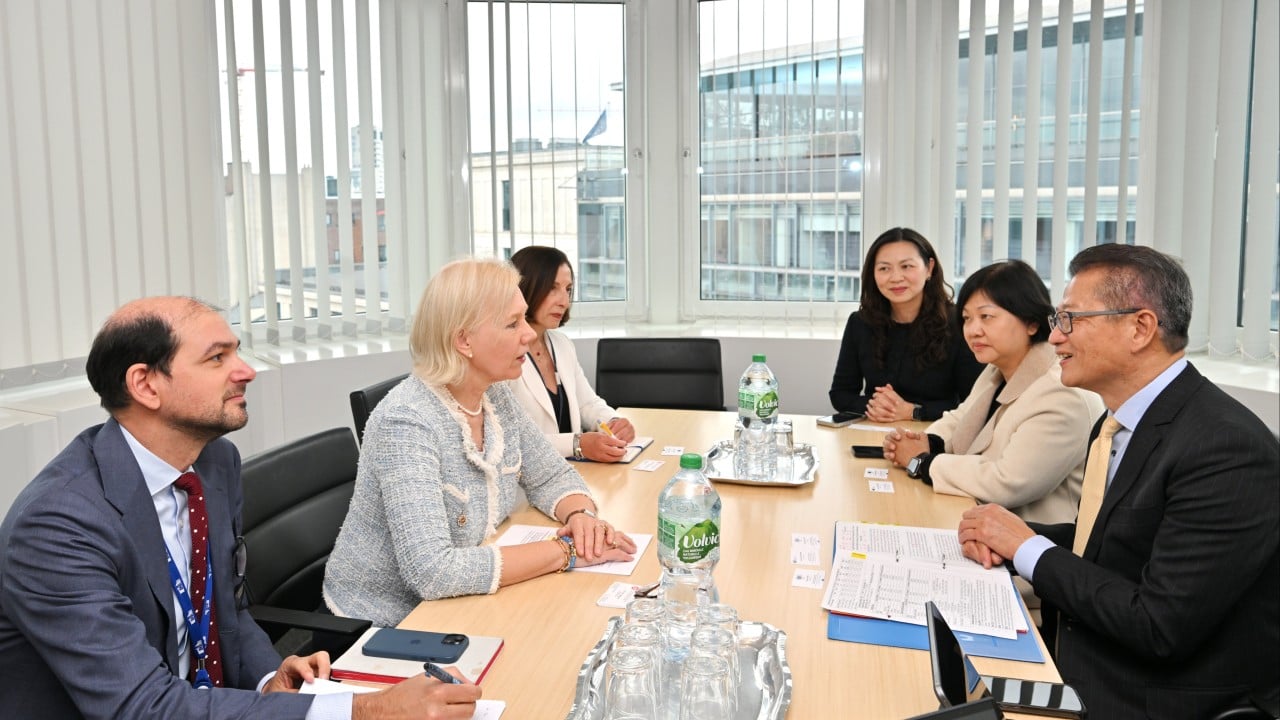
This is the invisible crisis Paul Chan set out to address during his European tour, hitting major financial nodes like London, Berlin, and Frankfurt. The mission wasn’t to deliver a series of triumphant press releases. It was to confront the skepticism head-on.
The core of the argument Chan put forward to European leaders and investors is rooted in a fundamental mechanism that many outsiders have misunderstood: the "One Country, Two Systems" framework. To the uninitiated, this sounds like political jargon. In practice, it is the legal framework that allows a common law system to thrive inside the borders of a civil law superpower.
For a European business, common law is the oxygen of commerce. It means contracts are enforceable, intellectual property is protected by predictable precedents, and the judiciary operates independently. If you sue a counterparty, you know the rules of the game. Chan’s message across European capitals was simple: the infrastructure that made the city an international financial center remains completely intact. The courtrooms still operate in English. The capital still moves without restrictions. The peg to the US dollar is not going anywhere.
But logic alone rarely wins a skeptical heart. You need to address the anxiety.
The Dinner Table and the Balance Sheet
During a series of private dinners and closed-door roundtables in Germany, the atmosphere was polite but cautious. European business leaders are currently trapped in a painful vice. On one side, they face stagnant growth at home and the urgent need to access the massive consumer markets of mainland China, particularly the affluent, tech-heavy Guangdong-Hong Kong-Macao Greater Bay Area. On the other side, they face immense political pressure to "de-risk" their supply chains and financial exposure.
It is a agonizing tightrope walk.
Imagine sitting in a wood-paneled room in Frankfurt, the rain beating against the glass, listening to a presentation about the Greater Bay Area—a region of over 86 million people with a economic output that rivals Canada. For a European industrialist, that isn’t just a statistic. That is the survival of their company's next three generations. If they pull back now, their competitors in other parts of the world will fill the vacuum.
The strategy deployed during these meetings was not to deny the differences between Europe and China, but to reframe them.
Dialogue is not about achieving total agreement. That is a utopian myth. True diplomatic dialogue is about creating a predictable framework for disagreement, so that commerce can continue while the politicians argue. By positioning the city as the unique intermediary—a place where European firms can anchor their regional headquarters under familiar legal structures while plugging directly into the mainland’s economic engine—the pitch moves from political debate to pure pragmatism.
It is an argument that appeals directly to the ledger. If you want to tap into the green transition in China, or the explosion of artificial intelligence firms in Shenzhen, you need a financial launchpad. Berlin cannot provide that. Neither can Singapore, not with the same deep, systemic integration into the mainland's financial plumbing.
The Unseen Architecture of Trust
The skepticism, however, runs deeper than legal structures. It lives in the emotional realm of perception.
When you spend years watching news cycles dominated by conflict, you develop a mental fatigue. You begin to view international relations through a lens of inevitable decoupling. It feels safer to retreat into regional silos.
But silos are incredibly expensive.
When Europe and Asia pull apart, the cost of everything rises. Capital becomes less efficient. Innovation slows down because scientists and engineers are no longer sharing data across borders. The green transition—something both Europe and China claim as an existential priority—stalls because the financial instruments required to fund massive offshore wind farms or battery gigafactories cannot clear international regulatory hurdles.
This is where the true stakes of these diplomatic missions reveal themselves. It is not about whether a specific bank opens a new branch next week. It is about maintaining the plumbing of global civilization.
During his addresses, Chan repeatedly pointed to green finance and sustainability as the natural neutral ground for co-operation. Europe has the regulatory sophistication and the institutional mandate to invest sustainably. Asia has the sheer scale of projects requiring capital. By creating joint standards for green bonds and carbon trading, the two regions can build a bridge made of mutual self-interest that bypasses political grandstanding.
It is a delicate calculation. It requires acknowledging that while the macro-narrative is fraught with tension, the micro-level interactions—the joint ventures, the research partnerships, the cross-border listings—are more vital than ever.
The Reality on the Ground
There is an inherent vulnerability in going on a roadshow like this. To stand before an audience of European financiers who are hyper-aware of global risks is to invite intense scrutiny. They will ask the hard questions about data security, about political stability, about the long-term viability of the financial system under shifting geopolitical alignments.
The answer cannot be a glossy brochure.
The only effective response is a transparent inventory of realities. Yes, the world has changed. Yes, supply chains are shifting from absolute efficiency to absolute resilience. But resilience does not mean isolation. In fact, a resilient business model requires diversified access to capital, and there is no scenario in the next half-century where the economic weight of the world does not continue to tilt toward Asia.
As the European tour concluded, the success of the initiative will not be measured in sudden, dramatic announcements. It will manifest in the quiet decisions made months from now by people like Claire in Paris. It will be the decision not to divest. It will be the choice to sign off on a new joint venture in the wealth management connect scheme. It will be the subtle, vital resumption of capital flow through channels that had begun to gather dust.
The flight back across the continents returns to the same quiet hum. Below, the vast expanses of the global economy continue to churn, oblivious to the individuals trying to steer its course. The binders are packed away. The teacups are cleared. What remains is the slow, invisible work of gravity—the natural pull of capital toward opportunity, and the stubborn, human belief that a bridge is always more useful than a wall.