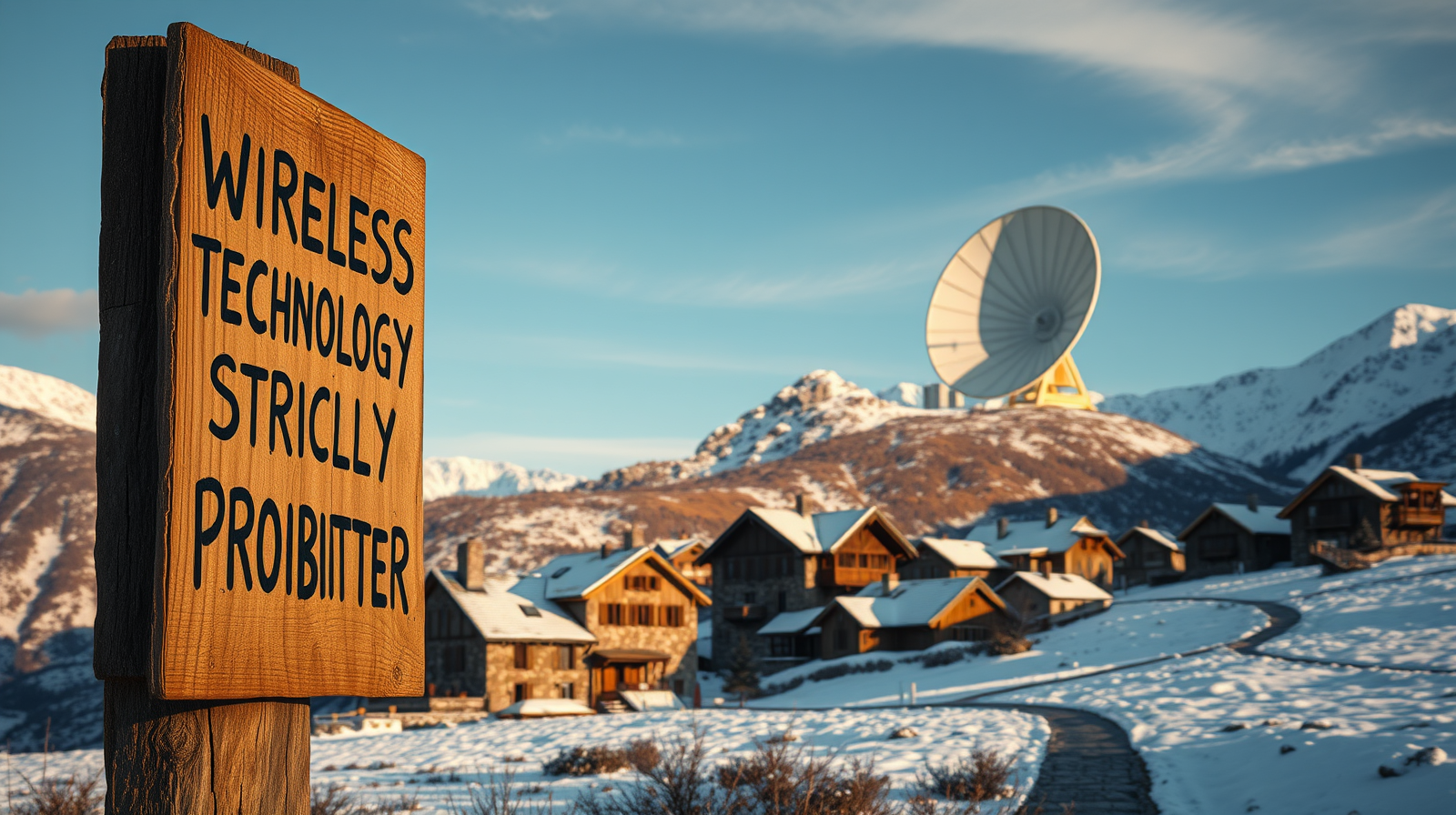
Imagine trying to explain modern internet addiction to someone who lives in a place where pressing the button on a microwave can technically interfere with listening to the stars.
Most people picture West Virginia through rolling mountain ridges and coal mining history. They don't picture a massive 13,000-square-mile bubble where the radio waves are heavily regulated. This is the National Radio Quiet Zone, established back in 1958 by the Federal Communications Commission and the Interdepartment Radio Advisory Committee. It exists to shield ultra-sensitive radio telescopes at the Green Bank Observatory from human-made interference.
If you think life here feels like stepping back into the 1970s, you are only half right. The reality is far more nuanced, full of surprising technological compromises, and heavily misunderstood by internet tourists.
The Reality of Living Inside the Bubble
Let's clear up a massive misconception right away. The National Radio Quiet Zone is huge—roughly the size of massachusetts and connecticut combined—spanning parts of West Virginia, Virginia, and a sliver of Maryland. Hundreds of thousands of people live inside this zone. Most of them have standard cell service, Wi-Fi networks, and everyday gadgets.
The strict rules change dramatically depending on your proximity to the actual scientific instruments.
As you approach the observatory in Pocahontas County, the restrictions tighten. Within a ten-mile radius governed by the West Virginia Radio Astronomy Zoning Act, permanent fixed transmitters face heavy limits. Right at the core, inside the small unincorporated community of Green Bank itself, the rules get intense.
In the immediate vicinity of the telescopes, ordinary consumer electronics like Wi-Fi routers, Bluetooth devices, and remote controls can cause data spikes that ruin astronomical observations. Observatory staff actively drive around the surrounding area with spectrum analyzers, hunting down rogue signals. When a faulty device or an unshielded microwave oven starts leaking electromagnetic radiation, someone from the observatory might literally knock on your door to ask you to turn it off.
Why the Telescopes Need Absolute Silence
Radio astronomy doesn't work with traditional optical lenses. Giant metal dishes point up at the sky to detect faint, natural radio waves emitted by pulsars, distant galaxies, and hydrogen clouds.
These cosmic signals are remarkably weak. The total amount of energy collected by all the radio telescopes on Earth combined is equivalent to a tiny fraction of a single snowflake hitting the ground.
When someone fires up a cellular network tower or a wireless router nearby, it creates a deafening roar in the radio spectrum. It is the astronomical equivalent of trying to hear a whisper across a rock concert. Without protection zones, the Green Bank Telescope—currently the world's largest fully steerable radio telescope—would be completely blinded.
Vehicles on the immediate observatory grounds must even use diesel engines. Standard gasoline engines rely on spark plugs that generate a broad spectrum of electromagnetic noise, which disrupts the sensitive instruments nearby.
Modern Exceptions and Changing Rules
Life inside Green Bank isn't completely frozen in amber. Rules adapt when reality demands it.
For the longest time, the local school operated entirely without Wi-Fi, relying on physical ethernet cables snaking through classrooms. That changed recently. Observatory engineers worked closely with local school officials to allow specific wireless routers to operate strictly on the 2.4 GHz frequency band during school hours, turning them off automatically when classes end. It is a calculated compromise, balancing cutting-edge cosmic research with the educational needs of local kids.
Outside the immediate ten-mile ring, daily life looks completely normal. You can stream movies, scroll social media, and use GPS navigation just like anywhere else in America. You just cannot throw up a massive unauthorized broadcast tower without going through a strict coordination process with the observatory's interference office first.
Dealing with the Electromagnetic Refugees
There is another quirky demographic drawn to Green Bank that often makes news headlines. Over the years, people claiming to suffer from electromagnetic hypersensitivity have packed up and moved into the Quiet Zone.
Medical science does not recognize electromagnetic hypersensitivity as a physical condition caused by ambient fields, but for individuals experiencing debilitating headaches, fatigue, or anxiety that they attribute to modern technology, Green Bank offers a psychological sanctuary. They live in homes lined with heavy foil, far away from cellular towers, seeking relief in the radio silence.
While scientists at the observatory are strictly focused on pulsars and black holes rather than human health ailments, these residents have woven themselves into the fabric of the local community.
Navigating a Visit to the Quiet Zone
Visiting Green Bank requires a mindset shift. If you plan to tour the observatory grounds, you are asked to leave your wireless gadgets behind or power them completely off.
- Turn off your cellular data and Bluetooth before you cross the perimeter.
- Expect analog solutions for communication in areas where digital signals create interference risks.
- Respect local signage regarding electronic equipment.
The locals don't view the restrictions as an oppressive government mandate. They see it as a shared civic duty to protect a window looking out into the wider universe.
Stop treating Green Bank like a sci-fi dystopia where humanity is banned from progress. It's a living, breathing laboratory where a small community chooses to keep things quiet so humanity can listen to the stars.