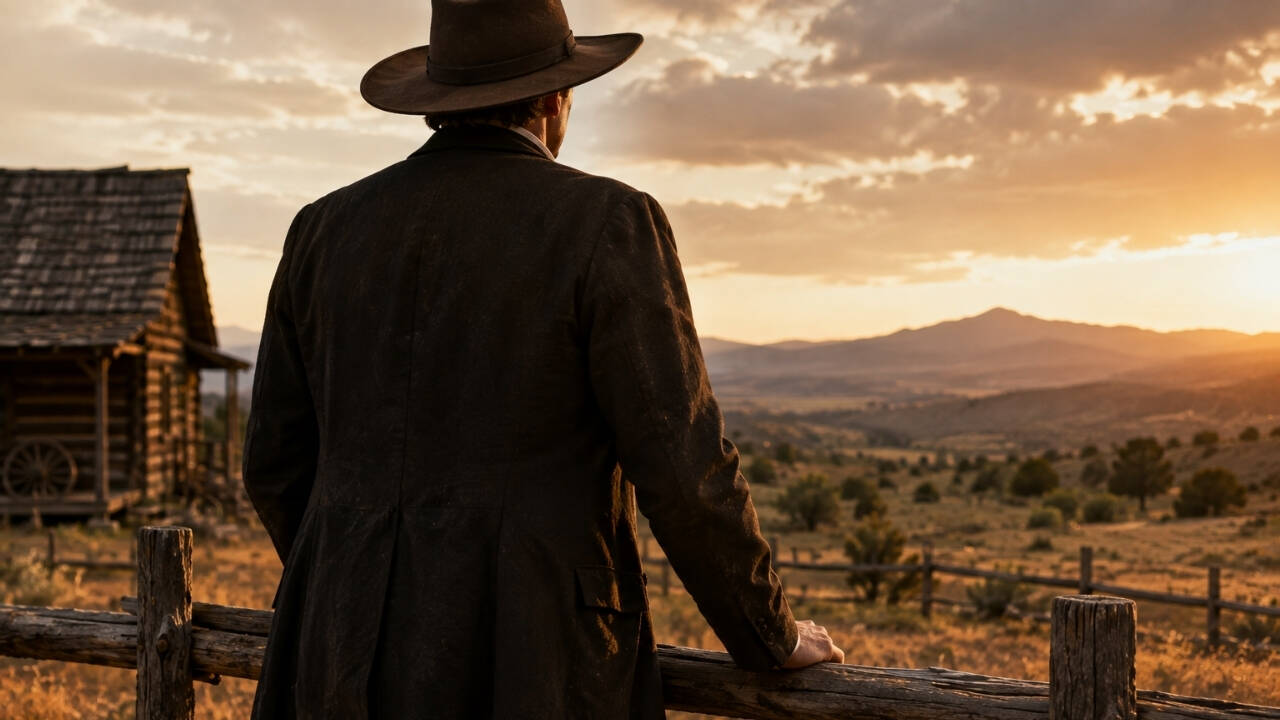
History loves a tidy redemption arc. Take Virgil Earp. The man walks away from the O.K. Corral with lead in his shoulder, flees Tombstone after an assassination attempt that ruins his arm, and reinvents himself as an honest dirt-scratching homesteader in territorial Arizona. Seventeen years after the gunfight, he files a claim on 160 acres. Two years later, he gets the patent. Cue the dramatic swelling orchestra music. The violent gunman becomes the peaceful pioneer.
Except that is not how frontier land acquisition worked, and it certainly is not who Virgil Earp was.
Most history buffs swallow this narrative whole because it fits a comfortable script. Gunfighter gets tired of blood, calms down, works the land, and becomes a respectable citizen. It is a lazy consensus built on romanticized local color rather than the gritty, predatory mechanics of late 19th-century real estate speculation in the American West.
Let us dismantle the myth right now. Virgil Earp did not move to the desert to grow alfalfa out of the goodness of his heart. He was playing an aggressive land game. And the common obsession with his homestead filing completely misses the financial desperation and speculative hustle that actually defined his later years.
The Myth of the Peaceful Homestead
Go look at the standard historical commentary surrounding Virgil Earp and his 1898 land claim near Prescott or the Huachucas depending on the local lore you are reading. The framing is always about rehabilitation. Writers treat the land patent as a reward for survival.
This view shows a fundamental misunderstanding of the Homestead Act of 1862. Congress did not pass that legislation to hand out free retirement packages to aging lawmen. The act was a massive economic engine designed to push capital, infrastructure, and taxable property into federal territories.
By the late 1890s, the frontier was rapidly closing. Prime agricultural acreage with water rights was scarce. Filing a 160-acre claim in arid Arizona territory was rarely about subsistence farming. It was about securing a cheap asset, proving up the bare minimum requirements mandated by the General Land Office, and flipping it or leveraging it for mining and grazing interests.
Virgil Earp was no dirt farmer. Throughout his life, he bounced from mining camps to saloons, dabbling in law enforcement when it paid a stable wage, but always chasing the next real score. He was a professional gambler by trade. Gamblers do not spend five years breaking their backs over dry soil for a subsistence corn crop unless there is an underlying financial play.
Following the Paper Trail of a Speculator
To understand what Virgil was actually doing, look at his track record with money. Historians love to paint the Earps as principled agents of order, but their financial ledger tells a different story. They were perpetual operators.
When Virgil filed his claim in 1898, he was aging, his shooting arm was permanently crippled from the shotgun blast delivered by hidden assassins in Tombstone, and his earning capacity as a bouncer, guard, and gun-for-hire was tanking. He needed assets.
Under the Homestead Act, a claimant had to reside on the land for five years, build a habitable house, and cultivate a portion of it. But let us look at how these rules were gamed on the ground. Commutation provisions allowed claimants to buy the land outright after just six months of residency by paying a standard government fee of $1.25 to $2.50 per acre.
Did Virgil stick it out for the full grind of traditional proving, or did he exploit the loopholes available to veterans and seasoned frontiersmen? Records show that veterans of the Union Army—which Virgil was, having served in the 24th Iowa Infantry—could deduct their wartime service time from the residency requirement. This drastically shortened the clock.
When you factor in these legal shortcuts, the romantic picture of Virgil toiling away for two long years under the desert sun dissolves. He was executing a calculated play to secure a deeded title with minimal friction. Once you hold a patent from the federal government, that land transitions from public domain to private capital. You can mortgage it. You can sell it to mining syndicates. You can use it as collateral.
That is not a farmer's journey. That is a speculator's exit strategy.
The Reality of Arizona Territory Real Estate
People look at 160 acres in Arizona and imagine a sprawling ranch. In reality, much of the territory claimed under these late-century provisions was valuable primarily for what lay underneath it or how it controlled access to scarce water sources.
Control a narrow canyon or a strategic strip with a spring, and you effectively control thousands of surrounding acres of open range. This was the open-range monopoly game played across the West. Cattle barons and smart operators used straw men or their own homestead rights to lock down water choke points.
While Virgil was not a cattle king like John Chisum, he understood the value of real estate leverage. His brother Wyatt spent a lifetime chasing phantom gold mines and running crooked faro games. Virgil was slightly more pragmatic, but the underlying ethos was identical: extract maximum value from whatever environment you happen to be standing in.
If you examine the local economic pressures of Arizona in 1898, the territory was booming with copper mining and railway expansion. Land values near transportation corridors and mineral deposits were shifting rapidly. Filing a claim wasn't about retreating from civilization; it was about positioning yourself ahead of the infrastructure curve.
Dismantling the People Also Ask Fallacy
If you search the digital archives regarding Virgil Earp, certain questions pop up repeatedly. Let us address the most common one with brutal honesty.
Did Virgil Earp live a quiet life after Tombstone?
The popular answer is yes, pointing to his time as a peace officer in California and his eventual settling down. The real answer is no. Virgil never lived a quiet life. Even in his later years in Goldfield, Nevada, during the boom of the early 1900s, he was still working as a pit boss, dealing cards, and staying tangled up in the high-stakes, violent underbelly of mining camp towns.
The idea that he traded his six-shooter for a plow and lived out his days in quiet anonymity is a comforting myth invented by biographers who wanted a neat book jacket conclusion. Virgil stayed on the hustle until his body finally gave out from pneumonia in 1905. The 1898 homestead claim was just one tactical move in a lifelong series of financial gambbits.
Unconventional Takeaways for Modern Operators
What can contemporary entrepreneurs and investors learn from an aging 19th-century gunfighter filing for desert acreage? Quite a bit, actually.
Most people approach asset acquisition with emotional sentimentality. They buy real estate because they "love the vibe" or because a location has sentimental value. That is the modern equivalent of believing Virgil Earp wanted to grow pumpkins.
- Never confuse lifestyle with leverage. Virgil did not file for land to enjoy the view. He filed because he needed a secure, deeded asset on the books when his physical labor capital was declining.
- Understand the rules of the system better than the regulators. The Homestead Act had specific loopholes, exemptions, and commutation clauses. Virgil used his veteran status and legal frameworks to optimize his time-to-value ratio. If you are not exploiting every legal mechanism available in your industry, you are leaving margin on the table.
- Recognize when your primary income stream is dying. By the late 1890s, Virgil could no longer rely on his reputation as a fast-draw lawman. His body was broken. He pivoted to land and asset acquisition because physical dominance had an expiration date. When your core advantage fades, you must transition to capital accumulation before the market forces your hand.
The hagiography of the American West is a product of dime novels and Hollywood screenwriters. They needed heroes who could transition seamlessly from violent law enforcement to peaceful agrarianism.
Strip away the folklore, look at the land office ledgers, and you find something much more interesting. You find a hardened, calculating survivor adapting to a closing frontier, using federal legislation as a financial instrument, and securing his position right up to the end.
Stop romanticizing the pioneer. Start studying the operator.