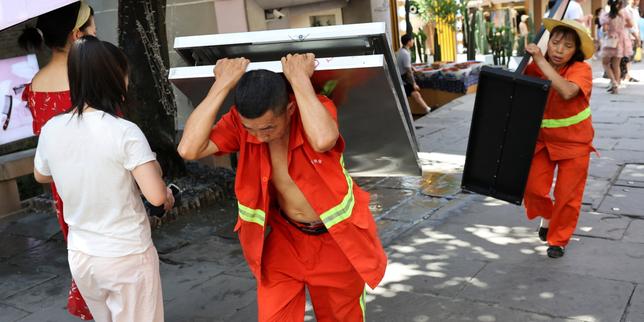
The humidity in Chongqing doesn’t just hang in the air; it sticks to your skin like wet wool. If you step out of the glittering, ultra-modern Liberation Monument shopping district and walk toward the docks where the Yangtze and Jialing rivers collide, you will hear a sound that defines the old soul of this city. It is the rhythmic, heavy scrape of rubber-soled shoes against wet limestone.
For decades, that sound belonged to the bangbang.
They are the human pack mules of China’s most vertical metropolis. Armed with nothing but a thick bamboo pole—a bang—and two nylon ropes, these migrant workers have carried the weight of Chongqing on their shoulders. They carried refrigerators up thousand-step cliffs. They moved crates of river fish to mountain markets. They transported the luggage of wealthy tourists who could not stomach the city's endless, steep staircases.
But the mountain is flattening. The bamboo poles are snapping. An entire way of life is vanishing into the smog, and nobody is coming to save it.
The Weight of Two Oceans
To understand the bangbang, you have to understand the geology of Chongqing. This is not Beijing, flat and sprawling. This is a city built on the jagged edges of the Daba Mountains. Streets run on top of skyscrapers. Monorails dive straight through apartment buildings. For generations, wheeled carts were useless here. If you wanted something moved from the riverbanks to the high ridges of the city, you needed muscle.
Consider Lao He. He is a hypothetical composite of the dozens of men I have watched sit on the stone steps of the Chaotianmen docks, but his reality is undeniable. Lao He is fifty-eight years old. His spine curves slightly to the left, a permanent physical map of the thousands of tons he has hauled over thirty years. His hands are thick, calloused landscapes where the skin has split and healed so many times it looks like tree bark.
On a good day ten years ago, Lao He could make eighty yuan—about twelve dollars—by carrying a massive wardrobe up a three-hundred-step alleyway. It was grueling, bone-crushing work. Yet, it paid for his son’s university tuition. It bought the seed for his family’s small plot of land in the rural Sichuan province.
The bangbang army once numbered over three hundred thousand men. They were the blood vessels of Chongqing's economy, moving goods where machines could not go. They were an indispensable institution.
Now, they are ghosts.
The Ghost in the Machine
The decline did not happen overnight, but it happened with brutal efficiency. Two unstoppable forces converged to render the bangbang obsolete: infrastructure and smartphones.
First came the concrete. The local government embarked on an unprecedented engineering campaign, carving highways out of cliffs, installing massive public escalators, and building elevators that travel hundreds of feet straight up the mountain faces. Suddenly, the vertical barriers began to dissolve.
Then came the digital revolution.
Imagine sitting on a stone step, waiting for someone to shout for a porter, while overhead, electric scooters whiz past. Today, Chongqing’s commerce moves through apps like Meituan and Ele.me. If a shop owner needs fifty pounds of flour moved across town, they don't look for a man with a bamboo pole. They tap a screen. A courier on an electric moped arrives, loads the cargo into a plastic bin, and uses the newly built highway network to deliver it in twenty minutes.
The bangbang cannot compete with an algorithm. They do not own smartphones capable of running these logistics networks, and even if they did, many are illiterate or struggle with digital interfaces. They are trapped in an analog existence inside a hyper-digital world.
The statistics tell a stark story. Demographers estimate that fewer than a few thousand active bangbang remain in Chongqing today. Their average age is well over fifty-five. Young migrants from the countryside no longer choose this path. Why would they? They can work in air-conditioned iPhone factories or ride delivery bikes in Shanghai. The bamboo pole has lost its economic gravity.
The Pride of the Burden
It is easy to look at this transition and celebrate it as progress. It is progress. No human being should have to spend forty years acting as a beast of burden, destroying their knees and vertebrae for the price of a bowl of noodles.
But if you sit with these men, you realize the truth is more complicated. There is a fierce, stubborn pride in the bangbang culture. They call themselves the "backbones of the city." They operated on a code of absolute honesty. You could hand a bangbang a briefcase containing thousands of yuan or a crate of fragile jade, walk away, and meet him two hours later at the top of the mountain. He would be there, sweating, waiting for you. They never stole. They never complained.
When we lose the bangbang, we don't just lose an outdated transport system. We lose a specific kind of human connection.
The modern delivery driver is a face hidden behind a plastic helmet visor. They drop a package at your door, send an automated text, and disappear. The bangbang was a neighbor. He sat in your kitchen, caught his breath, drank the tea you offered him, and shared news from the countryside. He was part of the urban fabric.
Now, that fabric is being replaced by seamless, frictionless automation.
The Last Descent
Watch Lao He today at the docks. The cruise ships still arrive, pouring wealthy tourists onto the piers. But the tourists have rolling suitcases now, and smooth ramps lead from the boats directly to the light rail stations.
He sits on his bamboo pole, which is balanced horizontally across a stone step. He smokes a cheap, pungent cigarette. Hours pass. His eyes scan the crowd, looking for a glance, a gesture, any sign of a customer. Nothing. The world rushes past him at the speed of 5G internet, while he remains anchored to the stone.
As evening falls, the neon lights of Chongqing spark to life. The city transforms into a cyberpunk dreamscape, reflecting brilliant pinks and cyber-blues off the surface of the Yangtze River. It looks like the future.
Lao He stands up, his joints popping audibly in the humid air. He lifts his empty bamboo pole, rests it across his calloused shoulder, and begins the long climb up the stairs toward his rented room—a windowless basement space he shares with three other porters.
He walks slowly, deliberately. Each step is a quiet defiance against a city that has outgrown him. His shadow stretches long and thin across the wet pavement, illuminated by the glare of a giant LED billboard advertising the latest smartphone. For a moment, the shadow looks like a monument. Then, a group of teenagers laughing over a livestream walks right through it, and the monument vanishes into the crowd.