The coffee in Extremadura is bitter before six in the morning. Mateo stirs it with a spoon that has lost its chrome, watching the steam rise against the cold kitchen window. Outside, the plains of Cáceres stretch out under a sky the color of wet slate, empty and vast. In a few minutes, he will pull on his heavy boots, zip his high-visibility jacket, and walk out the door toward the cooling towers that dominate the horizon.
Those towers are aging. Everyone knows it.
For forty years, the Almaraz nuclear power plant has hummed against the backdrop of the Tagus River like a steady, invisible heartbeat. It provides electricity to millions of homes, keeping refrigerators cold, hospital monitors beeping, and factories humming across the Iberian Peninsula. It is Spain's largest atomic facility, a colossal engine of concrete and steel that operates with the quiet persistence of a mechanical clock. But clocks run down. The original design demanded an end, a quiet retirement by the decade's close, leaving a void that no one quite knew how to fill.
Until now.
Spain has just blinked. Faced with the raw arithmetic of energy demand and the harsh realities of a transitioning grid, the government and the plant's owners reached an accord. Almaraz will not go dark in 2027 or 2028. Its operational life has been officially extended until 2030.
A stay of execution. A breathing space.
Listen closely. You can hear the collective exhale of an industry walking a tightrope.
The Weight of the Megawatt
Energy is an abstract concept until the lights go out. We turn a switch, and the modern world obeys. We rarely pause to consider the immense, delicate machinery keeping that light burning. Nuclear power is an exercise in magnificent tension. It demands absolute precision, cold mathematics, and human vigilance that never sleeps.
Almaraz is split into two massive reactors, Almaraz I and Almaraz II. Together, they represent roughly seven percent of Spain's total electricity generation. That is not just a statistic on a spreadsheet. That is hospitals operating without interruption during summer heatwaves. That is electric trains crossing the sun-scorched plains. That is industry staying competitive in a global market that punishes hesitation.
To understand why this extension matters, you have to look at the math of transition. Green energy is the destination, but the bridge is still being built. Solar panels drink the Andalusian sun, and wind turbines slice the northern gales, but the wind stops blowing when the weather stalls, and the sun sets every single evening. Storing that energy on a continental scale remains an expensive, unfinished puzzle.
Drop Almaraz too early, and the grid stumbles.
Mateo knows this. He has spent thirty years walking through the labyrinth of pipes and turbine halls, listening to the pitch of the machinery. To him, the plant is not a political football or a headline in a Madrid newspaper. It is a living machine requiring care, maintenance, and respect. When politicians argue about phase-out dates in air-conditioned rooms hundreds of kilometers away, Mateo is checking pressure valves and reviewing coolant logs.
He feels the weight of every megawatt.
The Politics of the Interim
The decision to push the retirement date to 2030 was never simple. It sits at the messy intersection of economics, environmental anxiety, and raw necessity.
For years, the political consensus leaned heavily toward a strict nuclear exit. The roadmap was drawn: shut them down one by one, replace them with renewables and natural gas as a transition fuel, and step boldly into a carbon-neutral future. It sounds clean on paper. Reality, however, is notoriously messy.
Energy prices spiked across Europe following geopolitical shocks. Inflation bit hard into capital investments. Grid operators looked at the projected curves of demand—fueled by the rapid rise of electric vehicles, heat pumps, and data centers—and did the math. The numbers did not lie. Shutting down Almaraz right now would force a dangerous reliance on fossil fuels or foreign imports, driving up costs for ordinary citizens and destabilizing the grid.
So, pragmatism won. A fragile, necessary compromise was struck. The operating license is stretched. The clock ticks a little slower.
Critics call it a betrayal of long-term climate goals. Supporters call it common sense. But standing in the shadow of the containment dome, these grand political debates feel distant. The immediate reality is simpler: Spain needs the power, and the plant is safe enough to keep giving it.
(Note: This perspective is drawn from the documented operational history of the facility and the technical assessments provided by Spain’s Nuclear Safety Council, the CSN.)
Inside the Control Room
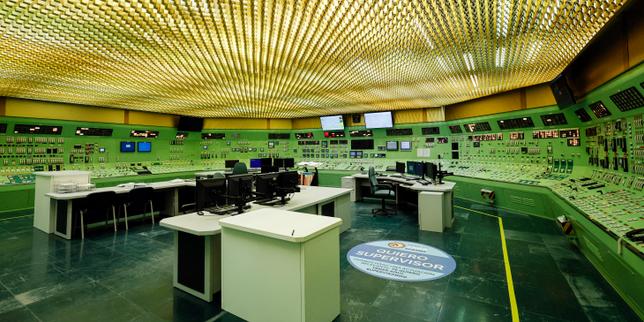
Step inside the control room of Almaraz, and the noise of the outside world vanishes.
It is an arena of soft lighting, endless banks of digital monitors, and the low, constant murmur of operators communicating in precise, clipped tones. There are no dramatic alarms blaring. There is only focus.
Elena sits at the primary console. Her hair is graying at the temples, and her eyes carry the accumulated fatigue of night shifts and emergency drills. She has worked here for twenty-two years. She remembers when the control room still featured analog dials that clicked mechanically with every fluctuation. Now, it is sleek glass and algorithms, but the core responsibility remains identical.
"People think nuclear energy is about fear," Elena says, her voice steady as her fingers hover over a keyboard. "They think of explosions or invisible hazards. But real nuclear work is about boredom. It is about doing the exact same meticulous check for the ten-thousandth time with the exact same level of attention as the first."
The extension to 2030 means Elena will likely work right up to the new finish line. It means her career will close not with an abrupt shutdown, but with a managed descent.
For the workforce, this extension is a lifeline. Almaraz is the economic lungs of the region. Entire towns—Almaraz del Arañuelo, Navalmoral de la Mata, and the surrounding villages—depend on the high-paying, stable jobs the plant provides. Without it, young people pack their bags and leave for Madrid or Barcelona. With it, the local bakeries stay open, schools have children in the classrooms, and families can plan for a future that extends past next Tuesday.
The extension buys time not just for the national grid, but for the local soul.
The Real Cost of Delay
Buying time is not free.
Extending the life of a nuclear plant built in the late seventies requires massive capital investment. Safety upgrades do not happen by accident. Pumps must be replaced, control systems modernized, and containment structures subjected to brutal, non-destructive testing to ensure the concrete has not fatigued under decades of thermal stress and radiation.
Millions of euros will flow into Almaraz over the next few years. The plant owners—a consortium of major Spanish energy giants including Iberdrola, Endesa, and Naturgy—must balance these mandatory upgrade costs against the revenue generated during the bonus years.
It is a high-stakes gamble. Every euro spent on a facility slated for closure by 2030 is a euro that cannot be invested in the next generation of grid infrastructure or battery storage farms.
Consider what happens next. As 2030 approaches, the hard deadline returns, sharper than before. The extension is not a cancellation of the phase-out; it is a postponement. It is a promissory note written to the future. When the calendar finally flips to a new decade, the question of what replaces Almaraz will be even more urgent, the stakes even higher.
The danger is complacency. Governments love extensions because they push difficult decisions across the political horizon, dumping them onto the next administration. If policymakers use this breathing room to coast, to kick the can down the road while ignoring the massive buildup of renewables and storage required to pick up the slack, then 2030 will arrive like a freight train.
The River and the State
Outside, the Tagus River flows past the plant, indifferent to human engineering. It has carved this landscape for millions of years, long before the first block of concrete was poured, long before electricity was harnessed from the atom.
The river water is drawn in to cool the steam condensers, warmed slightly, and returned to the current. It is a delicate choreography between industrial might and natural ecology, monitored constantly by environmental agencies to ensure the local ecosystem remains unharmed.
Almaraz is a monument to an era of big bets and centralized power. It represents the twentieth-century belief that human ingenuity could conquer scarcity through sheer scale. Today, we are trying to build a twenty-first-century energy system that is decentralized, fluid, and green. That shift is clumsy, expensive, and full of friction.
By keeping Almaraz alive until 2030, Spain has chosen reality over ideology. It is an acknowledgment that the green transition cannot be rushed by fiat or wishful thinking. It requires infrastructure, stability, and time.
Mateo finishes his coffee. The cup is empty, leaving a dark ring at the bottom. He stands up, stretches his back, and steps out into the crisp morning air. The massive concrete domes of Almaraz loom against the dawn, catching the first pale rays of sunlight. They will stand there for a few years more, holding back the dark, buying the future one rotation at a time.