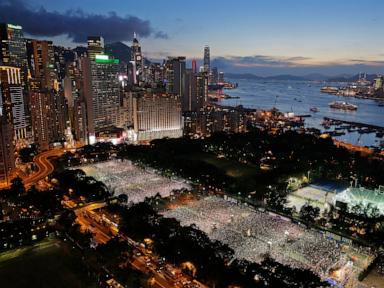
Silence has a weight. You do not notice it when it is filled with the roar of a crowd, the flickering glow of eighty thousand candlelight points, or the rhythmic chanting of slogans bouncing off the concrete facade of Victoria Park. But when the candles are swept away, when the park gates are locked under the cover of night, and when the air is scrubbed clean of dissent, the silence becomes crushing. It presses against your ribs. It demands to be felt.
For decades, the ritual was as reliable as the changing of the seasons. Every June fourth, the city of Hong Kong would tilt its collective axis toward the past. People from every walk of life—lawyers in frayed suits, students with ink-stained fingers, elderly grandparents leaning heavily on bamboo canes—would gather to remember. They did not gather to start a revolution. They gathered because forgetting felt like a crime against the dead.
Then came the verdict. Or rather, the long, agonizing machinery leading up to it.
To understand the trial of the former Tiananmen vigil organizers, you have to understand what it means to hold a memory in a place that has outlawed the past. The courtroom on trial was not just a chamber of judges, defendants, and legal briefs. It was an entire social contract, unraveling thread by thread under fluorescent lights.
Let us step inside that courtroom for a moment. Imagine, if you will, a hypothetical observer sitting on the wooden benches—someone whose face is etched with the quiet exhaustion of a generation that thought it had secured a different ending. The defendants sit in the dock. They are veteran activists, organizers who spent their youth handing out flyers and organizing logistics for an annual assembly that became a global beacon. They are grey-haired now. Their faces bear the lines of men and women who knew the price of their persistence long before the knock came at the door.
The charge against them sounds dry, almost bureaucratic on paper: subversion, incitement, unauthorized assembly. Legal jargon is a wonderful shield for power. It dresses up political necessity in the neutral language of statutes and sections. But beneath the legalese lies a simpler, starker reality. They are on trial for refusing to forget.
Consider how the mechanics of such a trial operate. The prosecution does not argue about the events of 1989 itself. Instead, they argue about the meaning of the remembrance. They argue that gathering to mourn is a threat to the architecture of the present. Every speech delivered years ago, every slogan chanted into the damp summer air, every banner unfurled—all of it is cataloged, analyzed, and reinterpreted as a dagger pointed at the state.
Power fears memory because memory is uncooperative. A monument made of bronze can be melted down. A plaque can be chiseled away. But a shared historical grief, carried in the muscle memory of hundreds of thousands of ordinary citizens, refuses to stay in the archive. It breathes. It mutates. It resists.
This is why the trial dragged on with such agonizing deliberation. Justice, we are told, is blind. But sometimes blindfolds are worn not to ensure impartiality, but to avoid looking at the human cost of the sentence being handed down. The defendants sat quietly. Some took notes. Others offered faint, reassuring smiles to family members seated behind the glass partition.
There is a terrifying vulnerability in watching people who were once loud become quiet figures in a courtroom. You realize how fragile civic life truly is. We build cities out of glass and steel, we trade stocks, we drink morning coffee, we complain about the humidity, and we assume that the floor beneath us is solid rock. We forget that the ground is actually a thin crust over deep magma.
When the organizers organized that final vigil, they knew the risk. They were not naive. They had watched the legal landscape shift. They had seen the laws rewritten overnight. Yet they went anyway because the alternative—staying home, pulling the blinds, pretending that the history of a generation never happened—felt infinitely more dangerous to their souls.
What happens when a society is told that its history is illegal?
People adapt, but the adaptation leaves scars. In the months following the crackdown on the vigils, the remembrance went underground. It fractured into tiny, stubborn acts of resistance. A bookstore shelf rearranged in the dead of night. A cryptic post on a secondary social media account that vanishes in minutes. A lone individual standing on a street corner, wearing an unremarkable beige shirt with an invisible, deafening message written all over it.
The trial of the organizers was designed to serve as a full stop. It was meant to be the final, definitive period at the end of a turbulent chapter. The message sent from the bench was meant to echo through every university lecture hall, every newsroom, and every dinner table: The matter is closed.
Except, history is never closed.
Sitting in that courtroom, watching the lawyers shuffle their papers and the judges adjust their spectacles, one realizes the fundamental paradox of authoritarian trials. They require enormous amounts of energy to suppress ideas that would otherwise fade naturally into the background. If the past truly did not matter, the state would not need to spend millions of dollars and countless hours proving that remembering it is a crime. The severity of the punishment is the ultimate admission of the power of the memory.
Think of the organizers not as political martyrs of a bygone era, but as custodians of a difficult truth. They took up a burden that no one asked for, simply because it was placed in their hands by circumstance. They stood in the dock not just to defend their own actions, but to assert a basic human right that predates every constitution ever written: the right to look backward and mourn.
The verdict, when it finally drops, will fill the headlines for a day or two. Analysts will dissect the prison sentences. Foreign governments will issue statements of condemnation that will be filed away in diplomatic drawers and forgotten by dinner time. The legal cycle will complete its circuit.
But outside the courtroom, beyond the reach of the jurisdiction, the wind still blows through Victoria Park on warm June nights. The grass still grows. The city continues its relentless, frantic pulse of commerce and survival.
And somewhere in the dark, beneath the watchful gaze of modern surveillance, someone will light a match. Not to start a fire, but simply to see in the dark.