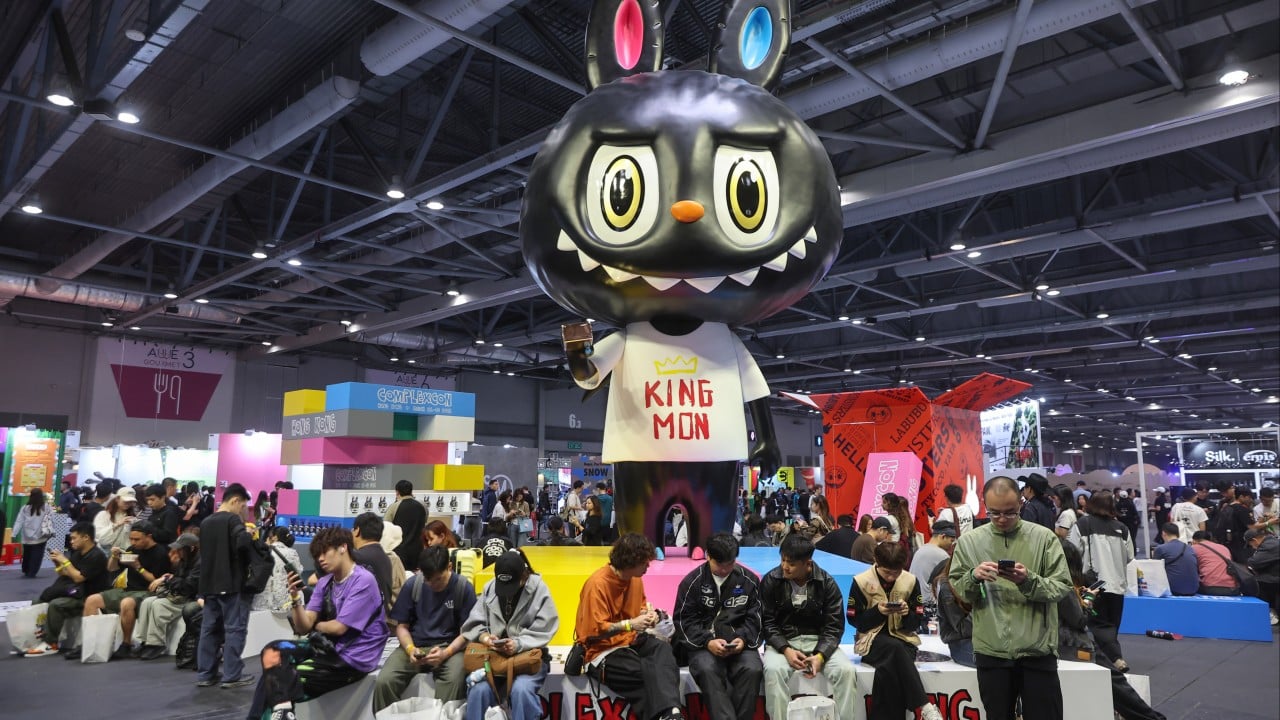
The sea of people stretching across the AsiaWorld-Expo during ComplexCon Hong Kong was not there by accident. While surface-level reports point to the presence of Blackpink’s Jennie or the sudden ubiquity of a mischievous, fanged creature named Labubu, these are merely the visible symptoms of a highly calculated supply-chain maneuver. The event served as a definitive proof of concept for how "pop culture" has been fully subsumed by high-velocity arbitrage. It wasn’t just a festival; it was a high-stakes stress test for the secondary resale market.
The frenzy surrounding Labubu—a character created by Kasing Lung and produced by the Chinese toy giant Pop Mart—is the result of a perfect alignment between celebrity endorsement and artificial scarcity. When Jennie Kim posted a photo of the plush monster, she didn't just share a personal preference. She triggered a cross-border liquidity event. What was once a niche "art toy" became a mandatory social currency, turning a three-day event in Hong Kong into a flashpoint for a new kind of consumer desperation.
The Pop Mart Mechanics of Manufactured Scarcity
To understand why thousands of people would wait hours for a plastic figurine, you have to look past the aesthetics. Pop Mart has mastered the "blind box" economy, a legalized form of gambling that exploits the human psychological drive for completion. At ComplexCon, this was amplified by the "event exclusive" tag.
Exclusive drops are designed to fail the majority of participants. If everyone who wanted a Labubu could buy one, the brand would die. The value is derived entirely from the thousands of people who leave empty-handed, as their unfulfilled demand is what sustains the astronomical prices on platforms like Dewu and StockX. We are seeing a shift where the product itself is secondary to the "drop" mechanics. The toy is just a physical receipt for a successful transaction in a crowded room.
The Jennie Kim Effect as a Market Catalyst
Celebrity involvement in the "vinyl toy" space isn't new, but the scale is changing. In the past, a celebrity might wear a brand to show they were part of an underground scene. Now, the celebrity is the scene. Jennie’s "validation" of Labubu didn't just introduce the character to her 80 million followers; it provided a signal to professional resellers that the asset was "safe" for speculation.
This creates a feedback loop. The fans want the item because the idol has it. The resellers want the item because the fans want it. The brand limits the supply to ensure the resellers can make a profit, which in turn keeps the brand’s perceived value high. It is a predatory ecosystem that relies on the "fandom" to provide the initial capital and the "hypebeast" infrastructure to provide the longevity.
Hong Kong as the Strategic Hub for the Resale War
Hosting ComplexCon in Hong Kong was a deliberate geographical play. As the gateway to the Mainland Chinese market—where Pop Mart’s headquarters and primary manufacturing base reside—Hong Kong serves as the neutral ground for international "cool" to meet Chinese manufacturing might. The city’s tax-free status on luxury goods and its robust logistics network make it the ideal clearinghouse for limited-edition collectibles.
The "thousands" who showed up weren't just local teenagers. A significant portion of the crowd consisted of "daigou" or professional shoppers who act as proxies for buyers in regions where the drops aren't happening. These individuals aren't interested in the artistry of Kasing Lung’s designs. They are calculating the weight of the boxes to determine shipping costs to Shanghai, London, or Los Angeles.
The Illusion of Community in the Age of the Bot
Events like ComplexCon often market themselves as "community gatherings," but the reality on the ground is increasingly transactional. When you have a crowd of that magnitude vying for a limited number of "exclusive" items, the "community" aspect dissolves into a series of sharp elbows and digital queues.
The introduction of QR-code-based lottery systems was intended to democratize the process, but as any veteran of the sneaker world knows, these systems are often compromised before the doors even open. Insiders, "friends and family" lists, and sophisticated botting of the reservation apps ensure that the most desirable items rarely make it to the "average" fan standing in the humidity outside the venue.
The Fragility of the Labubu Bubble
Is Labubu a lasting icon or a transient trend? History is littered with the corpses of "must-have" collectibles that lost their luster the moment the next celebrity pivoted to a new aesthetic. Beanie Babies, certain eras of Medicom Toy’s Bearbricks, and even specific NFT collections all followed this same trajectory:
- Discovery: A niche group finds a product with unique visual appeal.
- Validation: A top-tier influencer (like Jennie) adopts the product.
- Mass Speculation: Professional flippers enter the market, driving prices up.
- Oversaturation: The brand, seeing the demand, increases production to capture more profit.
- The Crash: The "exclusivity" vanishes, the flippers exit, and the fans are left holding depreciating plastic.
Pop Mart is currently walking a tightrope. They need to produce enough to satisfy shareholders but little enough to satisfy the "hype" requirements. If they lean too far into mass production, Labubu becomes a grocery store toy. If they keep it too restricted, they leave millions of dollars on the table and risk frustrating their core demographic into apathy.
The Geopolitical Dimension of C-Pop Toys
There is also an overlooked element of soft power at play here. For decades, the "collectible" market was dominated by American (Funko, Hasbro) or Japanese (Bandai, Sanrio) companies. The rise of Pop Mart and characters like Labubu represents the first time a Chinese intellectual property has achieved this level of global "cool" via a lifestyle-first approach.
By debuting major collections at a Western-originated festival like ComplexCon, these Chinese brands are effectively "laundering" their image, moving from "mass-produced goods" to "curated art." This is a sophisticated rebrand of Chinese manufacturing, positioning it at the center of global youth culture rather than just the factory floor.
The Emotional Tax of Modern Fandom
Beyond the spreadsheets and the resale margins, there is a human cost to this model of consumption. The "thousands" at ComplexCon represent a generation that has been taught to equate "ownership" with "identity." When you can't buy the house, you buy the $200 plush pendant that signifies you belong to a specific, elite tier of the internet.
This is the emotional tax of the modern attention economy. The anxiety of the "missed drop" and the dopamine hit of the "confirmed order" are powerful tools used by marketers to bypass rational spending habits. The presence of a global superstar like Jennie Kim serves as the ultimate "buy" signal, turning a consumer’s hesitation into a frantic need to participate.
The Role of Physical Retail in a Digital World
In a world where you can buy anything on your phone, why do thousands still flock to a physical convention center? Because the physical event provides the "proof of work." A photo of a Labubu bought on an app is one thing; a photo of yourself at ComplexCon, holding the bag, with the crowd in the background, is a much more valuable social asset.
The event is a content farm. Every person in that line is a micro-influencer, documenting their struggle to acquire the product. This "struggle" is part of the marketing. The long lines aren't a failure of organization; they are a visual representation of brand strength. They tell the world: Look at how much these people want this.
The Hard Truth About the "Investment"
Many of the people buying Labubus at ComplexCon view them as investments. They are wrong. While a few "chase" figures or extremely limited collaborations might hold their value, the vast majority of these items are liabilities masquerading as assets.
The secondary market for art toys is notoriously fickle. Unlike gold or even high-end watches, vinyl toys have no intrinsic value and are subject to the whims of a demographic with a notoriously short attention span. When the next "it" toy arrives—and it will—the Labubu market will likely see a massive liquidation event.
The winners in this scenario are not the fans or the small-time resellers. The winners are the platform owners, the event organizers, and the parent companies who have successfully offloaded their inventory at premium prices while shifting the "risk" of ownership onto the consumer.
Re-evaluating the ComplexCon Model
As ComplexCon expands its footprint into Asia, it is moving away from its roots as a "streetwear" convention and toward a "speculative asset" trade show. The focus has shifted from the "culture" of the creators to the "velocity" of the transactions.
If you were there to see the art, you likely left disappointed by the crowds. If you were there to see Jennie, you likely only saw her through the screen of a thousand smartphones held aloft. But if you were there to witness the raw, unvarnished power of industrialized hype, you saw exactly what the future of retail looks like: a crowded room, a ticking clock, and a plastic monster that everyone wants but nobody truly needs.
The real investigative question isn't "Why is Labubu popular?" but rather "Who benefits most from the chaos of the chase?" The answer is never the person standing in line. It is the entity that owns the line.
Observe the floor at the next major drop. Look past the brightly colored toys and the celebrity cameos. Count the shipping boxes. Watch the money change hands in the corners of the hall. That is where the real story lives. The Labubu phenomenon is not a toy craze; it is a masterclass in psychological engineering, designed to turn the common consumer into a frantic soldier for a brand’s bottom line.
Verify the manufacturing dates on your "exclusive" acquisitions before claiming they are rare. Many of these "drops" are simply phased releases of massive production runs, designed to create the illusion of scarcity where none exists. Would you like me to analyze the specific resale price volatility of the Labubu "Zimomo" variants compared to standard Pop Mart releases?