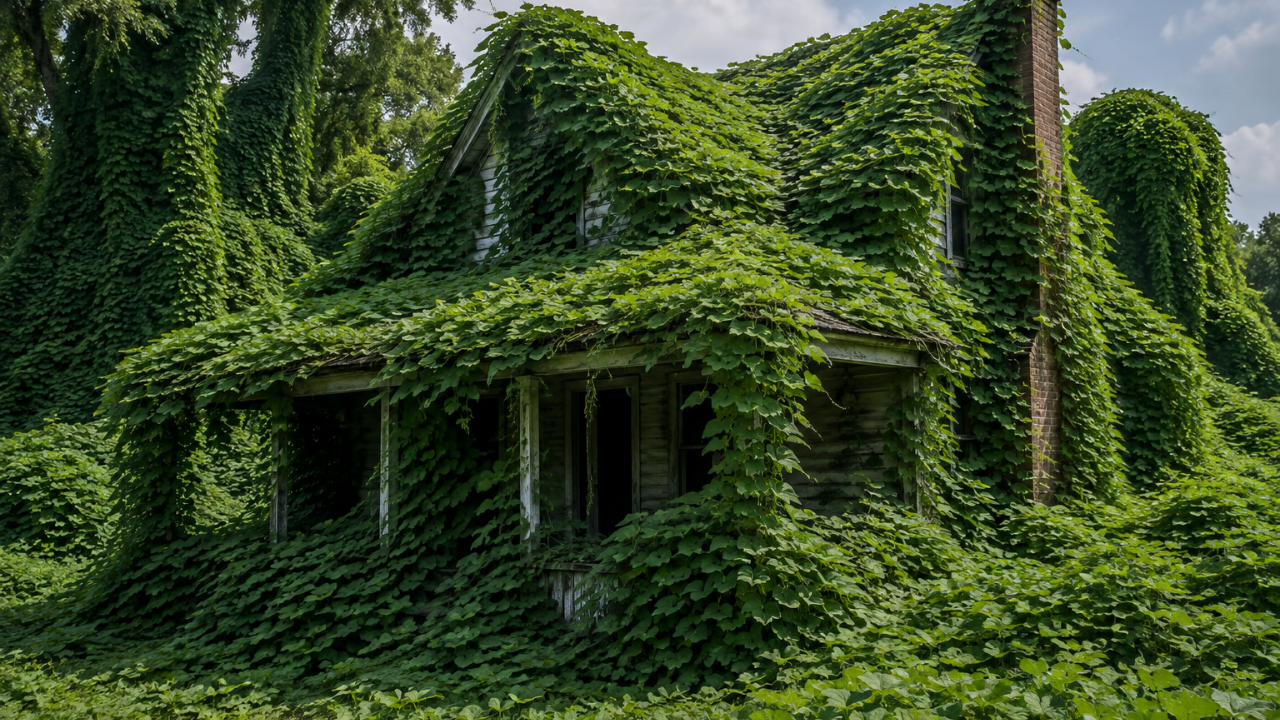
You see it draped over old barns, swallowing telephone poles, and choking out entire treelines across the American South. Kudzu isn't just an aggressive nuisance anymore. It's becoming a literal tinderbox.
We used to laugh at the "foot-a-day vine" as a quirky botanical mistake from the 1876 Philadelphia Centennial Exposition. Landowners planted it for shade. The government paid people to plant it for erosion control during the mid-twentieth century. Nobody stopped to think about what happens when a non-native, high-biomass climber dries out during a severe drought.
It burns. And it burns hot.
The Botanical Time Bomb In Your Backyard
Let's get one thing straight. Kudzu isn't native to North America, and it has no natural predators here to keep it in check. It covers over two million acres across the southern United States, stretching from Texas up to New York. That massive green canopy looks harmless enough in the humid summer months. But when winter hits, or when a dry spell takes hold, those lush vines die back.
They leave behind massive amounts of dry, woody material. Ecologists call this fine fuel load. Firefighters call it a nightmare.
Most people assume green plants are fire-resistant. Kudzu shatters that assumption. The dry, dead mat of vegetation accumulates year after year beneath the living canopy. It creates a vertical ladder of fuel that carries ground fires straight up into the forest canopy. Once fire hits the treetops, a slow-moving brush fire turns into an aggressive crown fire.
Forestry researchers at institutions like the University of Georgia have started looking closely at how invasive vines alter forest fire regimes. The data points to a grim reality. Areas heavily infested with kudzu experience hotter, more destructive fires than native hardwood forests alone. The vine essentially acts as kindling wrapped around trees, baking the bark and killing the host tree even if the flames pass quickly.
Why Traditional Control Methods Are Failing
You can't just mow it down and walk away. Trust me, I've watched people try. Kudzu has massive taproots that can weigh hundreds of pounds and reach deep into the soil. If you cut the vine without killing the root, it bounces back twice as thick.
Herbicides help, but spraying millions of acres of rugged terrain is expensive, logistically impossible in remote areas, and creates its own environmental headaches near waterways. Prescribed burns are tricky, too. Because kudzu burns with such intensity, introducing fire into an infested area can easily spiral out of control if the humidity drops even a fraction.
Land managers are turning to targeted grazing. Goats love kudzu. Put a herd of goats on a hillside choked with the vine, and they will strip it clean. But goats are a band-aid on a hemorrhage. They need constant fencing, water, and protection from predators. You have to graze the same patch repeatedly for years to starve out those giant taproots. Most property owners don't have the time or the budget for that kind of persistent warfare.
The Rising Wildfire Risk In Unexpected Places
Wildfires used to be a western problem. We all grew up watching California hillsides go up in smoke on the evening news. Climate shifts are rewriting that map. The Southeast is seeing longer, drier autumns and unpredictable winter droughts.
When you combine those weather patterns with millions of tons of dry, dead kudzu biomass sitting right next to suburban developments, you get a recipe for disaster. Homeowners in states like Mississippi, Alabama, and Georgia are finding out that an overgrown patch of vines at the edge of their property line isn't just an eyesore. It is a direct threat to their homes.
Embers from a roadside brush fire can ignite a dry kudzu patch instantly. Because the vines grow densely over fences and up power poles, the fire spreads rapidly toward structures. Fire departments are reporting stubborn, smoky fires fueled by invasive vines that take hours to put out because the tangled mass traps heat and resists water penetration.
What You Can Do About It Right Now
Stop ignoring the vines on your property. If you have kudzu creeping onto your land, treat it like an urgent property maintenance issue, similar to clearing dead brush or deadwood away from your foundation.
Cut the thickest vines at the base first. Paint the freshly cut stumps immediately with a systemic herbicide to target the root system, or be prepared to dig up the crown of the plant manually. Wear thick gloves and sturdy boots because those roots are stubborn and the terrain underneath is often uneven.
Clear a defensible space around your home. Keep a twenty-foot buffer zone completely free of heavy vines and dead underbrush. If your local county extension office offers assistance programs or educational workshops on invasive species management, sign up. Talk to your neighbors, too. Kudzu doesn't care about property lines, and a coordinated neighborhood effort is the only way to keep it from creeping back over your fence line next spring.