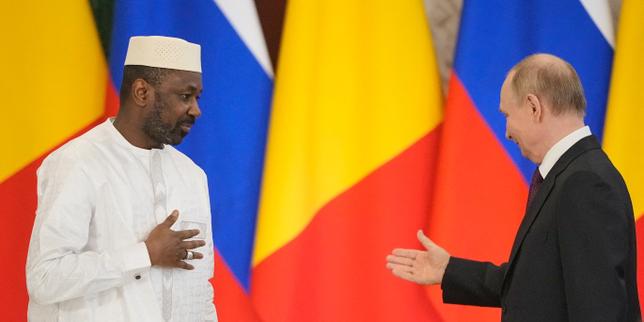
Moscow is actively orchestrating a quiet diplomatic realignment between Algiers and Bamako to consolidate its geopolitical grip on the Sahel. While public regional dynamics suggest deep-seated friction between Algeria and the Malian military junta, Russian intelligence and diplomatic emissaries are working behind the scenes to bridge the chasm. By positioning itself as the indispensable mediator, Russia aims to lock Western influence out of the central Sahel completely while securing its own long-term extraction monopolies.
The strategy hinges on exploitation. For months, external observers pointed to the public collapse of the 2015 Algiers Peace Accord as a sign of irreversible divorce between Mali and Algeria. The junta in Bamako accused Algiers of hosting separatist Tuareg leaders, while Algeria viewed Mali’s reliance on Russian mercenaries as a direct threat to its southern border security. Yet, this visible friction obscures a deeper, subterranean reality. Moscow does not benefit from a total war between Mali and Algeria; it benefits from a controlled state of dependency where both nations must look to the Kremlin to manage their mutual vulnerabilities.
The Architecture of Dependency
To understand how Russia manipulates this axis, one must look at the structural mechanics of the Wagner Group’s successor, the Africa Corps. The deployment of Russian operatives in Mali was never merely about counter-insurgency. It was designed to replace French security architecture with an extractive mechanism that trades raw security for sovereign assets.
Mali’s military leadership, led by Assimi Goïta, lacks the logistical capability to hold its northern territories without external air support and tactical intelligence. Russia provides this, but the price tag is staggering. Because the Malian treasury is functionally depleted, payment arrives in the form of gold mining concessions, particularly in the regions surrounding Kayes and Sikasso.
Algeria watches this expansion with deep anxiety. Historically, Algiers viewed the Sahel as its exclusive strategic backyard. A chaotic Mali spills refugees, weapons, and radicalized elements directly into Algeria’s vulnerable southern wilayas. The Kremlin understands this Algerian vulnerability perfectly. Instead of pushing Algeria away, Russian diplomats have used Algiers’ fear of instability to bring them to the negotiating table under Moscow’s auspices.
The mechanism is classic leverage. Russian officials have quietly assured Algiers that they are the only force capable of restraining the Malian junta from launching reckless cross-border incursions or completely disenfranchising the northern Tuareg populations, which would trigger a massive refugee crisis. To Bamako, Moscow presents itself as the sole shield against Algerian hegemony and UN-backed diplomatic isolation. By holding the keys to both capitals, Russia dictates the terms of the regional security conversation.
The Gas and Gold Equation
The convergence of interests extends far beyond military deployment into the realm of energy infrastructure and resource logistics. Algeria’s state-owned energy giant, Sonatrach, possesses the infrastructure that landlocked Sahelian states desperately need to commercialize potential resources and secure domestic energy supplies. Moscow wants a piece of that infrastructure.
Consider the stalled Trans-Saharan Gas Pipeline. While Western capitals hoped this project would diversify Europe’s gas supply away from Russia by drawing from Nigerian fields through Niger and Algeria, the reality on the ground has shifted. With pro-Russian juntas now controlling Niger and Mali, and Russian energy firms deeply embedded in Algeria’s upstream oil and gas sector, Moscow is effectively in a position to veto or control the flow of this corridor.
This is not a hypothetical threat. Russian state companies like Gazprom have maintained joint ventures and exploration agreements with Sonatrach for years. By fostering a controlled reconciliation between the Malian junta and the Algerian state, Russia ensures that future infrastructure routes running through the Sahel remain under the de facto supervision of Russian security personnel and corporate entities.
This strategy creates a self-reinforcing loop.
- Security Provision: Russia stabilizes or destabilizes the Malian-Algerian border at will using Africa Corps assets.
- Resource Extraction: Malian gold funds the local operations, reducing the financial drain on the Russian state budget.
- Strategic Veto: Algeria relies on Russian mediation to keep its southern border quiet, diluting its willingness to oppose Russian foreign policy goals elsewhere, including in international forums.
The Failure of Western Isolation
Western policy in the region has collapsed largely because it failed to anticipate this pragmatic alignment. Washington and Paris operated under the assumption that Algeria’s historic commitment to state sovereignty and non-intervention would make it a natural opponent of Russian mercenary expansion. That assumption was wrong.
Algeria’s foreign policy is driven by pragmatism, not ideological alignment with the West. The Algerian military establishment remembers well that Russia remains its primary supplier of advanced military hardware, including Sukhoi fighters and S-400 missile systems. When forced to choose between cooperating with a chaotic, Western-backed diplomatic framework or cutting a deal with the Russian operators who actually hold power in Bamako, Algiers chose the latter.
This leaves the West with virtually no leverage points left in the central Sahel. The withdrawal of French forces, followed by the expulsion of US troops from airbases in Niger, created a security vacuum that Moscow filled with deliberate speed. The narrative that Russia is overextended due to the war in Ukraine ignores the low-cost, high-yield nature of its African operations. A few thousand mercenaries and a handful of diplomatic operators are generating massive geopolitical dividends.
Managing the Fractures
The relationship between Algiers and Bamako remains inherently volatile, and Russia's role as a mediator is not without significant risk. The Malian junta is transactional and prone to erratic decision-making, driven by a desire for domestic survival and nationalist rhetoric. If Bamako pushes too hard into northern territories and triggers a full-scale regional conflict with Tuareg factions, Algeria will be forced to react militarily to protect its borders, regardless of Moscow's preferences.
Russia's strategy relies on keeping the conflict simmering but never boiling over. It requires a delicate calibration of violence. If the Sahel becomes completely stable, the juntas no longer need Russian mercenaries. If it collapses into total chaos, Russia's extractive operations become untenable, and its relationship with Algeria breaks permanently.
Therefore, the Kremlin’s ideal state is one of managed instability, where it acts as the permanent referee between two suspicious neighbors. Every diplomatic friction between Algiers and Bamako is an opportunity for a Russian envoy to fly in, offer security guarantees, renegotiate resource access, and further entrench the Kremlin's presence. The West continues to analyze the region through the lens of counter-terrorism and democratic governance, missing the fact that the map has been redrawn around resource extraction corridors and hard power brokerage.