The transition from targeted kinetic strikes to generalized regional conflict is rarely a product of intentional policy but rather the result of a feedback loop between tactical success and strategic miscalculation. When the United States executes strikes against Iranian-backed infrastructure or personnel, it engages in a high-stakes calibration of deterrence that assumes a rational-actor response from Tehran. However, the internal mechanics of Iranian proxy networks and the domestic political pressure on the U.S. executive branch create a friction point where "proportionality" becomes a subjective and dangerously fluid metric.
The current escalation cycle is defined by three specific structural drivers: the erosion of the "Grey Zone" threshold, the automation of retaliatory protocols within the Axis of Resistance, and the diminishing returns of economic sanctions as a coercive tool.
The Grey Zone Threshold Collapse
For decades, the conflict between Washington and Tehran operated in the "Grey Zone"—a space of competition that remains below the threshold of conventional war. This involved cyber operations, maritime harassment, and deniable proxy attacks. The recent shift toward overt missile exchanges indicates that the Grey Zone has reached a point of saturation.
When strikes move from clandestine sabotage to visible atmospheric kinetic events, the psychological barrier to total war thins. This creates a "Commitment Trap." Once a state actor like the U.S. publicly identifies a red line, failing to enforce it with increasing lethality signals weakness, while enforcing it triggers the very escalation the red line was meant to prevent.
The Architecture of the Proxy Feedback Loop
The United States often treats "Iran" as a monolithic entity, yet the operational reality of the Integrated Resistance Network (IRN) suggests a decentralized command structure that is prone to "unintended escalation."
- Tactical Autonomy: Groups like Kata'ib Hezbollah or the Houthis maintain a degree of local command. A local commander, sensing a "use it or lose it" scenario regarding their missile inventory during a U.S. strike, may launch an unauthorized high-casualty attack.
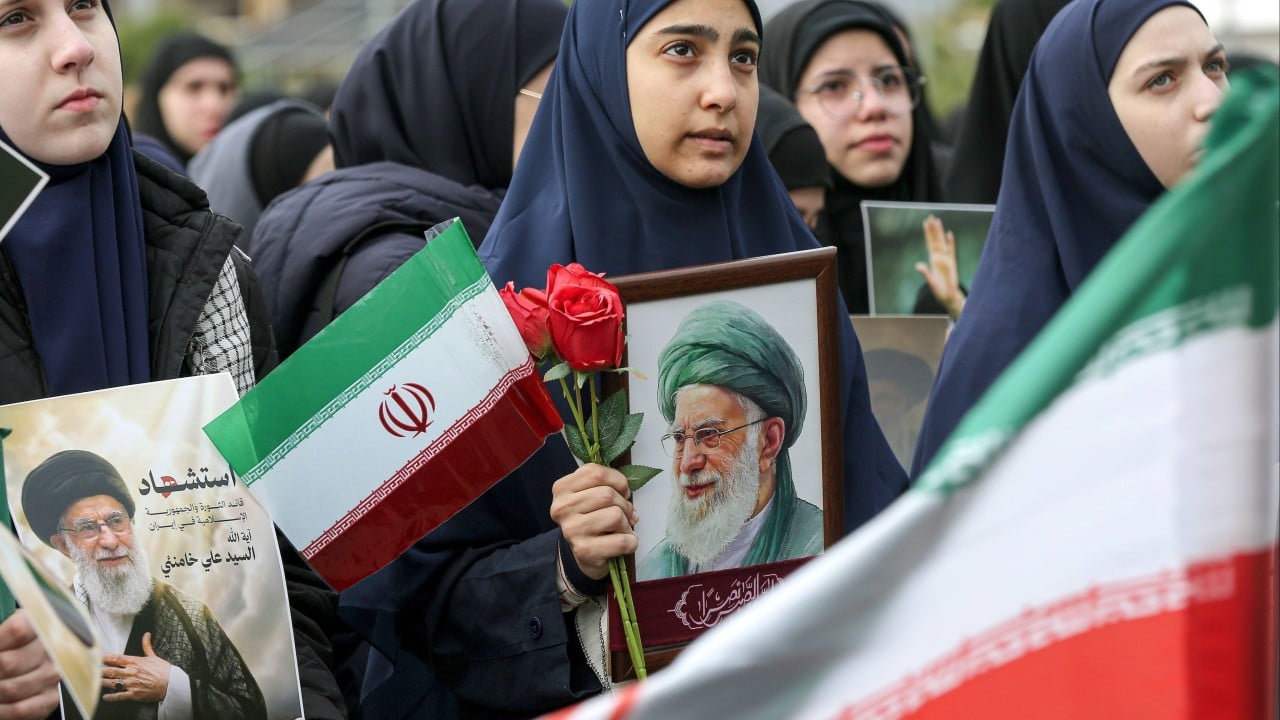
- The Martyrdom Cost Function: Within the IRN ideological framework, the loss of high-ranking personnel is not just a tactical setback; it is a recruitment and mobilization catalyst. This inverted cost function means that the more "effective" a U.S. strike is at eliminating leadership, the higher the political necessity for a massive Iranian response.
- Signal Noise: Tehran uses its proxies to send signals to Washington. However, the granularity of these signals is often lost in translation. A "warning shot" at a cargo ship may be interpreted by U.S. Central Command (CENTCOM) as a failed attempt at mass casualty, leading to a disproportionate retaliatory strike.
Logistic and Kinetic Realities of the Persian Gulf
The geography of the Strait of Hormuz dictates the math of any potential conflict. Approximately 20% of the world's total oil consumption passes through this chokepoint. The tactical problem for the U.S. Navy is not a lack of firepower, but the "Saturation Problem."
Iran's "Swarm" doctrine utilizes hundreds of fast-attack craft, low-altitude cruise missiles, and loitering munitions (drones) simultaneously. Even with a 95% interception rate, the 5% that penetrate can disable a multi-billion dollar carrier strike group asset. This creates an asymmetric cost exchange: a $20,000 Shahed drone forcing the expenditure of a $2 million RIM-162 Evolved SeaSparrow Missile (ESSM).
The Nuclear Breakout Variables
Every conventional strike on Iranian soil or high-value assets brings the "Nuclear Option" into sharper focus for Tehran. The strategic logic is simple: if conventional deterrence fails to stop U.S. "bombs dropping everywhere," the only remaining deterrent is the possession of a nuclear warhead.
The technical "breakout time"—the duration required to produce enough weapons-grade uranium ($U_{235}$ enriched to 90%) for a single device—has shrunk significantly. As of 2024, estimates suggest this window is measured in days or weeks, not months. A massive U.S. air campaign intended to degrade Iranian military capacity may inadvertently trigger the final sprint toward weaponization, as the Iranian leadership perceives it as an existential necessity for regime survival.
Economic Attrition vs. Kinetic Impulse
There is a fundamental misalignment between the U.S. Treasury’s "Maximum Pressure" campaign and the Pentagon’s kinetic operations. Sanctions are designed for long-term behavioral change through economic exhaustion. Kinetic strikes are designed for immediate tactical denial.
When these two tools are used concurrently without a clear diplomatic off-ramp, they produce "Cornered Rat Syndrome." If a regime believes its economic collapse is inevitable due to sanctions and its physical destruction is imminent due to strikes, it has zero incentive to negotiate and every incentive to maximize chaos to force a global intervention or a U.S. domestic political pivot.
The Intelligence Bottleneck
The primary risk in the current environment is "Intelligence Over-Confidence." The U.S. ability to track mobile missile launchers and underground "Missile Cities" in Iran is high, but not absolute. The "Deep State" in Iran (the IRGC) has spent thirty years hardening infrastructure against exactly the type of campaign recently signaled by political rhetoric.
- Hardened Sites: Facilities like Fordow are buried so deep that conventional bunker-busters may require multiple precision hits on the same coordinate to penetrate—a feat difficult to achieve under active anti-air fire.
- Information Silos: The compartmentalization of Iranian decision-making means that U.S. signals intelligence (SIGINT) may capture the "what" of a planned move, but rarely the "why," leading to reactive rather than proactive posturing.
Systematic Failure of Deterrence
Deterrence only works if the threat is credible and the path to de-escalation is visible. If the U.S. message is "we will strike until you stop," but Iran’s internal logic is "if we stop, we look weak and will be invaded," the result is a perpetual motion machine of violence.
The "bombs dropping everywhere" scenario is less likely to be a coordinated World War III and more likely to be a "War of Attrition 2.0"—a series of high-intensity strikes that degrade global shipping, spike insurance premiums, and deplete Western precision-guided munition stockpiles, all while leaving the core Iranian political structure intact.
Strategic Recommendation for Risk Mitigation
To break the escalation cycle, the strategic pivot must move from "punitive strikes" to "functional denial."
- Prioritize Interdiction: Shift focus from striking launch sites (which are easily replaced) to the maritime and land-based supply chains that feed the proxies. This reduces the capacity for violence without the high-optics escalation of striking the Iranian mainland.
- Decouple Proxy Actions: Publicly and militarily treat proxy actions as independent variables unless direct IRGC command-and-control is verified. This provides Tehran with a "face-saving" out to de-escalate without appearing to fold under U.S. pressure.
- Electronic Warfare Over Kinetics: Leverage non-kinetic disruption of Iranian C4ISR (Command, Control, Communications, Computers, Intelligence, Surveillance, and Reconnaissance) to demonstrate capability without producing the "martyrdom" footage that fuels regional unrest.
The objective is not to "win" a war that has no clear victory condition, but to manage a permanent state of tension at the lowest possible energy level. Any strategy that assumes a "final blow" against a regional power like Iran ignores the historical reality of asymmetric endurance.