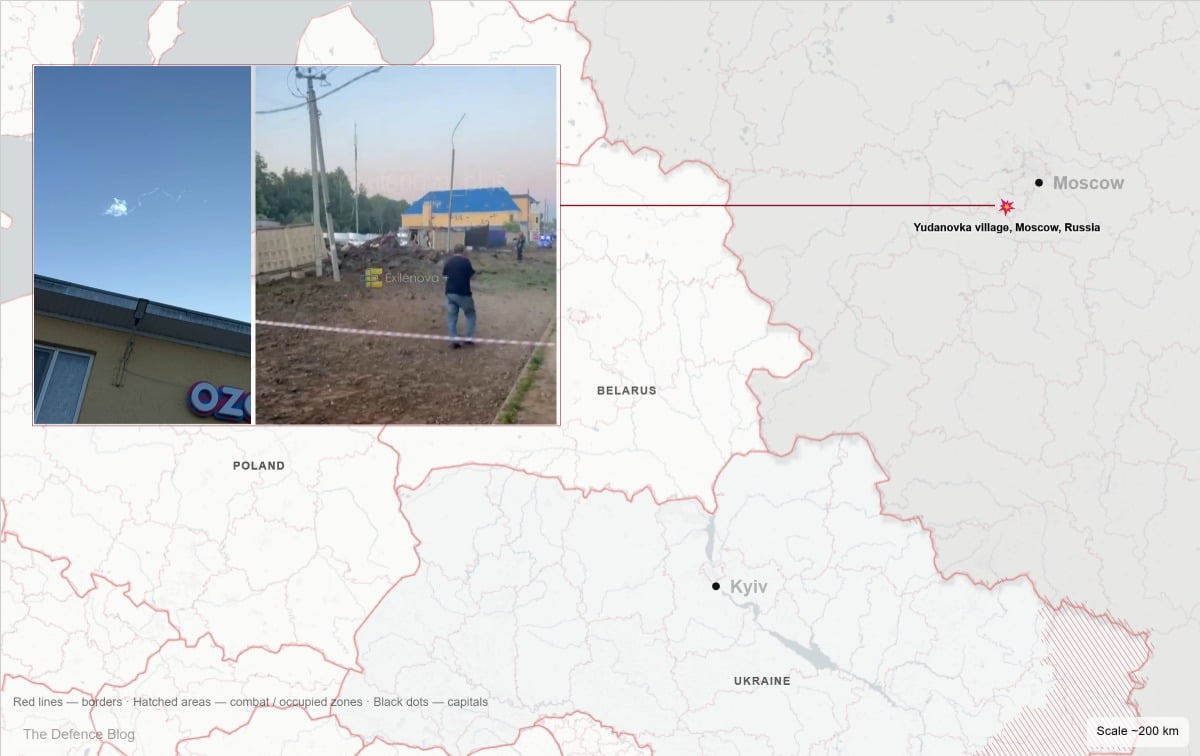
The physical appearance of a high-altitude vapor trail over the Moscow region on June 30 establishes a shift in the strategic framework of the Russo-Ukrainian War. Open-source intelligence (OSINT) indicators, coupled with a newly excavated high-energy impact crater, suggest that this event was not an standard drone operations profile but rather the initial operational testing of an indigenous heavy ballistic missile system. Moving beyond the media narrative of a psychological strike, a cold calculation of the engineering limitations and military objectives reveals that Ukraine is testing a sovereign long-range theater ballistic missile asset designed to bypass political restrictions on Western-supplied armaments.
The Triad of Sovereign Strike Constraints
Evaluating the strategic utility of an indigenous Ukrainian ballistic missile requires isolating the three primary operational bottlenecks that have dictated Kyiv’s long-range targeting architecture since 2022.
The Political End-User Limitation
Western security assistance via systems such as ATACMS and Storm Shadow remains tethered to geographic deployment restrictions. These limitations create a sanctuary zone within the Russian Federation's interior, allowing logistics hubs, command centers, and industrial facilities to operate without threat of conventional interdiction. An indigenous missile completely uncouples Ukrainian targeting choices from foreign diplomatic vetoes.
The Payload-Range Paradox
Long-range strike operations inside Russia have relied almost entirely on one-way attack (OWA) unmanned aerial vehicles (UAVs). While highly cost-effective and capable of impressive ranges, these platforms carry low-mass payloads—typically between 10 kg and 50 kg of explosives. They lack the kinetic energy and structural mass to compromise reinforced concrete facilities, underground bunkers, or heavy industrial machinery.
The Interception Vector
Slow-moving, air-breathing propeller drones travel at subsonic velocities ($150\text{ to }200\text{ km/h}$), making them highly vulnerable to point air defense systems, electronic warfare jamming networks, and mobile anti-aircraft gun crews if detected early. A ballistic missile introduces hypersonic terminal velocities, drastically compressing the target's defensive reaction window.
Technical Specifications of the Fire Point FP-9 Architecture
The aerospace framework underpinning this reported launch is centered on the FP-9, a heavy ballistic missile developed by the domestic enterprise Fire Point—the manufacturer behind the combat-proven Flamingo cruise missile system. Based on engineering benchmarks disclosed during the Eurosatory defense exhibition, the FP-9 platform utilizes specific design metrics engineered to penetrate deeply defended target zones.
+---------------------------+---------------------------------------+
| Parameter                 | Specification Value                   |
+---------------------------+---------------------------------------+
| Maximum Operational Range | 850 km - 855 km                       |
| Warhead Mass Capacity     | 800 kg (High Explosive / Fragment)    |
| Terminal Velocity Profile | Exceeding Mach 7                      |
| Propulsion System         | Solid-Propellant Rocket Motor         |
+---------------------------+---------------------------------------+
The geometry of a strike launched from Ukrainian-controlled territory to Moscow demands a minimum effective range of approximately $650\text{ to }750\text{ km}$, placing the FP-9's $855\text{ km}$ maximum range within the required operational envelope. A warhead mass of $800\text{ kg}$ places the weapon firmly in the heavy ballistic category, yielding more than double the destructive mass of a standard block ATACMS or Iskander-M variant.
The engineering challenge for Fire Point has historically been the local manufacturing of reliable solid-fuel rocket motors capable of delivering stable specific impulse ($I_{sp}$) values under varying thermal loads. Company disclosures from mid-June indicated that engine validation testing was nearing completion. The mid-summer event near Moscow suggests that field validation has bypassed static test-stand limits and entered live-trajectory testing.
The Physics of the Moscow Interception
The high-altitude vapor trail documented over Moscow Oblast allows for a reverse-engineering of the terminal engagement physics. When a ballistic missile enters the mid-course and terminal phases, its flight profile differs fundamentally from a low-altitude cruise missile or drone swarm.
The high-altitude condensation trail observed points directly to an extra-atmospheric or high-stratosphere flight path. Ballistic trajectories follow an arc where the apogee can reach altitudes well above $50\text{ km}$. This behavior forces air defense assets to rely on specialized, high-altitude interceptors like the S-400 Triumf or S-500 Prometheus systems, rather than conventional medium-range systems.
The terminal velocity profile of an FP-9 ($>\text{Mach }7$) means that from the moment the missile clears the radar horizon of Moscow’s early warning networks, the local air defense command has fewer than $120\text{ seconds}$ to achieve target lock, compute a fire solution, and launch an interceptor.
The existence of a significant ground crater coupled with the aerial vapor trail presents two likely engineering outcomes:
- A Partial Kill Engagement: The Russian air defense interceptor achieved a physical strike on the missile body but failed to initiate a high-order detonation of the $800\text{ kg}$ warhead in mid-air. The mass of the warhead then completed a kinetic descent to the surface, detonating upon ground impact.
- A Planned Test to Terminal Point: The launch was a live stress-test of Moscow’s inner air defense ring. The missile may have been programmed to test detection thresholds and tracking configurations, intentionally penetrating the capital zone to collect electronic intelligence (ELINT) data on Russian radar tracking loops before terminal engagement.
Strategic Implications for the Russian Defense Industrial Base
The development of the FP-9 alters the industrial math of the conflict. In June alone, Ukraine conducted at least 13 long-range strikes against industrial facilities, including the Titan-Barrikady plant in Volgograd and the VZPP-S semiconductor factory in Voronezh.
Prior to the deployment of heavy ballistics, these facilities could only be harassed by low-yield drone strikes capable of sparking localized fires or disrupting exterior electrical grids. An $800\text{ kg}$ ballistic payload traveling at hypersonic speeds introduces a structural demolition capability. The kinetic energy component alone, calculated as:
$$E_k = \frac{1}{2} mv^2$$
where $m$ represents the terminal mass and $v$ represents velocity, enables the penetration of reinforced concrete roofs protecting heavy manufacturing machinery, foundry floors, and missile assembly lines. This development forces the Russian Ministry of Defense into a difficult air defense redistribution dilemma. Russia must choose between deploying finite S-400 batteries along the frontline to protect tactical assets or pulling those systems back to shield high-value industrial hubs like Moscow, St. Petersburg, and critical oil refineries from structural destruction.
Systemic Production Bottlenecks and Strategic Outlook
While the June 30 event demonstrates a functional flight-test capability, a realistic assessment reveals distinct headwinds before Ukraine can achieve scale. Transitioning a complex aerospace platform from a successful prototype test to serial mass production requires resolving several systemic manufacturing challenges.
Supply chain dependencies represent a primary point of friction. Ukraine's defense sector remains reliant on European partners for high-end electronic subsystems. For instance, Fire Point’s parallel Freyja missile-defense project relies on German Hensoldt TRML-4D radars, alongside ongoing negotiations for European-sourced imaging infrared (IIR) homing devices and radio frequency (RF) seekers. Ensuring a reliable flow of these components through strict export controls and international bureaucratic loops introduces persistent schedule risks.
Domestic industrial vulnerabilities also limit output. Manufacturing solid rocket propellants requires specialized, static infrastructure that remains vulnerable to Russian long-range stand-off strikes. This exposure necessitates a highly decentralized, clandestine production network that naturally limits output speed.
Furthermore, the state certification process managed by the Ministry of Defense requires rigorous verification of operational reliability, guidance accuracy, and electronic counter-countermeasures (ECCM) before a weapon can be formally codified for mass deployment.
The strategic trajectory points toward a systematic campaign of low-rate initial production (LRIP) throughout the final quarters of the year. The military value of this program will not be realized via single, sporadic launches, but rather through synchronized, asymmetric strike packages. Operational planners will likely use large swarms of inexpensive, domestically manufactured drones to oversaturate Russian radar arrays and exhaust local interceptor stockpiles. Once air defense tracking networks are overwhelmed, low-volume salvos of FP-9 ballistic missiles will be launched to strike high-value, hardened infrastructure targets. This approach forces a costly imbalance on the defense, rendering localized containment strategies unsustainable over a prolonged campaign.
Indigenous Ballistic Missile Test Flight Dynamics
This video provides an expert breakdown of the FP-9's development cycle, testing timeline, and the engineering capabilities required to field a heavy ballistic system under active wartime constraints.