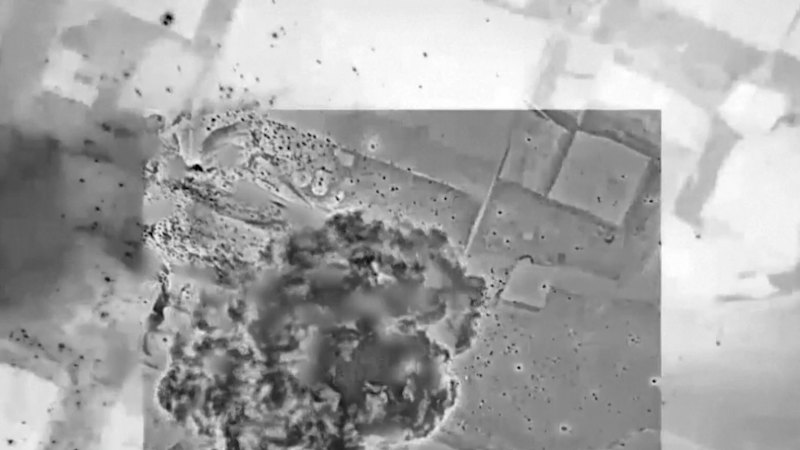
Every time a high-ranking militant commander is eliminated, the cable news chyrons turn red, press releases claim a decisive operational victory, and the public is fed the comforting lie that the threat has been crippled.
It is a seductive narrative. It satisfies our primal desire for poetic justice. A mastermind plots an atrocity, a precision strike removes him from the board, and the ledger is balanced.
Except modern asymmetric warfare does not work like a Hollywood thriller, and treating targeted assassinations as strategic endgames is the exact reason counter-insurgency campaigns drag on for decades without achieving political resolution.
Mainstream coverage of the death of a senior Hamas October 7 planner relies on a lazy consensus: remove the head, and the body dies. This "kingpin fallacy" ignores forty years of empirical counter-terrorism data, misunderstands how decentralized networks actually operate, and confuses tactical attrition with strategic victory.
The Kingpin Fallacy in Asymmetric Warfare
In conventional state-on-state conflict, decapitating the command structure creates immediate paralysis. If you destroy a division headquarters and kill the general, subordinate units lose access to supply lines, artillery support, and orders. The chain of command snaps.
Non-state militant groups like Hamas are explicitly engineered to survive this exact scenario.
Having spent years studying counter-insurgency doctrine and tracking leadership decapitation campaigns from the Levant to the Hindu Kush, I have watched military establishments pour billions into high-value target (HVT) programs only to face more adaptive adversaries five years later. The operational mechanics of a cellular insurgency are built around redundancy, mission-type tactics, and ideological succession.
When you eliminate a senior planner—whether it is Yahya Sinwar, Mohammed Deif, or a mid-tier brigade commander responsible for the October 7 breaches—you are not erasing institutional knowledge. You are simply triggering a pre-planned succession protocol.
Strategic theorist Jenna Jordan, who analyzed over a thousand leadership decapitation incidents across decades of global conflict, demonstrated a sobering reality in her research: targeting leaders frequently fails to bring about organizational collapse, particularly when the group is older, ideologically driven, and deeply embedded in a local population. In many cases, decapitation actually increases the group's resilience by weeding out older, more cautious commanders and promoting younger, more radicalized operators who have something to prove.
What the Mainstream Coverage Misses About October 7
To understand why the death of an October 7 architect changes less than headlines suggest, you have to understand how that operation was actually planned and executed.
The prevailing media narrative frames October 7 as the singular brainchild of one or two evil geniuses sitting in a bunker. That framing is factually wrong. The operation was the culmination of years of systemic intelligence collection, open-source reconnaissance, tactical rehearsals, and decentralized execution.
Consider the mechanics of the breach:
- Distributed Intelligence: Thousands of low-level operatives, border observers, and sympathetic laborers gathered granular data on sensor blind spots, troop rotation schedules, and base layouts over years.
- Compartmentalized Execution: Squad leaders were given specific, localized objectives—take this outpost, hold this intersection, breach this fence—without needing constant real-time direction from a central command room.
- Low-Tech Survivability: By abandoning digital communications in favor of hardwired underground networks and human couriers, the planners neutralized the most sophisticated signals intelligence apparatus in the Middle East.
Killing the man who signed off on the master plan does not erase the operational manual he left behind. Every surviving battalion commander now knows that a multi-pronged saturation attack using commercial drones, paragliders, and coordinated ground breaches can overwhelm a technologically superior border defense. The proof of concept is already out in the wild. You cannot assassinate an idea that has already been proven to work.
The Hydra Effect and Organizational Mutation
Let us run a thought experiment. Imagine a scenario where an intelligence agency successfully eliminates the top twenty commanders of an entrenched insurgent group within a single ninety-day window. On paper, the organization has been gutted.
What happens on day ninety-one?
First, operational security tightens dramatically. The surviving mid-level commanders assume their phones, radios, and safe houses are compromised. They stop holding meetings. They devolve decision-making authority down to the smallest possible tactical unit—four-to-six-man cells operating independently.
Second, strategic coherence disappears, which sounds like a win until you realize what replaces it. A centralized leadership structure can negotiate, enforce ceasefires, and weigh the long-term political costs of an attack. A fractured collection of autonomous cells cannot. When you destroy the top brass, you often destroy the only people within the adversary's ranks who possess the authority to stop fighting.
We saw this play out during the height of the Iraq War. Joint Special Operations Command perfected the industrial-scale elimination of Al-Qaeda in Iraq (AQI) leadership, culminating in the death of Abu Musab al-Zarqawi in 2006. It was hailed as a turning point. Yet within eight years, the surviving remnants of that exact network mutated into ISIS—a vastly more ruthless, territorially ambitious, and media-savvy organization that erased the border between Iraq and Syria.
Eliminating high-value targets creates a vacuum. In conflict zones, vacuums are never filled by moderates.
Answering the Questions You Should Actually Be Asking
When news breaks of a major militant leader's death, public search interest spikes around a predictable set of questions. Almost all of them are framed around the wrong premise.
Does killing the planner bring hostages home faster?
The uncomfortable truth is that it frequently does the exact opposite. Hostage negotiations require a clear chain of command capable of verifying who is alive, where they are held, and guaranteeing safe passage during an exchange. Eliminating the central architects fractures that control. Local captors, cut off from senior leadership and fearing imminent death, become infinitely less predictable and harder to bargain with.
Does this degrade Hamas's ability to launch another October 7?
Tactically, yes—for now. Combined with the destruction of tunnel networks, rocket manufacturing facilities, and weapons caches, losing veteran planners degrades immediate offensive capacity. Strategically, no. Rebuilding a militia requires recruits, grievances, and funding. As long as the underlying political and territorial conditions remain unresolved, recruitment pipelines stay full. A seventeen-year-old who lost his family in a retaliatory strike does not need a veteran planner to teach him how to assemble an improvised explosive device.
Is targeted assassination ever strategically effective?
Yes, when it is paired with a viable political off-ramp and a credible governance alternative. In the early 2000s, targeted strikes against Hamas leadership during the Second Intifada temporarily forced the group into a unilateral truce—not because the strikes alone broke their will, but because the leadership realized their organizational survival required a pause to regroup and transition into electoral politics. Without a political endgame, kinetic strikes are just mowing the grass.
The Downside of the Contrarian View
To be entirely transparent, dismissing targeted killings altogether is just as naive as treating them as a silver bullet. There is a massive cost to letting architects of mass murder walk free.
Deterrence is a real psychological factor in international security. If a state allows the orchestrators of a catastrophic attack to survive, it signals weakness to every other regional adversary watching from the sidelines. Furthermore, veteran commanders possess irreplaceable soft skills: they know how to resolve internal factional disputes, secure illicit financing from foreign sponsors, and maintain discipline among unruly fighters. Removing them creates friction, slows down operational tempo, and buys time for defensive forces to reorganize.
The flaw is not in taking the shot. The flaw is in believing the shot ends the war.
How to Actually Dismantle an Insurgent Network
If eliminating top planners only yields temporary tactical relief, what actually works? History—from the British campaign in Malaya to the Colombian government's decades-long struggle against the FARC—points to a much less glamorous, far more difficult blueprint.
- Starve the Logistics, Not Just the Leadership: A commander without ammunition, fuel, or payroll is just a guy shouting in a tunnel. Disrupting financial networks, smuggling corridors, and precursor supply chains cripples an organization's ability to regenerate far more effectively than killing its figureheads.
- Offer a Credible Alternative to the Population: Insurgencies survive because they provide governance, welfare, and identity where states fail. Until a legitimate, locally accepted administrative alternative is established on the ground, the militant group remains the only game in town.
- Exploit Internal Fissures Instead of Uniting Them: High-profile assassinations create martyrs that rally rival factions together. Effective counter-insurgency exploits the natural friction between political wings and military wings, between external financiers and local fighters, forcing the group to tear itself apart from the inside.
The Reality Behind the Headlines
Military spokespeople will continue to announce the deaths of senior planners with triumphant press briefings. Media outlets will continue to run profiles of the dead commanders, cataloging their crimes and declaring a milestone reached.
Do not mistake the scoreboard for the outcome of the game.
Killing the architect gives you a moment of quiet on the construction site, nothing more. As long as the foundation remains untouched, someone else is already picking up the pencil.