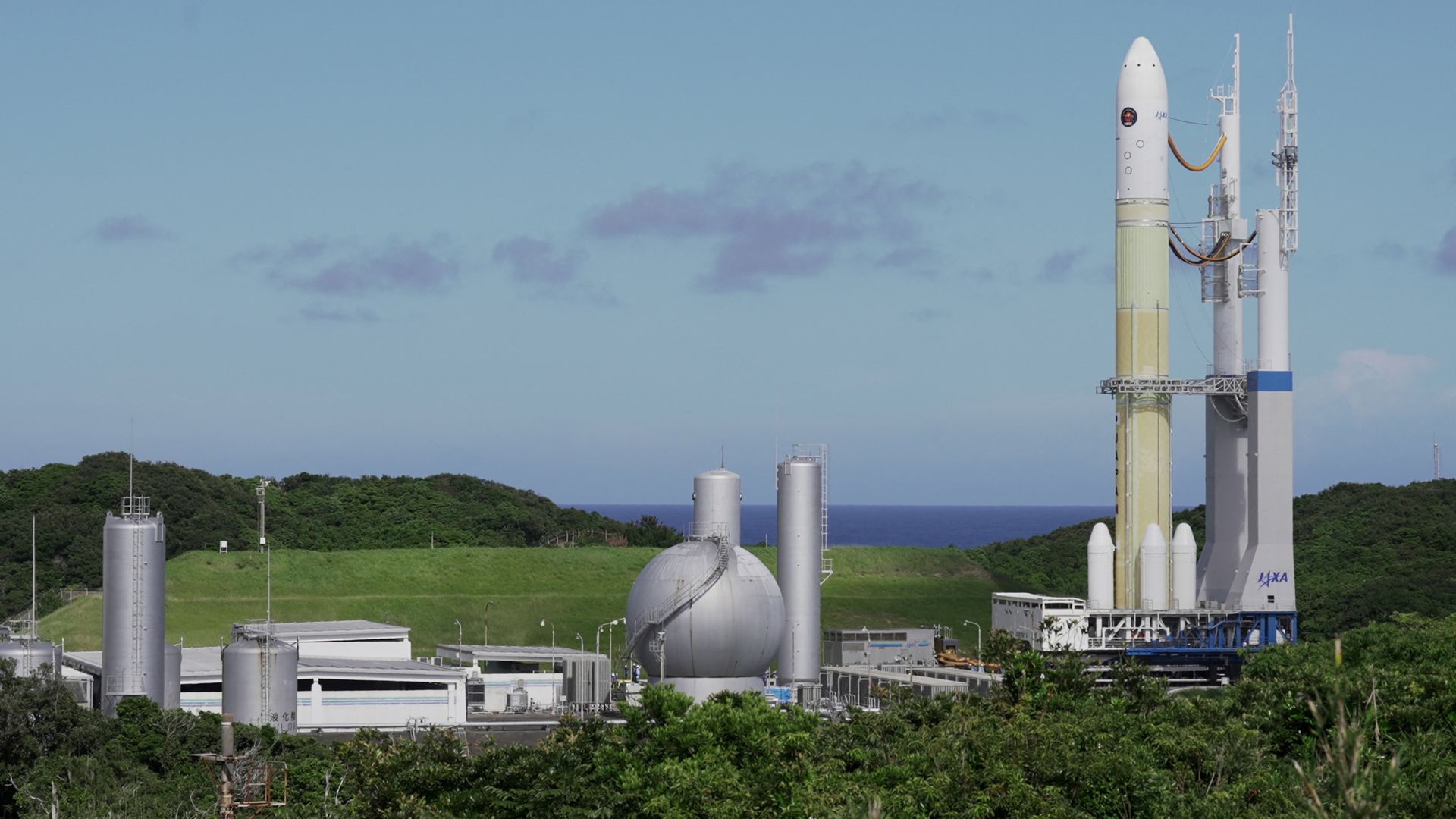
Japan just launched a spacecraft to Mars, and no, it isn't landing on the Red Planet itself. On October 19, 2026 (early October 20 in Japan), the Japan Aerospace Exploration Agency sent its Martian Moons eXploration (MMX) spacecraft soaring out of Tanegashima Space Center aboard an H3 rocket, kicking off a five-year round trip to Phobos and Deimos.
If you only glance at headlines, you might assume a moon sample return is a warm-up act for grabbing dirt off Mars. Honestly, that misses the whole point. Going after Phobos is a sharper, smarter scientific gamble that could answer how our inner solar system worked before life took hold on Earth.
Why Phobos Beats Landing on Mars Right Now
Everyone loves dramatic Mars landings. We've watched rovers touch down on the Martian surface for decades, and sample return from Mars itself has been tangled in soaring costs and shifting timelines. Phobos is a completely different play.
Measuring roughly 22 kilometers across, Phobos is a lumpy, potato-shaped world orbiting close to Mars. Because it sits inside the Martian system, debris blasted off ancient Mars by giant impacts likely rained down onto Phobos over billions of years. Grabbing a sample from Phobos doesn't just tell us about the moon. It gives researchers a backdoor look at ancient Martian material without fighting a deep Martian gravity well or thick atmosphere during ascent.
There's a catch, though. Low gravity flips spacecraft engineering upside down. On a small body like Phobos, a gentle thruster burn or a clumsy touchdown can bounce your probe right back into space. That's why MMX relies on quasi-satellite orbits rather than standard circular orbits, letting the spacecraft dance in relative stability around a tiny moon that barely pulls on anything.
Captured Asteroid or Giant Impact Debris
Look at Phobos and Deimos—the smaller second moon at about 13 kilometers across—and two rival origin stories immediately clash. Were they asteroids wandering through the solar system that Mars snagged with its gravity? Or did a massive collision smash chunks off early Mars (or trigger a ring-to-moon cycle)?
Remote cameras and spectrometers can only guess so far. Heat from a giant impact would bake out much of the volatile water and certain chemical signatures, whereas a captured primitive asteroid would hold onto richer water-bearing minerals and organics. Bringing at least 10 grams of surface regolith back to Earth lets laboratories run tests that no robotic probe could carry.
What's genuinely surprising here is how much Phobos's fate ties back to Earth's story. Researchers estimate Phobos is spiraling inward and could be torn apart into a ring around Mars in roughly 20 to 50 million years, possibly repeating a cycle that happened before. Studying how water and ingredients for life moved around the early inner solar system helps explain why Earth stayed habitable while Mars lost its ancient rivers and thicker atmosphere.
How MMX Actually Grabs the Dirt
JAXA isn't flying into deep space with guesswork. Japan already proved it can pluck samples from small bodies and bring them home safely with Hayabusa and Hayabusa2. MMX takes that playbook further with a three-module design—propulsion, return, and exploration—and an international team alongside JAXA, including NASA, CNES, DLR, and ESA.
Here's the rough sequence once the craft reaches the Mars system around August 2027:
- Scout first with Idefix: A small rover developed with French and German partners (CNES and DLR) will deploy to the surface of Phobos in 2029 to check soil mechanics, slopes, and rocks before the main spacecraft commits to touching down. Moving at roughly a millimeter per second, it's built for careful reconnaissance rather than speed.
- Touch down and sample twice: MMX plans up to two soft landings in 2030 to collect surface material. One sampler uses a robotic arm corer (C Sampler), while a pneumatic sampling system (P Sampler, derived from Honeybee Robotics' PlanetVac technology backed in early testing by The Planetary Society) blows gas to push regolith into a collection chamber.
- Fly by Deimos and head home: After wrapping up on Phobos, MMX is slated to conduct close flybys of Deimos before departing the Martian sphere around 2030, aiming for a return capsule drop in 2031.
What Could Go Wrong Before 2031
Five years in deep space is a long time for anything to go sideways. A single valve sticking, a communications hiccup millions of kilometers from Earth, or a surface that's looser or rockier than expected during touchdown could complicate sampling.
Even a successful landing doesn't guarantee a slam-dunk answer on every scientific question right away. Ten grams is a tiny amount of material—think a couple of teaspoons of coarse grains and dust—so curating it without contamination and rationing it across international labs takes serious discipline. And while MMX has strong backing and clear milestones, planetary science always carries risk when you push into new territory.
Practical Ways to Follow the Mission
If you want to track this mission without getting lost in hype, start with JAXA's official MMX portal for mission milestones and science working team updates, and check The Planetary Society's MMX overview for plain-English breakdowns of the sampling hardware and planetary science stakes.
Bookmark the major calendar checkpoints—arrival in the Mars system in August 2027, rover deployment on Phobos in 2029, sample collection in 2030, and Earth return in 2031. When 2027 rolls around, pay close attention to how MMX handles quasi-satellite orbit station-keeping and early observations of Phobos's surface; those weeks will tell you right away whether the spacecraft is healthy and ready for the tricky surface work ahead.