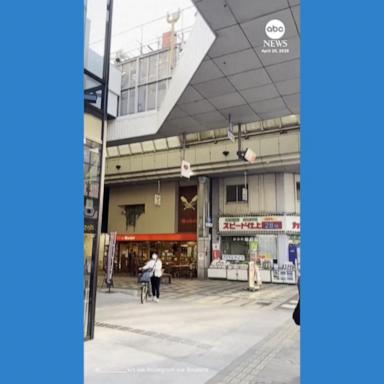
On April 20, 2026, at 4:53 p.m. local time, the floor fell out from under the Sanriku Coast. A magnitude 7.5 earthquake, tearing through a 70-kilometer rupture zone along the Japan Trench, sent 80-centimeter tsunami waves into Kuji Port and forced nearly 176,000 people to flee for higher ground. While the immediate tally of 26 damaged buildings and four injuries suggests a bullet dodged, the underlying seismic shift has triggered a rare "megaquake" advisory. The Japan Meteorological Agency (JMA) now warns that the probability of a magnitude 8.0 or higher event has spiked tenfold for the coming week. This was not just a tremor; it was a stress test for a nation built on the brink of collapse.
The Mechanics of the Sanriku Rupture
This particular event occurred at a depth of 35 kilometers where the Pacific plate grinds beneath the Okhotsk microplate. It is a violent, high-friction zone that moves at roughly nine centimeters per year—roughly the speed your fingernails grow. When that tension snaps, it does so with a thrust motion that displaces massive volumes of seawater.
The 12-second duration of the primary rupture on April 20 was mercifully short, yet the energy release was concentrated in a shallow profile that maximized surface intensity. In Aomori and Iwate, the shaking hit a JMA Shindo 5+, a level where furniture topples and unreinforced walls crack. The real story, however, isn't the damage that happened, but the damage that didn't.
Automated Survival Systems
Japan operates the world's most aggressive automated defense network. Within seconds of the initial P-wave detection, the Tōhoku, Hokkaido, and Tokaido Shinkansen lines cut power. Bullet trains traveling at 300 km/h were brought to a controlled halt before the more destructive S-waves could reach the tracks. This is the difference between a minor service suspension and a catastrophic derailment.
The energy sector followed a similar script. Tohoku Electric Power’s Onagawa No. 2 reactor, though already offline for maintenance, remained stable. Nuclear regulators reported zero abnormalities across the northern fleet. Even the industrial giants—refiners like Idemitsu and Eneos—reported that their facilities in Hokkaido and Sendai absorbed the shock without leaking a drop of product.
The Advisory Shadow
The JMA has issued an "Off the Coast of Hokkaido and Sanriku Subsequent Earthquake Advisory" valid through April 27. This is the first major test of Japan's updated "Megaquake" warning protocols since they were refined following the 2011 disasters. The logic is grounded in the "Nankai Trough" and "Japan Trench" models, where a large slip often acts as a precursor—a foreshock—to a significantly larger rupture on an adjacent fault segment.
Statistically, when a magnitude 7.5 occurs in this region, the chance of a magnitude 8.0 following within seven days increases from 0.1% to roughly 1%. That may sound low, but in the world of risk management, a tenfold increase in the probability of a civilization-altering event is a flashing red light.
Why the Tsunami was Small but the Threat is Large
The 80-centimeter surge recorded today was a "minor" tsunami by Japanese standards, but its arrival at Kuji Port serves as a reminder of the Sanriku coast’s dangerous geography. The coastline is jagged, filled with narrow, deep bays that act as funnels. This "sawtooth" coastline can amplify even a small wave into a deadly wall of water as it moves inland.
Modern seawalls, many rebuilt to 12-meter heights after 2011, easily contained the 80-centimeter surge. However, these walls are designed for specific thresholds. If the predicted magnitude 8.0 event occurs, the displacement of the seabed could be five to ten times greater than what was seen on April 20.
Infrastructure Under Strain
While the physical buildings largely stood their ground, the societal friction of mass evacuation remains an unsolved problem. Forcing 175,000 people out of their homes on a Monday afternoon creates immediate economic and psychological paralysis. Schools in Urakawa remain closed. Ferry services across the Tsugaru Strait are frozen.
The electrical grid held, maintaining a reserve margin of 9%, but the local power outages in Hiraizumi show that the "last mile" of the grid is still vulnerable to line snaps and transformer failures during Shindo 5+ shaking. The question for the next 168 hours is not whether Japan is prepared—it is whether the system can handle a second, larger blow while the first is still being processed.
Keep your emergency kits at the door and your phones charged. The earth is still moving.