The ground shifted on a Thursday afternoon, but the real shock arrived via a smartphone notification. When a 7.1 magnitude earthquake struck off the coast of Kyushu on August 8, 2024, it triggered something unprecedented in Japanese history. For the first time, the Japan Meteorological Agency (JMA) issued a "Megaquake Advisory." This was not a prediction of an imminent disaster, but a cold, statistical warning that the probability of a massive rupture along the Nankai Trough had significantly increased. In a country where tremors are a daily background noise, this specific alert stripped away the veneer of normalcy, forcing 125 million people to reckon with a geological time bomb that has been ticking for centuries.
Japan is currently trapped between the need for hyper-vigilance and the economic reality of a prolonged state of high alert. The advisory specifically focuses on the Nankai Trough, an underwater subduction zone where the Philippine Sea Plate slides beneath the Eurasian Plate. History shows that when one section of this line snaps, the rest often follows in a terrifying "twin" earthquake scenario. The 2024 Kyushu tremor happened at the edge of this zone, effectively poking a sleeping giant.
The Geometry of a Megathrust Disaster
To understand the severity of the Nankai Trough threat, one must look at the math of the Earth’s crust. This isn't about standard seismic activity. We are talking about a megathrust earthquake, the most powerful type of seismic event on the planet. The Nankai Trough stretches nearly 900 kilometers along Japan’s Pacific coast, from Shizuoka to the southern tip of Kyushu.
When this fault line eventually ruptures in its entirety, the energy released will be catastrophic. Government estimates suggest a magnitude 8 or 9 event could kill upwards of 323,000 people. This isn't hyperbole. It is a projection based on the 1707 Hoei earthquake, which remains the only historical event known to have ruptured all segments of the Nankai Trough simultaneously.
The mechanics are brutal. The subducting plate drags the edge of the upper plate downward, building immense elastic tension. Eventually, the friction can no longer hold. The upper plate snaps back upward, displacing trillions of tons of seawater. In the 2024 alert, an 80 cm tsunami was recorded in Miyazaki prefecture. That was a warning shot. In a full-scale Nankai event, waves are projected to reach heights of 30 meters in some coastal areas, arriving in as little as five minutes after the shaking stops.
The Problem of the Twin Earthquake
The most terrifying aspect of the Nankai Trough is its tendency for "temporal clustering." In 1854, two massive quakes struck 31 hours apart. In 1944 and 1946, the gap was two years. This pattern is why the JMA's new advisory system exists. If a "half-rupture" occurs, the risk of a second, potentially larger quake in the adjacent segment becomes hundreds of times higher than the baseline risk.
We saw this play out in 2011 with the Tohoku earthquake. A magnitude 7.2 foreshock preceded the massive 9.1 disaster by two days. At the time, the world—and many scientists—viewed the first quake as the main event. Japan learned a bitter lesson that year. The current advisory system is the institutionalized memory of that failure.
The Infrastructure of Anxiety
Living under a "Huge Earthquake Advisory" creates a unique psychological and economic friction. Within hours of the 2024 notice, supermarket shelves across central and western Japan were stripped of bottled water and emergency rations. Prime Minister Fumio Kishida canceled a planned trip to Central Asia, signaling that the state’s command structure needed to be physically present.
But how do you keep a modern economy running when the government tells you a cataclysm might happen in the next seven days?
The logistics are a nightmare. High-speed rail lines, the Shinkansen, operated at reduced speeds in high-risk zones, adding hours to travel times. Nuclear power plants, particularly the Hamaoka plant in Shizuoka, are under constant scrutiny. Hamaoka sits directly above the predicted rupture zone and has been dubbed the "most dangerous nuclear plant in Japan." While it has been offline since 2011 for massive sea-wall reinforcements, the mere presence of spent fuel rods in a zone expecting a 20-meter tsunami is enough to keep any disaster manager awake at night.
Silicon and Seismicity
Beyond the immediate human toll, the Nankai Trough is a dagger pointed at the heart of the global tech supply chain. The region under the advisory—stretching through Aichi, Osaka, and Kyushu—is home to Japan’s industrial belt.
- Kyushu (Silicon Island): Produces a significant portion of the world’s image sensors and automotive chips.
- Aichi: The global headquarters of Toyota and its massive network of Tier 1 suppliers.
- Osaka: A hub for chemical manufacturing and electronics.
A major quake here doesn't just stop Japanese factories; it halts production lines in Michigan, Munich, and Shenzhen. The "Just-in-Time" manufacturing model, perfected by Toyota, is notoriously fragile when faced with regional infrastructure collapse. If the Port of Nagoya is rendered inoperable by a tsunami, the global automotive industry faces a multi-month cardiac arrest.
The limits of Early Warning Systems
Japan has the most sophisticated seismic network on Earth. The S-net and DONET systems consist of thousands of pressure sensors and seismometers on the ocean floor, connected by fiber-optic cables. These systems can detect a tsunami or a seismic wave before it even reaches the coastline, providing precious seconds of lead time.
However, technology has its limits. The 2024 advisory highlighted a critical flaw in public communication: the "Warning Fatigue" factor. The JMA issued the advisory for a one-week period. As the days passed with no follow-up quake, the tension inevitably ebbed. People returned to their routines. This creates a dangerous "cry wolf" effect. If the big one happens two weeks or two months after an advisory is lifted, the death toll could be higher because the population had just let their guard down.
The science of earthquake prediction is still largely an exercise in probability, not prophecy. We can measure plate velocity, we can track "slow slip" events, and we can map historical intervals. But we cannot say "Monday at 4:00 PM." The JMA is walking a tightrope, trying to provide actionable intelligence without causing a permanent state of panic that would eventually be ignored.
Re-engineering a Nation for Survival
The Nankai Trough threat has fundamentally changed how Japan builds. This isn't just about bolting furniture to walls. It is about a massive, multi-decade engineering project to move the country's vital organs.
Japan is increasingly looking at "redundancy" as a survival strategy. This includes the development of a secondary capital capability in Osaka, should Tokyo be paralyzed. It involves the construction of the Chuo Shinkansen, a maglev train that will run mostly through deep tunnels inland, making it far less vulnerable to tsunamis than the current coastal Tokaido line.
Coastal towns have moved from passive defense (sea walls) to active evacuation strategies. In places like Kuroshio in Kochi Prefecture, where a 34-meter tsunami is possible, the town has built massive "Tsunami Evacuation Towers"—elevated steel platforms designed to keep hundreds of people above the waterline. They have also pioneered "Horizontal Evacuation," creating mountain paths that allow residents to reach high ground in under three minutes.
The Financial Fallout
The insurance industry is already pricing in the Nankai risk. The Japanese government’s Earthquake Insurance System is a public-private partnership because the private market simply cannot handle the projected $2 trillion in economic damages a Nankai megathrust would cause. To put that in perspective, that is nearly 40% of Japan’s total GDP.
Investors are quietly shifting assets. There is a documented "de-risking" trend where companies are moving critical data centers and backup manufacturing to Hokkaido or the Sea of Japan coast—areas furthest from the Nankai Trough. This internal migration is reshaping the economic geography of the country, moving the center of gravity away from the vulnerable Pacific coast.
The Reality of the "Big One"
We have to stop thinking about the Nankai Trough as a singular event. It is a recurring geological cycle. The last major quakes were in the 1940s, during the chaos of World War II. Before that, the 1850s. The interval is roughly every 100 to 150 years. We are currently in the "danger zone" of that cycle.
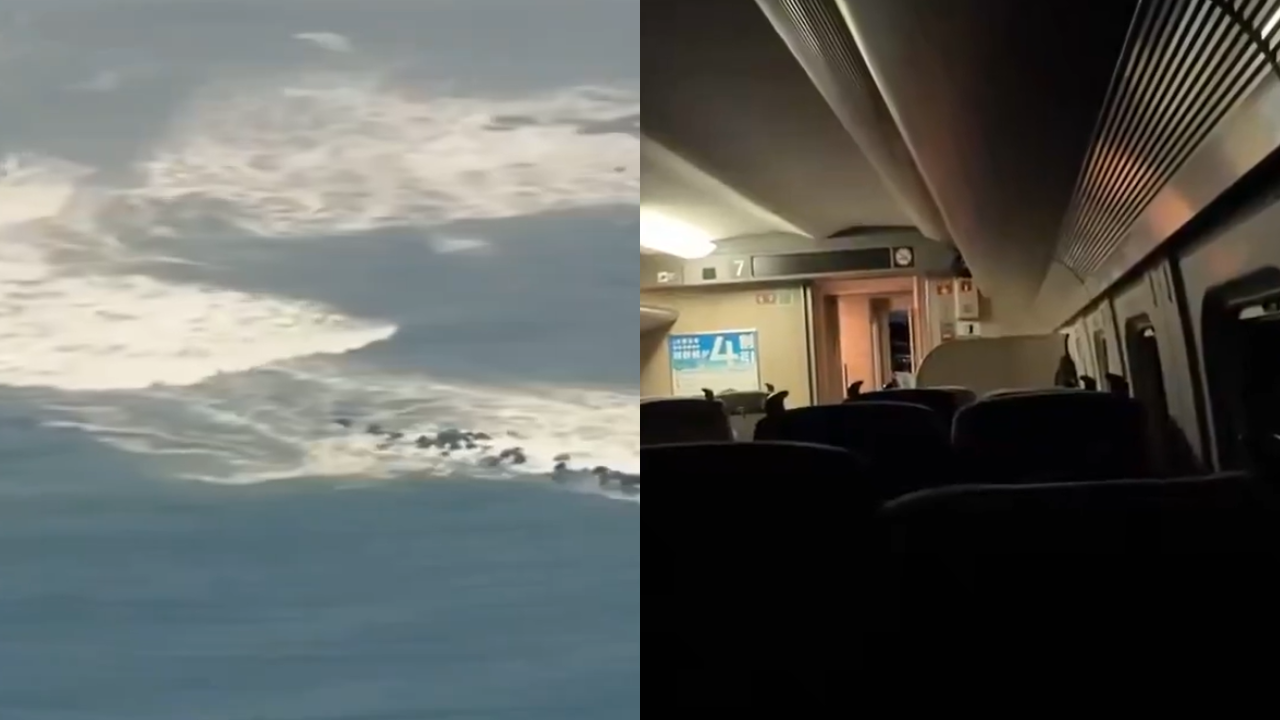
The 7.1 magnitude quake in Kyushu was a reminder that the plates are moving, and the tension is real. An 80 cm tsunami might seem small, but even a wave that size carries enough force to sweep a vehicle off a road or crush a small boat. It was a test of the national alert system, and in many ways, the system worked. People moved to higher ground. Trains stopped. The government mobilized.
But the real test remains in the future. The "Huge Earthquake Advisory" is a tool for a society that has accepted it cannot stop nature, only outrun it. The most critical takeaway for the global community is that Japan’s struggle is a blueprint for other subduction zones, such as the Cascadia fault off the coast of the Pacific Northwest in the United States.
The Nankai Trough isn't just Japan's problem; it is the ultimate case study in how a modern, high-tech civilization survives an encounter with the raw power of the planet. When the next advisory comes—and it will—the window for preparation will be measured in minutes, not days. Secure your heavy furniture, map your route to high ground, and never assume the first tremor is the only one.