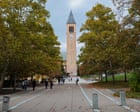
Silence has a very specific weight on a college campus in November.
If you have ever walked across the Arts Quad in Ithaca, New York, just as the autumn wind strips the last copper leaves from the oaks, you know the sound of that silence. It is the hum of fluorescent lights in cavernous libraries, the crunch of gravel under hurried boots, and the quiet, almost reverent murmur of an institution that believes its own mythology. For more than a century and a half, Cornell University has built its identity on Ezra Cornell’s famous founding promise: any person, any study. It is an ethos of radical openness, intellectual rigor, and moral accountability.
Until the machinery of institutional self-preservation grinds into motion.
When the Cornell faculty senate cast a historic vote of no confidence against the university’s leadership over its handling of the Jane Doe allegations, the headlines treated it like a procedural earthquake. Dry news briefs tallied the ballots, quoted carefully worded administrative statements, and moved on to the next campus controversy.
They missed the point entirely. A vote of no confidence is not a bureaucratic technicality. It is the sound of a community realizing that the house they built to shelter truth has quietly been converted into a fortress to protect reputation.
The Architecture of a Quiet Crisis
To understand why professors—people who generally prefer tenure-track peace, grant applications, and esoteric debates over public mutiny—would openly revolt against their own administration, you have to step away from the press releases.
Picture a hypothetical junior faculty member. Let’s call her Dr. Elena Vance. She isn't an activist; she is a biochemist who spends twelve hours a day staring at protein folding models. She chose academia because she believed in rules, evidence, and the slow, methodical pursuit of clarity. One Tuesday afternoon, a graduate student closes Elena’s office door, sits in the chair across from her desk, and begins to cry. The student isn't crying about a failed experiment. She is crying because she filed a formal complaint—a Jane Doe case, anonymized to protect her from retaliation—and watched her trauma disappear into an administrative black hole.
This is a composite scenario, of course, drawn from the countless conversations that happen behind closed doors at elite universities every semester. Yet it captures the exact emotional friction that ignited the Cornell faculty revolt.
In the real world of Ithaca, the Jane Doe allegations didn't just test a policy manual; they tested the foundational trust between the people who actually teach and research at the university and the executives who manage its endowment and public image. When allegations of misconduct, mishandled investigations, or procedural failures surface at a major institution, the administration often treats the crisis like a toxic spill. The primary instinct is containment. Lawyers are brought in. Non-disclosure agreements are drafted. Language becomes sterile, passive, and impenetrable.
Mistakes were made.
Policies are under review.
We cannot comment on pending personnel matters.
To an executive board, that language looks like prudent risk management. To the faculty sitting in the lecture halls, it looks like moral cowardice.
Why Professors Rarely Revolt
You have to appreciate how rare this kind of rebellion actually is.
Academia is inherently conservative in its daily operations. Professors are trained to argue with precision, to cite sources, and to respect institutional hierarchies—especially when those hierarchies fund their laboratories and underwrite their sabbaticals. Getting three hundred tenured academics to agree on lunch is a minor miracle; getting them to formally declare that their university’s top leadership is unfit to govern is nothing short of extraordinary.
So what broke the dam?
It wasn't a single bad memo. It was the cumulative weight of opacity. Over months, as details surrounding the Jane Doe allegations trickled out—allegations involving how complaints were processed, how victims were treated, and whether senior officials shielded favored figures or buried uncomfortable truths—a disturbing pattern emerged. Faculty members began asking basic questions in senate meetings. They wanted to know how Title IX and misconduct protocols were actually functioning behind the curtain. They wanted assurance that when a student or colleague came forward under the banner of "Jane Doe," the system wasn't rigged to exhaust them into silence.
Instead of transparency, they got stonewalling.
Think of a university’s governance like a suspension bridge. The cables are the administration—the legal teams, the deans, the president’s office—providing tension, structure, and financial support. The deck, the part people actually walk across every day, is the faculty and students. For decades, the deck trusts that the cables are anchored into solid bedrock. A no-confidence vote happens when the people on the bridge look up, notice the cables are frayed, and realize the engineers are painting over the rust instead of fixing the steel.
The administration’s defense followed a predictable script. Leaders pointed to privacy laws, legal constraints, and the complexity of modern compliance frameworks. And to be fair, managing a multi-billion-dollar research institution while navigating federal mandates, due process rights, and reputational hazards is genuinely difficult. Nobody envies the person sitting in Day Hall when a crisis hits. The legal minefields are real, and rushing a judgment can destroy innocent lives just as easily as ignoring a complaint destroys victims.
Yet acknowledging complexity does not excuse evasion. When leadership uses privacy laws as a shield to avoid explaining systemic failures, trust evaporates.
The Invisible Toll on the Classroom
When the news of the no-confidence vote broke, outside observers mostly asked one question: Does this actually fire anyone?
Legally, no. A faculty senate vote of no confidence is symbolic. It does not automatically strip a university president or provost of their title, nor does it force a board of trustees to clean house by Friday afternoon. In purely technical terms, the executives could wake up the next morning, pour their coffee, and keep signing checks.
To dismiss the vote as "merely symbolic," however, is to completely misunderstand how power works in a community of ideas.
Authority in a university does not flow from a badge or a corporate org chart; it flows from consent. A university president cannot force a historian to care about strategic initiatives, nor can a provost compel a physicist to sit on a diversity task force if the professor believes the leadership lacks integrity. Once that moral authority is gone, the administration isn't leading anymore—it is merely occupying space.
Consider what happens next in the quiet corners of campus.
A talented young researcher with offers from Stanford, MIT, and Cornell looks at the headlines. She reads about a faculty so alienated from its own administration that it had to stage a public vote of rebuke. She wonders: If I bring my lab here, and something goes wrong—if one of my students is harmed, or if I need institutional backing—who is actually steering the ship? She takes the offer in California.
Meanwhile, inside the undergraduate dorms, students absorb a darker lesson. Colleges spend millions of dollars on orientation week seminars preaching accountability, consent, and speaking truth to power. When those same students watch their university’s highest officials fumble a Jane Doe investigation and then circle the wagons when questioned, the hypocrisy is deafening. It teaches twenty-year-olds that rules are only for people without leverage.
I remember sitting in a crowded auditorium during a similar institutional crisis years ago, watching a senior dean try to read a legalistic statement to a room full of angry students and exhausted professors. His hands trembled slightly as he held the paper. Every time he used a corporate euphemism—"stakeholder alignment," "procedural bandwidth"—you could feel the oxygen leave the room. He thought he was sounding professional. In reality, he sounded like a stranger who had wandered into the wrong building and didn't speak the language.
That disconnect is the true heart of the Cornell story. It isn't just about one set of allegations or one embattled leadership team. It is about the corporate colonization of higher education.
The Corporate Trap in Higher Education
Over the last thirty years, American universities have increasingly modeled themselves after Fortune 500 companies. Presidents are recruited like CEOs. Communications departments have ballooned into crisis-PR war rooms. Legal counsel sits at the elbow of every academic decision, whispering about liability exposure before anyone asks about moral obligation.
In a corporation, that mindset makes a certain cold sense. If a tech company faces a product recall or an executive scandal, its primary duty is to protect shareholder value and brand equity.
A university is not a tech company. Its currency is credibility.
When an institution of higher learning adopts the crisis-management playbook of a corporate conglomerate, it slowly poisons its own bloodstream. The very act of protecting the brand destroys the thing that made the brand valuable in the first place: the public’s belief that this is a place where truth matters more than convenience.
The Jane Doe allegations forced that contradiction into the harsh daylight of an Ithaca winter. On one side stood an administrative apparatus conditioned to minimize exposure, control the narrative, and keep messy human realities behind closed doors. On the other stood a faculty whose entire professional lives are dedicated to interrogating evidence, demanding rigor, and refusing to accept "because we said so" as an answer.
When those two worldviews collided, something had to give.
The debates leading up to the vote were reportedly raw, emotional, and deeply personal. These were not partisan political operatives scoring points for a cable news cycle. They were scholars—engineers, classicists, veterinarians, sociologists—wrestling with what it means to belong to an institution that has lost its moral compass. Many of them loved Cornell fiercely. That was precisely why they voted against its leadership. You do not bother to stage an intervention for a stranger; you do it for family when you see them destroying themselves.
What Happens When the Dust Settles
So where does a fractured campus go after the ballots are counted?
The immediate aftermath of a no-confidence vote is always awkward. The board of trustees usually issues a statement reaffirming its support for the administration, hoping the storm will blow over once final exams begin and students scatter for winter break. Administrators promise "listening sessions" and "working groups"—the classic bureaucratic sedatives designed to let anger dissipate into calendar invites.
Sometimes, that strategy works. Attention spans are short, and academic calendars are relentless.
Yet even if the current leadership survives the news cycle, the scar tissue remains. Once a faculty crosses the Rubicon of a formal no-confidence vote, the relationship is permanently altered. Every future budget cut, every curriculum reform, every strategic plan will now be viewed through a lens of deep suspicion. The administration has lost the benefit of the doubt—and in academia, the benefit of the doubt is the oil that keeps the whole machine from seizing up.
Real recovery requires something that corporate crisis manuals never recommend: radical humility. It requires leaders to step away from the talking points, look their colleagues in the eye, and admit not just that "mistakes were made," but who made them, why they happened, and what concrete guardrails will ensure that the next Jane Doe isn't sacrificed on the altar of institutional reputation.
Outside the brick walls of the faculty senate chamber, the wind still blows across Cayuga Lake, indifferent to university politics. Students still hurry to morning lectures with lukewarm coffee in hand. Researchers still peer into microscopes, chasing answers to questions that won't be solved for decades. The daily rhythm of the university goes on, steady and deceptive, like ice covering a deep river.
Beneath that surface, however, the current has shifted forever—a quiet reminder that even the grandest stone towers can only stand as long as the people inside them believe they are worth defending.