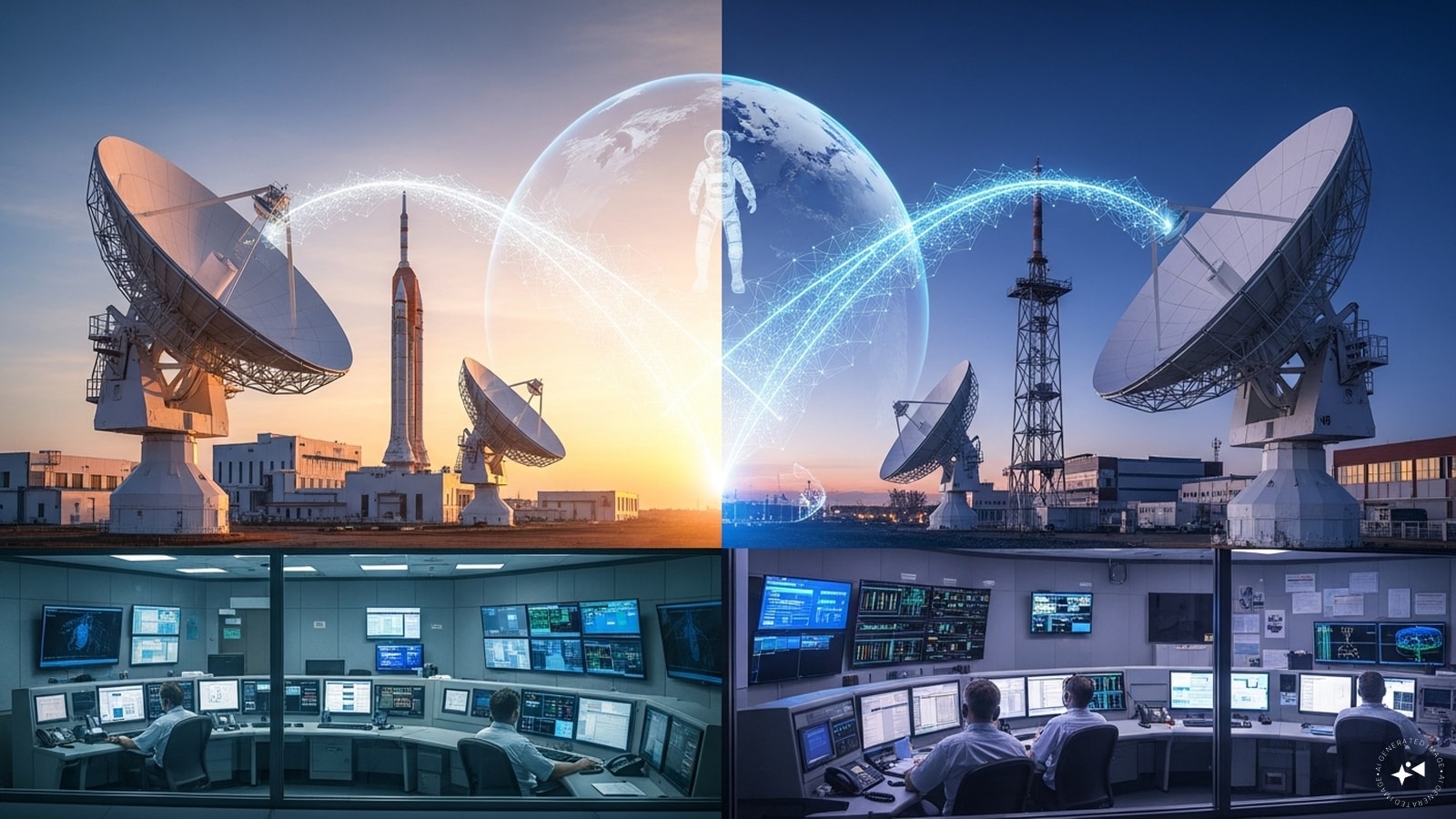
India is moving toward its first crewed spaceflight, but the Indian Space Research Organisation (ISRO) has a blind spot problem. No matter how powerful the LVM3 rocket is, once the Gaganyaan crew module clears the horizon over the Indian Ocean, India’s local ground stations lose their grip on the craft. To bridge this silence, ISRO is establishing a dedicated, high-speed fiber link with the European Space Operations Centre (ESOC) in Germany. This is not just a backup plan; it is an admission that human safety in orbit requires a level of global connectivity that no single nation can provide alone.
The Geography of Silence
The physics of Low Earth Orbit (LEO) is unforgiving. A spacecraft like Gaganyaan will circle the planet at approximately 7.8 kilometers per second. At that speed, the window for a ground station in Bengaluru or Port Blair to "see" the capsule is measured in minutes. Once the craft passes beyond the curvature of the Earth relative to India, the mission goes dark. For a different view, check out: this related article.
For an uncrewed satellite, a few minutes of radio silence is routine. For three Indian astronauts sitting in a pressurized tin can 400 kilometers up, silence is a liability. If a life-support system fails or a fire breaks out while the craft is over the Atlantic, waiting for it to drift back into Indian range is a death sentence. By plugging into the European Space Tracking network (Estrack), ISRO gains eyes in places like Kourou in French Guiana, Maspalomas in Spain, and Santa Maria in Portugal.
The Technical Backbone of the European Link
This isn't a standard internet connection. ISRO is deploying a specialized private network using Multiprotocol Label Switching (MPLS). This architecture allows mission data to bypass the public internet, traveling through dedicated routers that prioritize Gaganyaan’s telemetry over any other global traffic. Related insight on this trend has been provided by The Next Web.
The hardware involved is equally rigorous:
- Radio Frequency Compatibility: ISRO recently shipped suitcase-sized models of the Gaganyaan radio suite to Germany. Engineers at the Ground Segment Reference Facility are currently simulating every possible interference to ensure the Indian transmitters don't "stutter" when talking to European dishes.
- Latency Compression: In a high-risk abort scenario, every millisecond of lag between the spacecraft and the flight director’s console can change the outcome. The fiber link is designed to handle massive data bursts—high-definition video of the crew, 4K sensor data, and vital medical telemetry—with near-zero latency.
- The 15-Meter Advantage: The primary anchor for the first Gaganyaan flights will be the 15-meter antenna in Kourou. Its position near the equator makes it the perfect "catcher's mitt" for the specific orbital inclination ISRO has chosen for this mission.
Why India Can’t Do It Alone
There is a lingering nationalist sentiment that ISRO should be entirely self-reliant. However, building a global ground station network requires more than just money; it requires geopolitical real estate. India does not have territories in the South Atlantic or the Caribbean. Even the most advanced Indian Tracking, Telemetry, and Command Network (ISTRAC) stations are geographically limited.
Relying on Europe’s ESOC provides a level of redundancy that protects against local hardware failures. If a cyclone hits an Indian station, the mission control in Darmstadt can pick up the slack, relaying commands to the crew module via the European network. This is the "safe room" of spaceflight—a diplomatic and technical insurance policy.
The High Stakes of Data Integrity
The integration goes deeper than just sharing a radio frequency. Under the Technical Implementing Plan (TIP) signed in late 2024, the two agencies have synchronized their software protocols. This ensures that when an ESA antenna receives a stream of raw binary from Gaganyaan, the Indian servers in Bengaluru can decode it instantly without translation errors.
This level of cooperation is rare. It involves sharing proprietary encryption logic and hardware specifications that are usually guarded as state secrets. The decision to open these doors reflects a shift in ISRO’s philosophy: the prestige of a successful launch is secondary to the absolute necessity of bringing the crew home alive.
The Logistics of the First Flight
The first uncrewed test mission, G1, will serve as the live stress test for this European bridge. During this flight, the ground stations will be pushed to maintain a "handshake" as the module transitions from Indian to European coverage.
Engineers will be looking for "signal drop-off" at the edges of the horizon. If the transition isn't perfect, the flight software will need to be re-patched before a human ever steps inside the capsule. The goal is a persistent, unbroken tether that ensures the Mission Control Centre is never more than a fraction of a second away from the astronauts, regardless of which continent is passing beneath them.
This partnership essentially turns the European Space Agency into a temporary wing of the Indian space program. Without this 8,000-kilometer fiber-optic umbilical cord, Gaganyaan would be flying blind for nearly 60 percent of every orbit. In the business of human spaceflight, those are odds no one is willing to take.