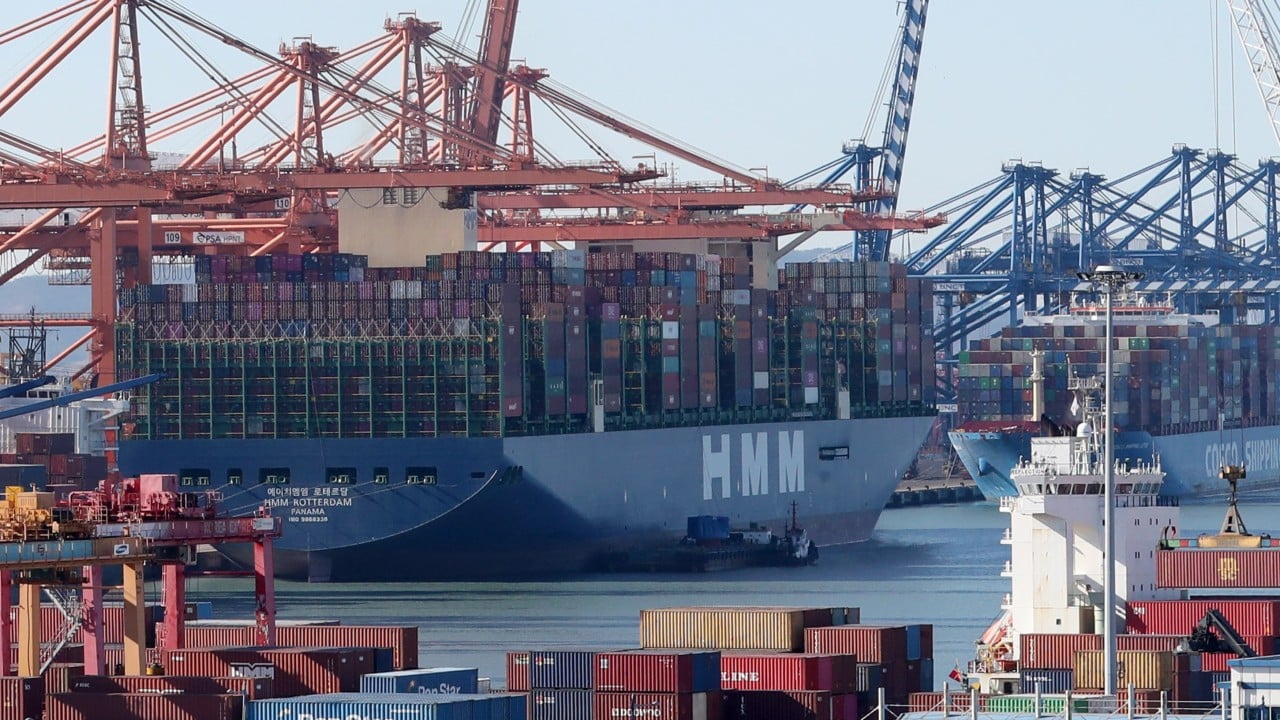
The sea smells different when it is trying to kill you. Captain Park knows this odor well. It is a sharp, metallic bite of old ice and diesel exhaust, hanging heavy in the air off the northern coast of Russia. For decades, the path from East Asia to the markets of Europe meant a long, expensive detour. It meant threading through the narrow choke point of the Suez Canal, burning millions of gallons of heavy fuel oil, sweating out the politics of the Red Sea, and watching calendars bleed away in slow motion.
Today, the geography of the planet is shifting under our feet. And a South Korean container ship is about to test a route that used to exist only in the fever dreams of 19th-century explorers.
Consider what happens when the roof of the world melts.
Ice retreats. Water opens. Beneath the frantic geopolitical hand-wringing in Western capitals—where diplomats worry about naval choke points and the quiet alignment of foreign powers along frozen coastlines—lies a simpler, heavier truth. Economics abhors a long line. If a ship can cut thousands of miles off a voyage, someone will eventually point the bow north and push the throttles forward.
Let us be clear about what this journey represents. This is not a casual pleasure cruise. (Note: When I speak of the captain's immediate interior monologue here, I am using a narrative framework to translate the cold telemetry of maritime logistics into human scale). Park stands on the bridge, staring out at a horizon that stretches endlessly flat, watching chunks of multi-year ice drift past like broken teeth. Every mile of the Northern Sea Route shaved off the journey to Rotterdam means millions of dollars saved. It also means entering a maritime wilderness where rescue helicopters are hours away and the nearest deep-water port is a ghost town of rusted industrial ambition.
Western capitals look at this trial run with furrowed brows. They see a strategic vulnerability. They see a warming Arctic becoming a Russian toll road, patrolled by icebreakers and monitored by radar stations that have sat silent since the Cold War. They see South Korea—a technological powerhouse tethered to global trade lanes—testing the waters of a new era, one where the shortest distance between two points cuts straight through a geopolitical minefield.
Yet, step back from the map rooms of Washington and Brussels for a moment. Look at the logistics chain.
A standard container ship crawling from Busan to Hamburg via the Indian Ocean takes roughly thirty to thirty-five days. Up north, through the ice-choked channels of the Russian Arctic, that same vessel can slice the timeline down by nearly a third. Time is fuel. Fuel is carbon. Carbon is money. When those three variables align, maritime commerce ignores borders, political anxieties, and diplomatic warnings. It moves. Water always finds the lowest level, and cargo always finds the shortest line.
History rhymes, of course. We have seen this hunger before. For four hundred years, European merchants broke their ships and froze their bones trying to find the Northwest Passage or the Northern Sea Route. They wanted spices, silk, and a shortcut to the riches of the East. They found frozen tombs instead. Sir John Franklin left men behind in the white silence because he believed the ice would yield.
It did not yield for them. Not then.
Now, the climate crisis—driven by the very industrial engine that makes these container ships possible—is doing what human grit could not. It is carving open the ice. There is a dark, bitter irony to this voyage. The ships burning the world are now using the wreckage of that burning to find a faster way around it.
On the bridge of the test vessel, the digital navigation charts glow with emerald lines. Satellite data streams in from polar orbits, mapping the shifting density of floes six hundred miles ahead. Ice-class hulls are thicker, reinforced with high-yield steel designed to crush pack ice before it can punch a hole in the fuel tanks. This is high-stakes engineering meeting raw nature.
What happens when the Arctic becomes a routine shipping lane?
The answer is already unfolding in the quiet boardrooms of shipping conglomerates in Seoul, Tokyo, and Oslo. Ports are being planned where tundra used to be. Insurance underwriters are frantically rewriting risk models for waters where GPS signals can be jammed and winter darkness swallows the sun for months at a time. The ecology of the polar north, finely tuned over millennia to a relentless, frozen quiet, is suddenly being introduced to the deep, pulsing thrum of marine diesel engines.
The South Korean vessel pushes onward, breaking a white path through the blue-black water. Behind it trails a wake of bubbles and exhaust, a temporary scar on an ancient surface that is closing back up almost as fast as it is torn apart.
Park watches the radar screen sweep in steady, hypnotic circles. Out there, past the glass, the world is smaller than it used to be. And far more dangerous.