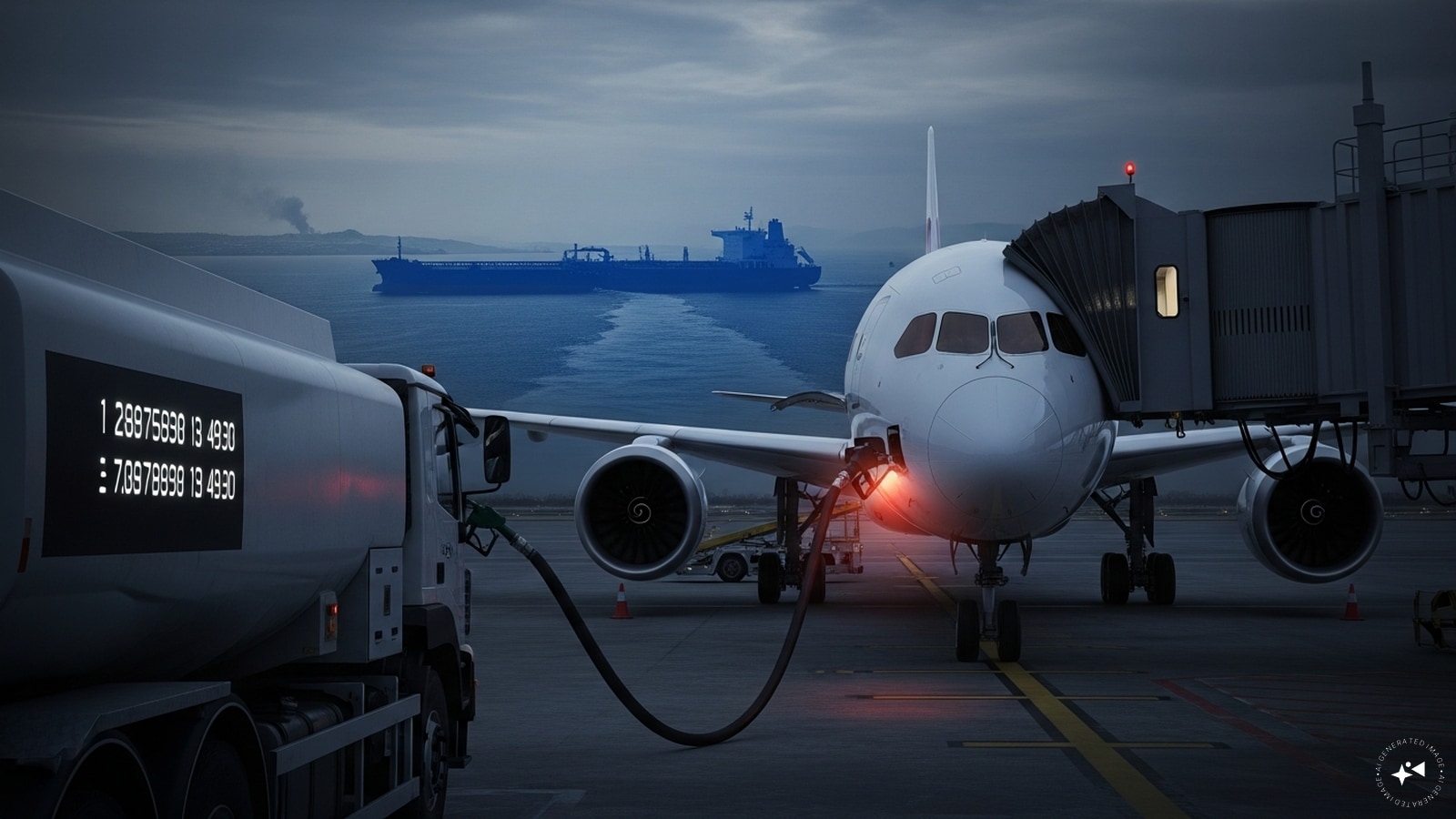
Captain David Vance adjusted the thrust levers of his Boeing 737, feeling the subtle, powerful surge of 20,000 gallons of highly refined kerosene coming to life beneath his feet. To the 162 passengers sitting behind him, the cabin smelled faintly of stale coffee and industrial carpet. To Vance, it smelled like money burning.
For twenty-four years, Vance has watched the world change from seven miles up. He has flown through recessions, volcanic ash clouds, and global lockdowns. But these days, the tension isn't in the weather radar. It is on the fuel manifest.
Every time a flight dispatcher uploads a flight plan now, the numbers look slightly more terrifying. In the span of just a single month, the financial landscape beneath American commercial aviation didn't just shift; it ruptured. By April, the collective fuel bill for US air carriers had quietly doubled.
Double.
Think about your own monthly expenses. Imagine waking up to find your rent, your mortgage, or your grocery bill had multiplied by two overnight, not because you bought more, but simply because the world became more expensive while you slept. Now scale that up to an industry that measures its consumption not in gallons, but in billions of barrels.
This isn't just a corporate headache for spreadsheet-wielding executives in Chicago, Atlanta, or Dallas. This is a quiet crisis that ripples from the tarmac directly into your wallet, changing how, when, and if we can afford to connect with the people we love.
The Anatomy of a Squeeze
To understand why the global forecast for airline profits is currently plummeting, you have to look at how a modern jet engine breathes. It requires a highly specific flavor of petroleum product known as Jet A-1. It cannot be substituted. It cannot be rationed if you want to stay in the air.
When you buy an airline ticket, you are essentially purchasing a fraction of a massive oil transaction. For years, fuel hovered predictably around twenty to twenty-five percent of an airline’s total operating costs. It was a manageable beast. Today, that beast has broken its chain.
The mechanism behind this surge is a brutal combination of geopolitics and refining bottlenecks. When global crude oil supply gets tight, refineries prioritize diesel and gasoline—the fuels that keep trucks moving and commuter cars running on the ground. Jet fuel becomes an afterthought in the refining queue. The technical term for the price difference between a barrel of crude oil and the jet fuel refined from it is the "crack spread." Right now, that spread is a yawning chasm.
Consider what happens next: an airline faces a choice. It can absorb the cost and watch its profit margins disintegrate into thin air, or it can pass the bill to the person sitting in seat 14B.
They choose seat 14B. Every single time.
The Human Toll of a Spreadsheet Line Item
Let’s look past the sterile financial reports and the Wall Street tickers. Let’s look at Elena, a hypothetical but entirely accurate representation of millions of travelers this year.
Elena lives in Denver. Her mother lives in Miami and is recovering from knee surgery. Six months ago, a round-trip ticket between those two hubs cost roughly three hundred dollars. Elena could swing that once a month. She could be there to help with groceries, to sit on the porch, to ensure her mother wasn't isolated.
Last week, Elena logged online to book her next trip. The price tag for the exact same economy seat, with the exact same airline, flying the exact same route, was seven hundred and fifty dollars.
She stared at the screen, her mouse hovering over the "purchase" button, feeling a cold knot form in her stomach. She closed the tab. She couldn't do it.
That is the invisible casualty of the jet fuel squeeze. It isn't just a dip in quarterly earnings for a multinational corporation. It is a forced separation. It is the business trip canceled, the family reunion scaled back, the wedding missed because the cost of cutting through the sky has become a luxury reserved only for the affluent or the desperate.
The Myth of the Flat Ticket Price
Many travelers believe airlines are simply greedy. It is an easy conclusion to reach when you are being charged forty dollars to check a suitcase or seven dollars for a box of stale crackers. But the reality of airline economics is surprisingly fragile.
Airlines are essentially logistics companies operating on razor-thin margins. In a good year, a major carrier might make a net profit of just a few dollars per passenger. They make their real money on the sheer volume of humanity they move across continents.
When the price of jet fuel doubles, that tiny profit margin vanishes instantly. To survive, airlines deploy complex algorithms—dynamic pricing models—that constantly scan the market, adjusting ticket prices by the minute based on demand, weather, and fuel costs.
But there is a ceiling to what the public will tolerate. Economists call it demand destruction. If a ticket to see grandma costs as much as a used scooter, people stop buying tickets. They stay home. They use video calls. They drive.
When demand drops, airlines start cutting routes. They stop flying to smaller regional airports. They ground older, less efficient aircraft. The entire network shrinks, leaving smaller communities isolated and making the remaining flights even more crowded and chaotic.
The Mirage of Alternatives
It is tempting to look toward the future for a rescue. We hear constant talk of Sustainable Aviation Fuel, or SAF, made from cooking oil, plant waste, and synthetic hydrocarbons. It sounds beautiful. It promises a world where we can fly guilt-free, insulated from the volatile swings of the oil market.
But the reality is a cold shower.
Currently, SAF accounts for less than one percent of global aviation fuel consumption. There simply isn't enough infrastructure to produce it at scale. Even if you could find it, it costs up to four times more than traditional jet fuel. Switching to it tomorrow would not lower your ticket price; it would triple it.
Electric planes? They are decades away for anything larger than a commuter hopper, weighed down by the stubborn physics of battery weight. Hydrogen? A radical redesign of aircraft and airports that will take half a century to realize.
For the foreseeable future, we are chained to the fossil fuel grid. When that grid shakes, the cabin shakes.
The Flight Manifest of Tomorrow
Back in the cockpit, Captain Vance watches the sunset bleed across the horizon over Nebraska. The sky is an immaculate, peaceful orange, utterly detached from the economic storm raging on the ground.
He knows that every mile his aircraft covers is costing the company more than it did last year, last month, even last week. He can see it in the lighter passenger loads on certain mid-week routes. He can hear it in the anxious conversations among the flight attendants during layovers, wondering if layoffs or schedule cuts are on the horizon.
The global airline industry is a canary in the economic coal mine. It reacts first, fastest, and most violently to energy shocks. What starts as a spike in a commodity market in London or New York turns into an empty seat in a cabin, which turns into an empty bedroom in a grandmother's house two thousand miles away.
The next time you hear a pilot announce that the aircraft is reaching its cruising altitude, look out the window at the landscape passing beneath you. The true cost of that view is no longer just the price of admission. It is a fluctuating, heavy tax on our ability to remain connected, a reminder that our freedom to roam the sky is entirely at the mercy of the dark, expensive fluid pumping through the wings.