The screen in the corner of the control room hums with a low, hypnotic frequency. Outside, the night is pitch black, silent, and entirely deceptive. To anyone standing in the cool morning air of a suburban valley thousands of miles away, the sky looks peaceful. Stars blink through a thin layer of high-altitude cirrus clouds. But inside this bunker, miles from any front line, the sky is crowded. It is crowded with ghosts.
We tend to think of modern conflict as loud. We picture thunderous explosions, screaming jet engines, and the brute force of iron colliding with concrete. Yet the reality unfolding on the monitors before us is eerily quiet. It is a war of mathematics, of microsecond calculations happening faster than a human heartbeat, fought by machines that never blink and operators who have learned to live in a perpetual state of hyper-vigilance. Discover more on a related issue: this related article.
Consider what happens when a threat appears.
Not a soldier marching across a border, but an aluminum tube packed with explosives, programmed by GPS coordinates to find a specific window on the third floor of an administrative building. It flies low, hugging the contour of the terrain, ducking below radar horizons, invisible to the naked eye. It travels at hundreds of miles per hour, driven by a small, whining turbine or an electric motor that sounds remarkably like a lawnmower until it is directly overhead. Additional journalism by The Verge highlights related perspectives on this issue.
This is the central dilemma of contemporary defense. How do you protect a city when the danger arrives uninvited, unannounced, and shaped like a toy?
For decades, military doctrine was built around brawn. You built thicker armor, heavier tanks, and larger interceptor missiles costing millions of dollars apiece. But economics have a cruel way of rewriting strategy. When an adversary can manufacture a crude flying bomb out of commercial off-the-shelf parts for a few thousand dollars, firing a multi-million-dollar rocket to stop it is financial suicide. You win the skirmish and lose the treasury.
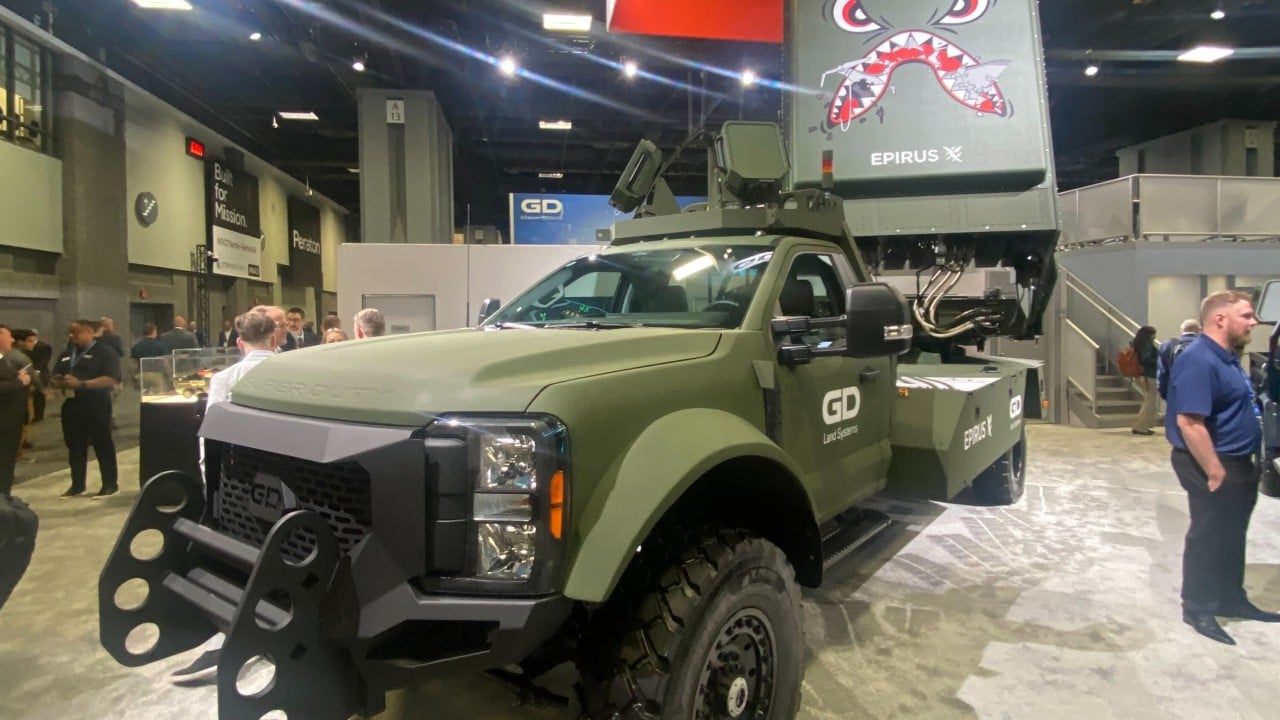
This economic trap is precisely what brought engineers, tacticians, and defense manufacturers together at recent expos, gathering around rows of sleek, matte-black hardware that looked more like advanced scientific laboratory equipment than weapons of war. They are not merely building bigger guns. They are building an entirely new grammar of survival.
Let us step inside a hypothetical radar telemetry truck during a live simulation.
The air smells faintly of hot ozone and stale coffee. Sergeant Marcus Vance sits hunched over a dual-monitor console, his fingers resting lightly on a mechanical trackball. He has been on duty for six hours. His eyes are bloodshot. His job is not to pull a trigger, but to interpret whispers.
A tiny green pixel flickers on the edge of the holographic grid. It is moving at Mach 0.1, hugging a riverbed twenty miles out.
"Potential trace," Vance mutters, his voice flat, devoid of panic through sheer repetition.
Beside him, an automated detection algorithm—a neural net trained on terabytes of previous flight paths—interrogates the data. Is it a flock of migrating geese? Is it a rogue crop duster? Or is it a loitering munition looking for a heat signature?
The system decides in three hundred milliseconds. It is hostile.
In the past, this is where the scramble would begin. Sirens would wail. People would run for basements. Today, the response is chillingly swift and remarkably invisible. Instead of an interceptor missile tearing skyward with a roar of solid rocket fuel, a localized electronic warfare pod pivots silently on its mount atop a nearby hill. It emits a narrow, focused beam of invisible radio frequency energy.
You cannot see the beam. You cannot hear it. But to the oncoming drone's internal navigation computer, it feels like sudden, blinding white noise.
The drone's GPS receiver loses its lock. Its internal compass, scrambled by spoofed signals, begins to drift. Deprived of its digital eyes and ears, the machine hesitates. It wobbles in the crosswinds, its pre-programmed logic loops failing to resolve the sudden sensory deprivation. Within seconds, the guidance system gives up, the motor cuts out, and the projectile tumbles harmlessly into an empty field, detonating against the dirt where no one lives.
Total human intervention required: zero.
Total cost of the defense: pennies worth of electricity.
Yet, technology is never a silver bullet. Every defensive measure immediately spawns an offensive counter-measure in an endless, dizzying spiral of technological evolution.
When you jam GPS frequencies, attackers build drones that navigate by optical matching—taking snapshots of the ground below and comparing them to onboard topographical maps, matching terrain features like a hiker checking a paper map. When you blind their optical sensors with lasers, they switch to thermal imaging. When you counter thermal signatures, they fly in total radio silence using pre-loaded inertial navigation units that do not rely on outside signals at all.
This cat-and-mouse game forces military designers to think less like artillery officers and more like chess grandmasters playing three games simultaneously.
At the recent defense showcases, the crowd gravitated toward the kinetic interception systems—the high-energy lasers and hyper-velocity micro-missiles designed to physically shred incoming threats out of the sky when electronic jamming fails. These systems represent a marvel of engineering physics. Imagine trying to hit a speeding bullet with another bullet while both are navigating wind shear, atmospheric distortion, and counter-measures. Now, replace the bullet with a beam of concentrated light that must dwell on a rapidly spinning, tumbling target long enough to burn through its carbon-fiber skin and ignite the internal payload.
It sounds like science fiction. But watching a test video in a climate-controlled convention center is vastly different from standing in a bunker when the alarms finally sound for real.
I spoke with a veteran defense analyst who spent thirty years evaluating tactical systems in active zones. He looked past the shiny brochures and polished chrome models on the showroom floor. He pointed to a simple, unadorned folding table in the corner of a manufacturer's booth.
"Everyone wants to talk about the lasers," he told me, shaking his head slightly. "Everyone gets excited about the high-tech kill mechanisms. But you want to know what actually wins these engagements? It isn't the weapon. It's the plumbing."
By plumbing, he meant integration.
You can have the best radar in the world, the fastest interceptor, and the smartest artificial intelligence algorithm. But if your radar talks to a computer system that uses a different data protocol than your launcher, you are dead in the water. The friction of communication—the milliseconds lost translating one digital dialect into another—is all a fast-moving threat needs to slip through the net.
The true revolution happening in modern sky defense is not about building bigger explosives. It is about creating a unified nervous system. It connects coastal patrol boats, desert radar stations, urban rooftop sensors, and mobile command vehicles into a single, breathing organism. When one sensor detects a disturbance, every node in the network instantly knows its vector, velocity, and probable intent.
It is a sobering realization. We are spending billions of dollars to weave an invisible web of safety around our cities, turning the empty air above our heads into a heavily guarded highway patrolled by algorithms.
As the simulation in the bunker concludes, the green dot on Sergeant Vance's screen vanishes, replaced by a clean, empty grid. The room is quiet again, save for the hum of cooling fans and the faint clicking of keyboards.
Vance takes a slow sip of cold coffee. He does not smile. He does not celebrate. He simply resets his tracking parameters, leans back into his ergonomic chair, and waits for the next ghost to appear in the dark.