Silence.
That is the first thing you notice when a prairie dies, not the brown grass or the cracked mud at the bottom of a stock dam, but the heavy, suffocating absence of wings beating against the morning wind. For three generations, if you stood on the edge of a dry-land pasture in western South Dakota at dawn, you expected a riot of noise—the sharp, metallic trill of western meadowlarks, the low drumming of sharp-tailed grouse on their spring dancing grounds, the sudden whirr of a pheasant flushing from a ditch. Instead, across millions of acres of the Northern Great Plains, that symphony had been thinning out for decades, replaced by the dry rattle of cheatgrass and the hum of a diesel pickup hauling hay to cattle standing in dirt lots.
Consider a hypothetical rancher we will call Caleb, standing beside a sagging four-strand barbed-wire fence thirty miles west of the Missouri River. Caleb is not a villain in a conservationist’s parable; he is a guy trying to pay off an operating note at the local bank before the interest eats him alive. Like his grandfather before him, Caleb turns his herd out onto a massive, continuous pasture in May and leaves them there until October. He knows the land is tired. He can see the bare soil widening around the watering tanks and the invasive grasses creeping in where native bluestem used to reach a horse’s belly. To fix it, the agronomists tell him, he needs to divide his three-thousand-acre spread into twenty smaller paddocks and move his cattle every three days.
Caleb does the math in the cab of his truck, and the numbers laugh in his face. Building twenty miles of interior barbed-wire fence costs upwards of twelve thousand dollars a mile in labor, treated posts, and steel, and once it is in the ground, that wire becomes a permanent prison for migrating pronghorn antelope and a lethal obstacle for low-flying prairie grouse. So Caleb leaves the gates open. The cattle camp out near the water, nibbling the tender regrowth down to the roots while ignoring the tougher forage half a mile away, and every year the grass gets a little shorter, the soil gets a little hotter, and the birds stop coming back.
For over a century, the American West has been trapped in a false choice between keeping cattle ranchers solvent and keeping native grassland ecosystems intact. When you overgraze a pasture, you strip away the tall, varied structure that ground-nesting birds require to hide their eggs from coyotes and hawks. Yet if you pull the cattle off the land entirely, the prairie also suffers, choking on its own dead thatch because these grasses evolved over millennia alongside millions of migrating bison that mowed, trampled, and fertilized the earth in dense, fast-moving herds before disappearing for months at a time. Ranchers knew they needed to mimic the bison, to bunch their cattle tight and keep them moving, but steel wire and wooden posts made that biological necessity financially impossible.
Until the fence disappeared into orbit.
The Ghost in the Pasture
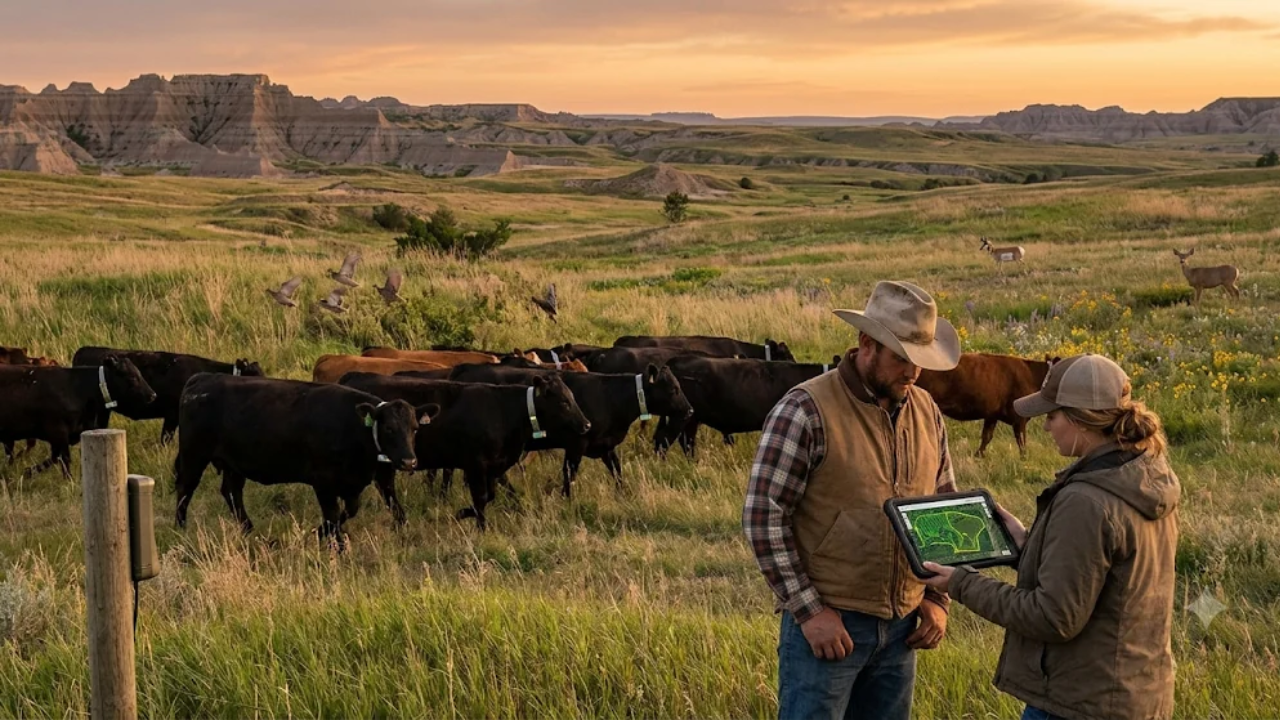
To understand how a constellation of satellites hundreds of miles above the Earth ended up saving nests in South Dakota, you have to look at what a cow actually wears around its neck now. Picture a heavy-duty nylon strap fitted with a solar-powered box no larger than a brick, resting just behind the animal’s ears. There is no wire stretched across the draw, no cedar posts driven into the rocky clay, and no rusting staples waiting to snag a deer’s hide. Instead, a rancher sits at a kitchen table with a cup of coffee and draws a polygon on a tablet screen, tracing the contour of a ridge or boxing off a sensitive creek bed using satellite imagery and GPS coordinates.
When a cow approaches that invisible digital boundary, the collar emits a sharp, rising audio tone—a warning chirp that sounds a bit like a backing-up delivery truck. If the animal ignores the sound and takes another step toward the restricted grass, the collar delivers a mild, harmless static pulse, roughly a fraction of the jolt you get from touching a traditional electric fence. Within forty-eight hours, a herd of two hundred Angus cows learns the rules of a game they cannot see. They hear the beep, turn their heads back toward the fresh pasture, and keep grazing.
It sounds almost absurdly simple, yet the ecological chain reaction triggered by that invisible boundary is rewriting the rules of wildlife management across South Dakota. When ranchers use virtual fencing to concentrate cattle into small, high-density groups for just a few days before shifting the digital lines to a fresh paddock, the land finally gets what it has been starving for since the nineteenth century: rest. Not a few days of relief, but sixty, ninety, or even three hundred days of uninterrupted recovery where native warm-season grasses can send roots six feet deep into the dark loam and push seed heads toward the sky.
What Happens When the Grass Grows Back
Walk into a pasture in central South Dakota two years after a rancher trades barbed wire for satellite coordinates, and the transformation hits your boots before it hits your eyes. The ground feels spongy, armored by a thick layer of trampled plant litter that traps snowmelt and keeps soil temperatures twenty degrees cooler during brutal July heatwaves. Look closer at the vegetation, and you no longer see a monotonous crew-cut of uniform grass; you see a chaotic, three-dimensional architecture of tall switchgrass, purple coneflower, wild licorice, and low-lying buffalo grass.
Wildlife biologists call this structural heterogeneity, though a simpler metaphor is an apartment building with different floor plans for different tenants. A killdeer or a horned lark wants bare, open ground to spot approaching predators from a hundred yards away. A sharp-tailed grouse needs thick, knee-high cover to shield its clutch of a dozen speckled eggs from the mid-day sun and circling harriers. A newly hatched pheasant chick, no bigger than a walnut, cannot eat grain; it survives almost exclusively on soft-bodied insects that thrive only in broadleaf wildflowers blooming inside rested pastures.
Because satellite-guided rotational grazing allows ranchers to leave entire sections of their property untouched during the critical spring nesting window between April and July, those wildlife tenants are moving back in at rates that have stunned even veteran conservationists. Across pilot programs spanning tens of thousands of acres in South Dakota—backed by partnerships between ranchers, state wildlife agencies, and conservation groups like Ducks Unlimited and the World Wildlife Fund—landowners are documenting dramatic rebounds in grassland bird density, pollinator abundance, and big game movement.
Consider what happens next when a drought hits, as it inevitably does on the High Plains. In 2021, when scorching heat withered pastures across the Dakotas and forced thousands of producers to sell off breeding herds at steep losses, the ranchers running intensive rotational systems still had standing forage. By using virtual boundaries to keep cattle out of fragile riparian zones along creeks and wet meadows, those producers preserved critical green refuges that kept both their calves and the local waterfowl populations alive while neighboring pastures turned to dust.
The Math of a Living Prairie
If you want to know why this technology is spreading across the Dakotas faster than almost any conservation program in recent memory, stop talking about ecology and look at a ledger. Ranchers are among the most fiercely independent business owners on the planet, and they have spent decades listening to outsiders tell them how to manage their land without offering to pay the bills when commodity prices crash. Virtual fencing works because it solves an acute labor and capital crisis at the exact same moment it heals the soil.
Hiring a ranch hand in rural South Dakota has become nearly impossible, and building permanent cross-fencing across rugged, rolling breaks is backbreaking work that locks a business into a rigid layout forever. If a sudden rainstorm fills a dry creek bed or a patch of invasive thistle explodes on a north-facing slope, a rancher with barbed wire cannot easily move his fences to adapt. With a satellite-linked platform, that same rancher can redraw his grazing plan from the seat of a tractor in three minutes, funneling cattle onto an invasive weed patch to stomp it out before it goes to seed, or fencing off a newly discovered grouse lek so the birds can breed in peace.
Critics sometimes balk at the upfront subscription and hardware costs of smart collars, which can run forty to fifty dollars per animal per year depending on the provider and cost-share grants. It is a fair skepticism; margins in the cow-calf business are razor-thin, and technology that fails in a blizzard or loses signal in a deep canyon is worse than useless. Early adopters in South Dakota spent plenty of frustrating afternoons troubleshooting battery drains, dead cell zones, and stubborn bulls that decided a mild static pulse was a minor inconvenience on the way to greener grass.
Yet the math keeps tilting in favor of the sky. Even with annual collar fees, bypassing permanent interior fencing saves ranchers tens of thousands of dollars in upfront capital expenditures, while improved forage utilization often allows a pasture to support ten to twenty percent more grazing days without degrading the land. Meanwhile, conservation organizations and federal programs have stepped in to subsidize up to seventy-five percent of the initial rollout for producers willing to protect sensitive bird habitat, recognizing that paying for a few hundred smart collars is dramatically cheaper than buying up land or watching another grassland species slide onto the endangered list.
Removing the Wire
There is a quiet irony in watching a piece of space-age hardware undo one of the defining inventions of the nineteenth century. When Joseph Glidden patented barbed wire in 1874, he shattered the open range, making modern ranching possible while slicing the American prairie into rigid, unnatural squares. For a hundred and fifty years, wildlife paid the price for those straight lines. Pronghorn antelope, which evolved to run horizontally across the plains rather than jump vertically over obstacles, routinely trap themselves against bottom wires during brutal winter blizzards, starving to death yards away from shelter. Mule deer and elk snap legs on sagging strands, while thousands of low-flying prairie chickens and grouse die every year from colliding with wires they cannot see in the dim twilight.
Every mile of interior barbed wire that a South Dakota rancher rolls up and hauls to the scrap heap because a satellite signal has taken its place is a death trap removed from the landscape. The fence no longer bisects the migration corridor; it exists only as a whisper of radio waves beamed down to a collar, shifting smoothly across the hills in rhythm with the rain, the grass, and the seasons.
Stand back on that ridge in western South Dakota at dawn now, five years after the wires came down and the collars went on. The cattle are bunched tight in a half-mile paddock two draws to the east, heads down, tearing into waist-high big bluestem while leaving behind a carpet of trampled stems and rich manure. Behind them, across two thousand acres of resting prairie that will not see a hoof until next autumn, the wind moves through seed heads heavy with grain. Somewhere out in the tall grass, a hen pheasant shifts over a clutch of twelve warm eggs, hidden beneath a canopy that didn't exist five springs ago, while a meadowlark lands on an empty wooden fencepost—the only one left standing—and splits the morning open with a song.