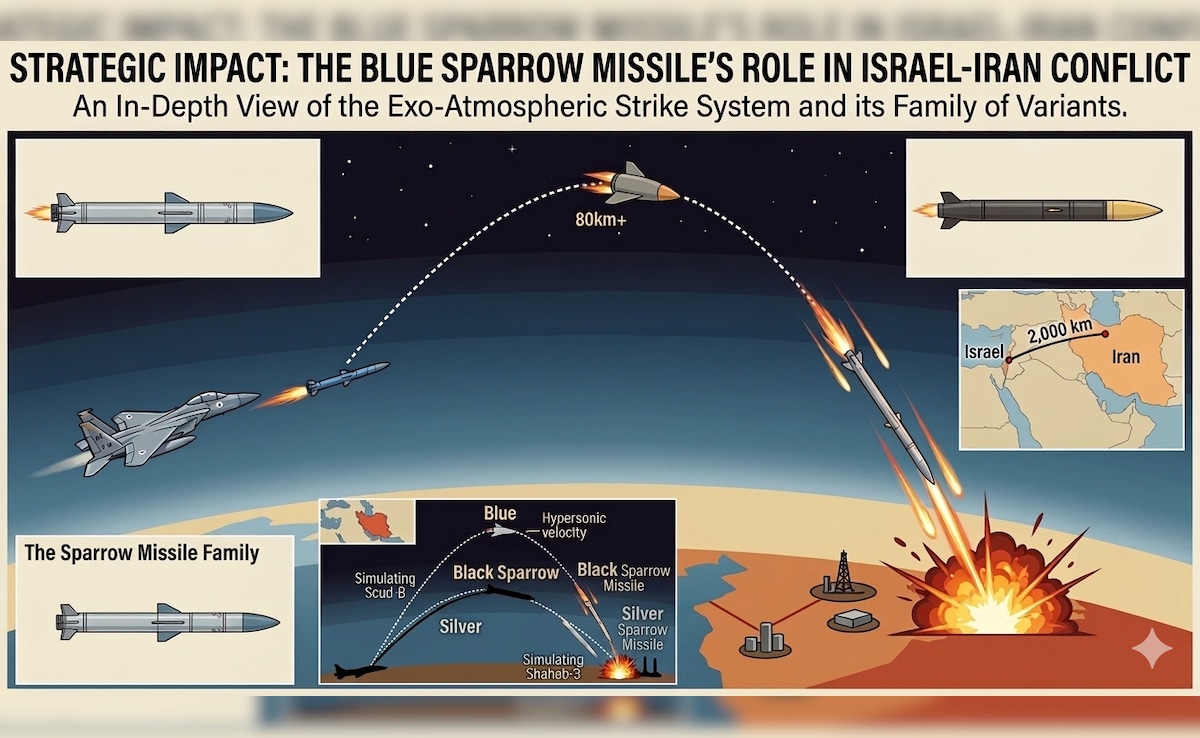
The effectiveness of a shield depends entirely on the strength of the hammer that tests it. While global attention remains fixed on the dramatic interceptions by Israel’s Iron Dome or David’s Sling, the true engineering feat happens months before a conflict begins, often thousands of feet above the Mediterranean. This is the world of the Sparrow missile family—Blue, Black, and Silver—produced by Rafael Advanced Defense Systems. These are not weapons designed to strike a ground target or down an enemy fighter. Instead, they are high-fidelity target missiles, sophisticated mimics built to die so that defense systems can learn how to live. Without the Sparrow's ability to simulate Iranian or Syrian ballistic threats, the multi-layered defense architecture of the Middle East would be nothing more than an unproven theory.
Military analysts often overlook target drones as mere "practice rounds," but the Sparrow series represents a peak in ballistic engineering. These air-launched vehicles are dropped from F-15 fighter jets, igniting their motors to scream toward the edge of space before plunging back down to simulate the chaotic, high-velocity reentry of an IRBM (Intermediate-Range Ballistic Missile). They are the "sparring partners" of the Arrow-2 and Arrow-3 interceptors. If a Sparrow can outmaneuver or outpace an interceptor during a test, the software is rewritten. It is a brutal, expensive, and necessary evolution. You might also find this similar story useful: The Silicon Engine and the Soul of the Machine.
The Engineering of Deception
The Sparrow family serves a singular purpose: to act as a digital and physical doppelganger for the world’s most dangerous threats. To understand why these missiles matter, one must understand the physics of a ballistic trajectory. A standard missile follows a predictable arc, but modern threats from adversaries like Iran involve separation—where the warhead detaches from the booster—and high-speed maneuvers designed to confuse radar.
Rafael didn't build one target; they built a hierarchy of threats. The Black Sparrow was the pioneer, designed to simulate short-range ballistic missiles like the Scud-B. It provided a relatively simple "point-to-point" target for the early versions of the Arrow system. However, as regional threats evolved, the Black Sparrow became obsolete. It lacked the range and the radar cross-section (RCS) complexity required to test modern sensors. As extensively documented in latest reports by Mashable, the implications are significant.
The Blue Sparrow stepped in to fill that gap. This mid-tier variant is significantly more complex, mimicking the Shahab-3 or other medium-range missiles. It features a modular payload section. This allows engineers to swap out "heads" to simulate different types of warheads, including those with specific electronic signatures or physical dimensions. When an F-15 releases a Blue Sparrow, the missile climbs to a high altitude, then orients its nose downward, accelerating to hypersonic speeds. It isn't just a flying metal tube; it is a sophisticated radio-frequency simulator that "tricks" the defense system into thinking a real city-killer is inbound.
The Silver Sparrow and the Hypersonic Threat
The crown jewel of the family is the Silver Sparrow. This is the heavyweight champion of target missiles, designed specifically to test the Arrow-3—Israel’s upper-atmosphere interceptor. The Silver Sparrow is massive, weighing over three tons. Its primary mission is to simulate the most advanced Iranian threats, such as the Sajil or newer liquid-fueled variants that can reach deep into European or Israeli territory.
What makes the Silver Sparrow terrifyingly effective as a test tool is its reentry behavior. At the edge of the atmosphere, it can simulate a "separating" warhead. For a radar operator at a Green Pine battery, the screen suddenly fills with multiple objects. Which one is the warhead? Which one is the discarded booster? Which one is a decoy? The Silver Sparrow provides the data that allows the Arrow’s algorithms to make that distinction in a fraction of a second.
The Mediterranean Testing Ground
Testing these missiles is a logistical nightmare that requires the coordination of an entire nation’s military and intelligence apparatus. Because Israel is a small country, it cannot fire ballistic missiles over its own land. Instead, the tests are conducted westward, over the Mediterranean Sea.
An F-15 "Baz" takes off from an Israeli Air Force base, carrying the Sparrow under its centerline. At a designated point over the sea, the pilot releases the missile. Gravity takes over for a few seconds before the rocket motor kicks in, sending the Sparrow on a steep, parabolic climb. This air-launch method is a stroke of genius. Launching from the air saves the massive amount of fuel required to overcome the thickest part of the atmosphere from the ground. It makes the "target" more mobile and harder for adversaries to track before the test begins.
Once the Sparrow is in its terminal phase—the descent—the defense batteries on the ground "see" it. The Green Pine radar locks on, the battle management center calculates an intercept point, and an Arrow missile is launched. The cost of a single test can run into the tens of millions of dollars. A single failure isn't just a budget hit; it’s a hole in the national security strategy.
The Economics of a Controlled Kill
One might ask why Israel doesn't just use older, decommissioned missiles as targets. The answer lies in the data. An old Scud doesn't have the sensors required to tell you why an intercept failed. The Sparrow family is packed with telemetry equipment. Every millisecond of the flight is recorded and transmitted back to ground stations.
- Black Sparrow: Simulates older, short-range ballistic threats (150-600 km).
- Blue Sparrow: Simulates medium-range threats with increased maneuvering (700-1,500 km).
- Silver Sparrow: High-altitude, long-range simulation for the Arrow-3 (2,000+ km).
This isn't just about hardware; it's about the "threat library." By using the Sparrow, the Israeli Ministry of Defense builds a digital catalog of how different missiles look on radar. When a real threat appears on the horizon, the system doesn't have to "think." It simply recognizes a pattern it has already defeated ten times during testing.
Strategic Sovereignty and the Export Market
While the Sparrow family was born out of necessity for Israel's own survival, it has become a significant asset in the global defense market. Nations across Europe and Asia are currently grappling with the reality of high-speed ballistic threats. Most of these countries have plenty of interceptors but very few ways to realistically test them.
Rafael has marketed the Sparrow series as the gold standard for "training against reality." By selling the target technology, Israel isn't just exporting a product; they are exporting the very metrics of success. If a country buys a Sparrow to test their own systems and the system fails, they realize they need Israeli-made interceptors to fix the gap. It is a masterclass in industrial strategy.
The Sparrow series also provides a layer of strategic ambiguity. By demonstrating that they can simulate—and therefore intercept—the most advanced missiles in the world, Israel sends a clear message to regional rivals. The test is the deterrent. Every time a Silver Sparrow is successfully swatted out of the sky over the Mediterranean, it makes the prospect of a real strike that much more futile for an aggressor.
The Silent Evolution
We are currently seeing a shift toward hypersonic cruise missiles and glide vehicles. These weapons don't follow a simple arc; they skip off the atmosphere like a stone on water. The next iteration of the Sparrow family is likely already in development, designed to mimic these non-ballistic trajectories.
[Image showing the trajectory of a Sparrow missile from air launch to reentry]
The difficulty of this engineering cannot be overstated. To simulate a glide vehicle, the target missile must have its own sophisticated control surfaces and the ability to withstand extreme thermal stress at Mach 5 or higher. The Sparrow must always be one step ahead of the threat it is mimicking, and two steps ahead of the interceptor it is training. It is an endless race where the finish line is constantly moving.
The next time you see footage of a white streak in the sky over Tel Aviv, remember that the success of that moment was bought and paid for years ago. It was forged in the "deaths" of hundreds of Blue, Black, and Silver Sparrows that sacrificed themselves to ensure the shield would hold.
Contact Rafael or the Ministry of Defense's official archives to view the unclassified telemetry data from the last Silver Sparrow flight to see the actual speeds these "dummies" achieve.