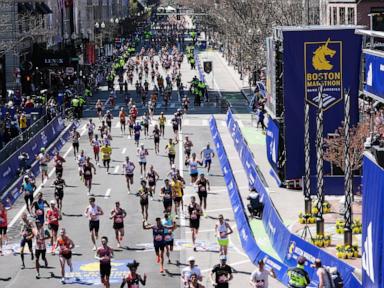
The air in Hopkinton on a Monday morning in April is thick with the scent of tiger balm and nervous sweat. Thirty thousand people are packed into a space that was never designed to hold them. They are a restless sea of spandex and expensive sneakers, vibrating with the collective kinetic energy of months of predawn long runs. To the casual observer, this is a celebration of human endurance. To Marcel Modlowsky, it is a fluid dynamics problem that could, if left unchecked, turn catastrophic.
We often think of crowds as collections of individuals. We see a person, then another, then a group. But when you compress thirty thousand bodies into the narrow, winding arteries of the Boston Marathon course, the individual ceases to exist. The crowd becomes a singular organism. It flows like water. It compresses like gas. It has a pulse, a temperature, and a terrifying capacity for turbulence.
Modlowsky is a crowd scientist. He doesn't look at the Boston Marathon as a race; he looks at it as a high-stakes logistics puzzle where the pieces are sentient and unpredictable. While the runners are worrying about their split times or their hydration strategy, Modlowsky is worrying about the density of human flesh per square meter. He is the man tasked with ensuring that the "growing field" of the world’s most prestigious marathon doesn't become a victim of its own success.
The Physics of the Starting Line
Imagine you are standing in the middle of a dense throng of people. You want to move forward, but the person in front of you is stationary. You feel a slight pressure against your back. That pressure isn't just one person; it’s the cumulative force of a thousand people behind them, all wanting to move. In crowd science, this is known as a "shockwave."
When a crowd reaches a certain density—roughly six people per square meter—it loses its ability to behave rationally. At this point, the crowd becomes "turbulent." If one person stumbles, the ripple effect moves through the mass like a wave through the ocean. You don't fall because you tripped; you fall because the liquid mass of humanity around you shifted, and there was nowhere for your weight to go.
This is the nightmare scenario Modlowsky works to prevent. The Boston Marathon has grown significantly since its humble beginnings in 1897. With over 30,000 official entrants, the logistics of simply getting them across the starting line without a trampling incident is a feat of engineering.
Modlowsky uses sophisticated computer modeling to simulate these movements. He creates digital ghosts of runners, assigning them "behaviors" based on years of observed data. He can predict where bottlenecks will form. He knows exactly how many seconds it takes for a "wave" of runners to clear a specific corner. By adjusting the timing of the starting corrals by even a few minutes, he can prevent a dangerous buildup of pressure miles down the road.
The Ghost in the Machine
Consider a hypothetical runner named Elias. Elias has trained for three years to qualify for Boston. He’s in Corral 2, Wave 1. He is focused on his watch. He has no idea that his ability to run a smooth race is being dictated by an algorithm designed to keep him from touching the person next to him.
If Modlowsky releases too many runners like Elias at once, the course "chokes." The road narrows at certain points—historic bridges, tight turns, or areas where spectators lean too far into the path. When the density rises, Elias is forced to slow down. He starts "weaving," a move that consumes 20% more energy and increases the risk of clipping someone's heel.
But if the release is too slow, the event drags on. The sun rises higher. The temperature climbs. Suddenly, Modlowsky isn't just managing space; he’s managing biology. A delayed start for the later waves means thousands of runners are hitting the "Wall" at Heartbreak Hill during the hottest part of the day.
The stakes are invisible until they are agonizingly real. Every minute of delay in Hopkinton translates to a higher rate of heat exhaustion in Newton. The crowd scientist must balance the physical safety of the crush against the physiological safety of the clock.
The Psychology of the Swarm
Data only tells half the story. Humans are not molecules in a pipe; they are emotional, irrational, and prone to "herding."
Modlowsky’s work involves a deep dive into the psyche of the athlete. Why do people cluster near the water stations even when there is an empty table ten yards ahead? Why do they speed up when they see a camera, regardless of their heart rate?
"Crowd turbulence" often begins with a psychological trigger. A sudden rain shower might cause a thousand people to suddenly veer toward the cover of a bridge. A celebrity runner might cause a "clumping" effect as people slow down to take selfies. Modlowsky’s models have to account for these "irrationalities." He builds buffers into the system—literal empty spaces on the road—that act as shock absorbers for human whim.
He also manages the spectators. Half a million people line the route from Hopkinton to Boylston Street. They are the "walls" of the pipe through which the runners flow. If the crowd leans in too far at the Wellesley "Scream Tunnel," the effective width of the course drops by three feet. That three-foot reduction, multiplied by 30,000 runners, creates a backup that can be felt ten miles upstream.
The Quiet Success of Nothing Happening
There is a strange irony in Modlowsky’s profession. If he does his job perfectly, nobody notices he was there.
A successful day for a crowd scientist is an utterly boring one. It’s a day where the transition from the buses to the village is seamless. It’s a day where the "waves" flow out of Hopkinton like a steady heartbeat. It’s a day where every runner has enough "personal bubble" to swing their arms without hitting a stranger.
When we see the aerial shots of the Boston Marathon, we see a colorful ribbon of humanity stretching across the Massachusetts landscape. We see the triumph of the will. We see the elite athletes sprinting toward the tape and the charity runners hobbling toward their medals.
We don't see the math.
We don't see the thousands of simulations run in the dark of winter to ensure that the "Crush" never happens. We don't see the subtle adjustments to the fence lines or the strategic placement of hydration stations designed to manipulate human movement without the humans even knowing they are being moved.
Modlowsky is the architect of the void—the space between the runners that allows the race to exist at all.
As the field continues to grow, the pressure on the course increases. The "Greatest Race in the World" is a victim of its own legend. More people want in. More people want to witness it. And every year, the margin for error shrinks.
The next time you watch the start of a major race, don't just look at the elite runners at the front. Look at the mass behind them. Watch the way they move as one. Notice the gaps. Notice the flow.
There is a silent conductor standing behind that movement, waving a baton made of data and physics, ensuring that the dream of 26.2 miles doesn't turn into a nightmare of 30,000 bodies.
Safety is not the absence of danger. It is the presence of meticulous, invisible design.