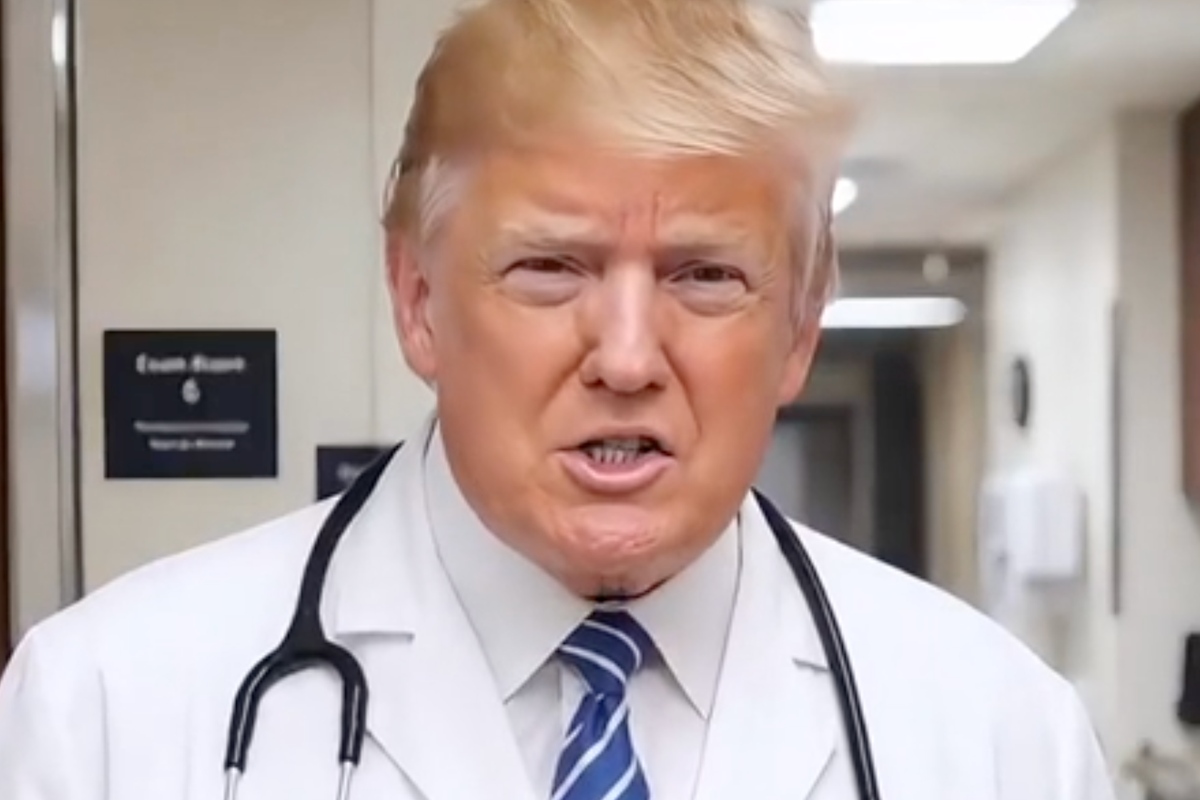
The lines separating state-sanctioned messaging, satire, and pure psychological operations just dissolved entirely on the executive stage. On Thursday, Donald Trump escalated his use of generative media by posting a hyper-realistic, AI-fabricated video on Truth Social. The clip depicts the president as a benevolent physician, "Dr. Trump," wearing a lab coat and stethoscope, diagnosing his high-profile celebrity critics with a fictional ailment called Trump Derangement Syndrome. Deepfakes of Robert De Niro, Whoopi Goldberg, Julia Roberts, Rosie O'Donnell, and Edward Norton appear as submissive, repentant patients praising his fictional treatment plan. This is not just another bizarre social media blip. It marks a terrifying turning point in political propaganda where the powerful can completely rewrite the reality and consent of their opposition without consequences.
What looks like a cheap laugh for a loyal base is a calculated assault on public truth. Veteran observers of political messaging know that the weaponization of a political opponent's likeness used to require immense technical coordination or, at the very least, an overt acknowledgement of parody. Now, it takes a few clicks and a handful of prompts. By deploying hyper-realistic synthetic media to force real human critics into saying things they never said, the current administration is establishing a playbook for total narrative control. It bypasses traditional media filters, exploits the legal gray zone of deepfake regulation, and erodes the very concept of shared objective reality.
The Weaponized Anatomy of the Doctor Trump Propaganda
The clip itself runs for ninety seconds, structured exactly like an afternoon television pharmaceutical advertisement. It opens with the synthetic version of Trump addressing the camera with perfect vocal inflection and familiar hand gestures. He asks viewers if they or someone they know has been diagnosed with the condition, before cutting to the fabricated celebrity testimonials.
The technical execution of the deepfake is remarkably precise. The AI-generated Robert De Niro looks directly into the lens, his digital eyes blinking naturally, declaring that he used to be constantly angry and made everyone around him miserable until he followed the president's treatment plan. The fictional solution offered by the digital commander-in-chief is a mix of folksy advice and brand placement, telling citizens to turn off mainstream news, say their prayers, and drink a Diet Coke whenever they feel anxious.
The response from the actual human beings targeted by this operation was immediate, though completely powerless to stop the spread of the footage. Rosie O'Donnell issued a blistering real-world statement following the video's release, completely rejecting the digital fantasy and stating that the president is clearly ill and getting worse daily. She openly called for the invocation of the 25th Amendment, impeachment, and conviction. Yet, within hours of the original post, White House Deputy Chief of Staff Dan Scavino Jr. reposted the video on X, granting it the implicit seal of federal approval. White House spokesperson Davis Ingle later defended the post as the president's right, dismissively stating that the fictional syndrome has rotted the brains of many people.
This systematic normalization from the highest levels of government turns a dangerous technology into standard operational practice. The administration is no longer just spinning the news. They are actively manufacturing behavioral evidence from their enemies to prove their own political points.
A Pattern of Escalation in the Oval Office
This medical parody did not happen in a vacuum. It is the latest escalation in a series of increasingly provocative synthetic media experiments deployed from the president's personal accounts over the last year. Each iteration serves to test the boundaries of public tolerance and legal pushback.
- The Fictional Breakdowns: In February, the president shared a highly offensive, racist synthetic video depicting Barack and Michelle Obama as apes. Despite widespread public outrage, the post remained online for hours before being silently deleted without an official apology.
- The Divine Imagery: Just two months ago, Trump posted an AI-generated image portraying himself as a Christ-like figure emitting divine light from his hands to heal a sick patient in a hospital bed. When confronted by prominent Christian allies and conservative commentators who labeled the imagery blasphemous, Trump claimed he merely thought it showed him as a doctor working with the Red Cross.
- The Papal Feud: During a bitter public disagreement with Pope Leo XIV, the president shared an image depicting himself in full papal regalia, effectively claiming a bizarre form of spiritual authority over his critics.
- The Monarchical Fantasy: Last year, the account went so far as to publish a fabricated Time magazine cover featuring Trump wearing a royal crown, accompanied by the caption declaring long life to the king.
These incidents show a clear psychological and strategic trend. The administration uses artificial imagery to elevate the executive to mythic, infallible status while simultaneously using the same tools to degrade, humiliate, and falsify the actions of political rivals.
The Total Collapse of Legal Recourse for Likeness Theft
The most chilling aspect of this development is the total lack of protection available to the victims. Under current American law, a sitting president who uses generative media to fabricate a celebrity's speech or appearance occupies a nearly untouchable position. High-profile figures like Julia Roberts or Edward Norton have virtually no immediate legal mechanism to force the removal of these videos from private social platforms or to seek damages for the theft of their identity.
The primary obstacle is the incredibly high standard required to prove defamation for public figures. Under established legal precedent, a public figure must prove actual malice, meaning the creator knew the statement was false or acted with reckless disregard for the truth. Because the video is framed with a thin veneer of satire and absurd medical advice, defense attorneys can easily argue that no reasonable viewer would believe Donald Trump actually obtained a medical degree and cured Robert De Niro in a real hospital.
This creates a malicious paradox. The video relies on hyper-realism to shock and entertain the viewer, yet relies on its underlying absurdity to escape legal liability. Intellectual property laws regarding the right of publicity are fractured across state lines, leaving a confusing mess of regulations that completely fail to address federal political speech. When the speaker is the head of the executive branch, federal immunity doctrines further complicate any attempt at civil litigation. The law is bringing a nineteenth-century knife to a twenty-first-century psychological war.
The Strategy of Satirical Plausible Deniability
Political scientists have long warned about the dangers of autocrats using humor as a shield for authoritarian behavior. By wrapping deepfakes in the format of a late-night television joke, the administration builds a perfect defensive wall against institutional criticism.
If a major news network runs an investigative segment on the dangers of fabricating opposition speech, the administration's defenders simply mock the press for lacking a sense of humor. They claim the critics are overreacting to a harmless joke. This gaslighting splits the public into two distinct camps. The first camp sees a harmless, funny video that owns the Hollywood elite. The second camp sees a calculated erosion of the digital record. The space between these two groups grows wider, making a shared national conversation completely impossible.
The ultimate victim of this strategy is the concept of documentation itself. When the public is repeatedly exposed to hyper-realistic fakes shared by the most powerful office in the world, they stop trusting anything they see on a screen. This leads directly to what researchers call the liar's dividend. A politician caught doing something corrupt on actual, verified video can simply claim the footage is a deepfake generated by their enemies. By polluting the information stream with obvious fakes, the administration protects itself from future exposures of real misconduct.
The Infrastructure Supporting Executive Synthetic Media
This is not a rogue operation run by a teenager in a basement. The production and distribution of these videos require a sophisticated understanding of algorithmic distribution and audience engagement.
The administration relies on an ecosystem of anonymous digital creators, right-wing influencers, and high-level campaign staff to source and amplify this content. These videos are often tested in smaller, radical online forums before being elevated to Dan Scavino's feed or the president's official Truth Social profile. This structure gives the White House an additional layer of separation. They can claim they are merely sharing content created by the public, rather than admitting to a centralized executive propaganda apparatus.
The social platforms themselves are entirely complicit in this distribution chain. Truth Social has zero structural guardrails against synthetic disinformation, as the platform is explicitly designed to maximize the president's unfiltered reach. Mainstream platforms like X have rolled back their trust and safety teams, allowing deepfakes of public figures to rack up millions of views under the guise of free expression or political commentary. The financial incentives favor engagement over accuracy. A hyper-realistic video of a celebrity crying over their political views generates massive traffic, ad revenue, and user interaction. The truth is simply not a viable business model for these platforms.
How to Confront the Executive Deepfake Era
Halting this slide into total informational chaos requires immediate, structural changes that go far beyond standard fact-checking or toothless social media terms of service.
First, Congress must pass a comprehensive, federal right of publicity law that explicitly bans the non-consensual commercial or political use of an individual's voice and likeness. This legislation must include clear statutory damages and fast-track injunction paths, allowing victims to force the immediate removal of deepfakes from digital platforms regardless of whether the creator claims the content is satire.
Second, digital distribution networks must implement mandatory, immutable cryptographic watermarking on all content generated by commercial artificial intelligence tools. If a video contains synthetic imagery or audio, that data must be baked directly into the file structure, enabling automated detection and clear labeling across all hosting services. Platforms that refuse to enforce these labels or fail to remove non-consensual deepfakes within a strict time window must lose their liability protections under Section 230 of the Communications Decency Act.
Finally, the mainstream press must stop treating these operations as entertaining lifestyle pieces or quirky social media trends. When a president fabricates the speech of private citizens to declare political victory, it is an abuse of executive power. Journalists must report on these videos not as funny gaffes, but as deliberate steps toward an authoritarian information model. The focus must shift away from the celebrities involved and toward the systematic degradation of our public record.
The Doctor Trump video is a warning shot across the bow of American democracy. If the public continues to accept the total fabrication of human speech as a normal part of the political circus, the ability to hold power accountable will vanish entirely. Reality cannot survive in an environment where the state can simply manufacture the surrender of its critics.